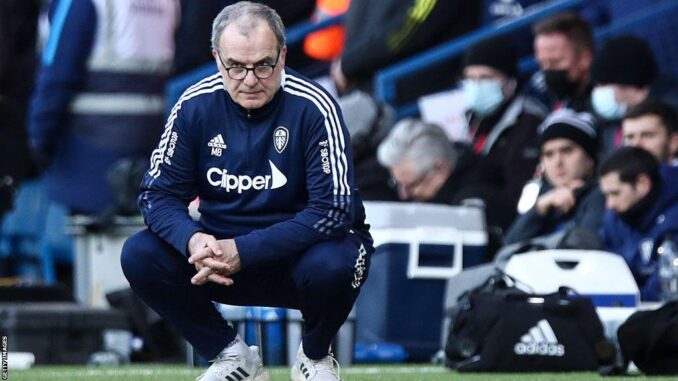
Who Is Marcelo Bielsa?

Marcelo Alberto Bielsa Caldera was born on July 21, 1955, in Rosario, Argentina. Although he played as a defender during his football career, he achieved global recognition as a manager.
Bielsa began his coaching journey at Newell’s Old Boys, where he developed his philosophy centered around:
- High-intensity pressing
- Quick transitions
- Aggressive attacking football
- Tactical flexibility
- Detailed match preparation
His dedication and unconventional methods earned him the nickname “El Loco,” but his football intelligence turned him into one of the sport’s greatest thinkers.
Marcelo Bielsa’s Early Coaching Success in Argentina
Bielsa first made headlines while managing Newell’s Old Boys. He led the club to domestic titles and established himself as one of South America’s brightest coaching talents.
His success at Newell’s included:
- Argentine Primera División titles
- Copa Libertadores final appearance
- Development of young players
- Implementation of high-pressing football
These achievements paved the way for opportunities abroad and ultimately established his reputation as a tactical innovator.
Marcelo Bielsa’s Journey in Mexico
Before becoming a household name in world football, Bielsa spent several important years in Mexico.
He managed:
- Atlas FC
- Club América
Although he did not win major trophies in Mexico, his influence was profound. Bielsa transformed youth development systems and emphasized technical football.
Many Mexican football experts credit Bielsa for helping modernize coaching methods in the country.
At Atlas, he worked extensively with young players and built foundations that benefited the club for years. His time in Mexico also allowed him to refine his tactical ideas and leadership style.
The Mexican chapter of his career became an important stepping stone toward international management.
Marcelo Bielsa and Argentina: Building a World Cup Favorite
In 1998, Bielsa became manager of the Argentina national team.
Argentina quickly emerged as one of the strongest teams in world football under his guidance.
The team featured stars such as:
- Gabriel Batistuta
- Juan Sebastián Verón
- Hernán Crespo
- Ariel Ortega
- Javier Zanetti
- Pablo Aimar
Argentina dominated World Cup qualification and entered the 2002 FIFA World Cup as one of the tournament favorites.
Many experts considered Bielsa’s Argentina among the strongest teams in international football at the time.
Marcelo Bielsa and the 2002 World Cup Disaster
The 2002 FIFA World Cup remains one of the most painful chapters of Bielsa’s coaching career.
Argentina entered the tournament as favorites but landed in a difficult group alongside:
- England
- Sweden
- Nigeria
Argentina defeated Nigeria but suffered a narrow defeat against England. A draw against Sweden ended their campaign in the group stage.
The early elimination shocked football fans worldwide.
Critics blamed Bielsa for:
Tactical Rigidity
Some observers believed Bielsa relied too heavily on his tactical system and failed to adapt.
Team Selection Issues
Questions arose regarding player choices and squad balance.
Immense Pressure
Argentina carried enormous expectations, and the team struggled to handle the pressure.
Although the 2002 World Cup ended in disappointment, many football analysts still believe Argentina was unfortunate because the team created numerous chances and often controlled matches.
The failure remains one of football’s biggest World Cup surprises.
Redemption with Argentina
Bielsa did not allow the 2002 disappointment to define his career.
He remained in charge of Argentina and guided the team to further success.
Achievements included:
Olympic Gold Medal
Argentina won the football gold medal at the 2004 Athens Olympics.
The team won every match and did not concede a single goal.
Copa América Final
Argentina also reached the final of the 2004 Copa América.
Although they lost to Brazil on penalties, Bielsa restored much of his reputation.
His period with Argentina demonstrated his resilience and ability to rebuild after setbacks.
Marcelo Bielsa’s Revolution in Chile
After leaving Argentina, Bielsa accepted one of his most challenging assignments: managing Chile.
At the time, Chile had struggled to establish itself among South America’s elite teams.
Bielsa completely transformed the national team.
Introducing Aggressive Football
Chile became known for:
- High pressing
- Fast attacks
- Energetic performances
- Fearless tactics
Developing Young Stars
Under Bielsa, players such as:
- Alexis Sánchez
- Arturo Vidal
- Gary Medel
developed into international stars.
Qualification for the 2010 World Cup
Chile reached the 2010 FIFA World Cup and became one of the tournament’s most entertaining teams.
Although they were eliminated by Brazil in the Round of 16, Bielsa’s impact was enormous.
Many Chilean supporters still consider him one of their country’s most important football figures.
Marcelo Bielsa’s Influence on Modern Coaching
Few coaches have influenced football tactics as deeply as Marcelo Bielsa.
Managers who have praised Bielsa include:
- Pep Guardiola
- Mauricio Pochettino
- Diego Simeone
Guardiola once described Bielsa as one of the coaches he admires most.
Bielsa’s tactical principles have become fundamental elements of modern football.
These include:
High Pressing
Winning possession immediately after losing the ball.
Positional Play
Creating numerical advantages in different areas of the field.
Intense Preparation
Detailed opponent analysis and tactical planning.
Attack-Oriented Philosophy
Encouraging teams to dominate matches through proactive football.
Even managers who never worked directly with Bielsa have incorporated his ideas.
Marcelo Bielsa and Leeds United
Perhaps no club outside South America embraced Bielsa more than Leeds United.
When he arrived in 2018, Leeds had spent sixteen years outside the Premier League.
Bielsa immediately transformed the club.
Building a New Identity
Leeds became:
- Energetic
- Entertaining
- Fearless
- Highly organized
Championship Success
During the 2019-20 season, Leeds won the Championship and secured promotion to the Premier League.
The achievement ended one of English football’s longest absences from the top division.
Premier League Return
Leeds finished ninth in their first Premier League season under Bielsa.
The club’s attacking football won admirers worldwide.
Although results eventually declined and Bielsa departed in 2022, his legacy at Leeds remains extraordinary.
Supporters regard him as one of the club’s greatest modern managers.
Marcelo Bielsa and Uruguay
In 2023, Bielsa became manager of Uruguay.
The appointment generated enormous excitement because Uruguay possessed one of South America’s most talented squads.
Key players included:
- Federico Valverde
- Darwin Núñez
- Ronald Araújo
Bielsa quickly implemented his trademark high-intensity football.
Uruguay achieved impressive victories against major opponents and qualified for the 2026 FIFA World Cup. Recent reports indicate that Uruguay’s World Cup campaign ended in disappointment, leading Bielsa to accept responsibility and step down from his role. His tenure featured both notable victories and internal challenges.
Despite the difficult ending, his influence on Uruguayan football remains significant.
Why Is Marcelo Bielsa Called “El Loco”?
The nickname “El Loco” means “The Crazy One.”
Bielsa earned the nickname because of his:
- Obsessive preparation
- Intense personality
- Unique methods
- Unconventional decisions
Stories about Bielsa have become legendary.
He is known for:
- Watching endless hours of match footage
- Living simply despite fame
- Studying opponents obsessively
- Demanding total commitment from players
While some consider his methods extreme, others see them as evidence of his remarkable dedication.
Marcelo Bielsa’s Coaching Philosophy
Bielsa believes football should be:
Aggressive
Teams should attack continuously.
Entertaining
Football must excite supporters.
Courageous
Players should take risks.
Disciplined
Every movement on the pitch has purpose.
His philosophy prioritizes development and expression over purely defensive approaches.
Even when results disappoint, Bielsa rarely abandons his principles.
That commitment has made him one of football’s most respected figures.
Marcelo Bielsa’s Career Achievements
Throughout his managerial career, Bielsa has achieved:
- Argentine league titles with Newell’s Old Boys
- Argentine league title with Vélez Sarsfield
- Olympic Gold Medal with Argentina
- Copa América runner-up
- World Cup qualification with Chile
- Europa League final with Athletic Bilbao
- Championship title with Leeds United
- World Cup qualification with Uruguay
Although he has not won numerous major international trophies, his influence extends far beyond medals.
The Legacy of Marcelo Bielsa
Marcelo Bielsa’s greatest contribution to football may be his ideas.
His tactical innovations have inspired generations of coaches.
He transformed:
- Argentina’s football culture
- Chile’s national identity
- Leeds United’s modern history
- Uruguay’s tactical evolution
Bielsa has shown that football is both a game and an intellectual pursuit.
His willingness to remain true to his principles, even during difficult periods such as the 2002 World Cup disappointment, has earned him admiration across the globe.
Few managers have shaped modern football more profoundly than Marcelo Bielsa.
Frequently Asked Questions (FAQs)
Who is Marcelo Bielsa?
Marcelo Bielsa is an Argentine football manager known for his high-intensity attacking style and influence on modern coaching.
Why is Marcelo Bielsa called El Loco?
He is nicknamed “El Loco” because of his obsessive preparation methods, tactical intensity, and unconventional personality.
Did Marcelo Bielsa coach Argentina?
Yes. Bielsa managed Argentina from 1998 to 2004 and won the Olympic Gold Medal in 2004.
What happened to Argentina in the 2002 World Cup under Bielsa?
Argentina entered the tournament as favorites but suffered a shocking group-stage elimination after facing England, Sweden, and Nigeria.
Did Marcelo Bielsa manage Chile?
Yes. He transformed Chile into one of South America’s most exciting teams and led them to the 2010 FIFA World Cup.
What did Marcelo Bielsa achieve at Leeds United?
He guided Leeds United back to the Premier League after a sixteen-year absence and became a legendary figure among supporters.
Has Marcelo Bielsa coached Uruguay?
Yes. Bielsa managed Uruguay from 2023 and guided the team to the 2026 FIFA World Cup before stepping down following a disappointing tournament campaign.
Why is Marcelo Bielsa considered influential?
Many elite coaches, including Pep Guardiola and Mauricio Pochettino, have acknowledged Bielsa’s tactical ideas and influence on modern football.