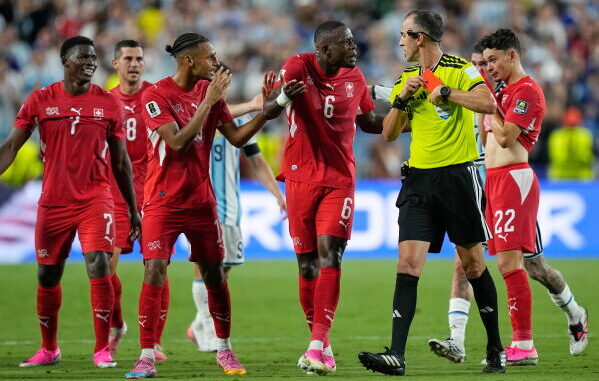
The Switzerland red card during the FIFA World Cup 2026 quarterfinal against Argentina instantly became one of the tournament’s biggest talking points. Swiss striker Breel Embolo was sent off after a dramatic VAR review, leaving fans around the world asking:
- Why did Switzerland get a red card?
- Why did Embolo get a red card?
- What is mistaken identity in soccer?
- How did VAR overturn the referee’s original decision?
The controversial incident changed the momentum of the match as Argentina defeated Switzerland 3-1 after extra time to book a place in the World Cup semifinals.
Why Did Switzerland Get a Red Card Today?
The Switzerland world cup red card came in the 72nd minute.
Initially, referee João Pinheiro showed a yellow card to Argentina midfielder Leandro Paredes, believing he had fouled Swiss striker Breel Embolo.
However, the Video Assistant Referee (VAR) reviewed the incident and concluded that there had been no foul. Instead, officials determined that Embolo had simulated contact, commonly known as diving.
The referee cancelled Paredes’ yellow card and instead issued a yellow card for simulation to Embolo.
Because Embolo had already been booked earlier in the match, the second yellow automatically became a red card, forcing Switzerland to play with 10 men.
Why Did Breel Embolo Get a Red Card?
The answer is straightforward.
Breel Embolo received a second yellow card for simulation (diving).
Although many fans initially believed Argentina had committed a foul, VAR showed that Embolo had gone down without sufficient contact.
Since this was his second caution, the referee showed the red card.
The dismissal left Embolo visibly emotional as he walked off the field in tears.
What Is Mistaken Identity in Soccer?
One of the biggest discussion points was the mistaken identity rule.
Normally, VAR cannot review every yellow card.
However, FIFA introduced an expanded mistaken identity VAR protocol for the 2026 World Cup.
This rule allows officials to intervene if the referee gives a disciplinary card to the wrong player.
In this case:
- Referee booked Paredes.
- VAR determined Paredes had not committed the offence.
- Officials ruled Embolo had simulated.
- The yellow card was transferred to Embolo.
Because Embolo already had one booking, he received a red card.
What Is Mistaken Identity in the World Cup?
The mistaken identity FIFA rule is designed to correct situations where the referee penalizes the wrong player.
Instead of allowing an incorrect booking to remain, VAR can identify the correct offender.
The Argentina vs Switzerland match became the most high-profile example of the rule during the 2026 FIFA World Cup.
What Is a Yellow Card in Soccer?
A yellow card in soccer is an official warning given by the referee.
Players receive yellow cards for offences including:
- Unsporting behaviour
- Persistent fouls
- Delaying the restart
- Dissent
- Simulation (diving)
- Tactical fouls
Receiving two yellow cards in the same match results in a red card and dismissal.
What Does Yellow Card Mean in Soccer?
A yellow card serves as a caution.
It tells a player that another bookable offence will result in dismissal.
This is exactly what happened with B. Embolo, who had already been cautioned before receiving another yellow for simulation.
Simulation Yellow Card Explained
Simulation occurs when a player attempts to deceive the referee into awarding:
- A free kick
- A penalty
- A booking for an opponent
When officials determine a player has deliberately dived, they may issue a yellow card for simulation.
Following the VAR review, officials ruled Embolo’s fall met this standard.
Argentina vs Switzerland Red Card: Match Impact
The Argentina vs Switzerland red card dramatically changed the quarterfinal.
Before the dismissal:
- Argentina led early.
- Switzerland equalized through Dan Ndoye.
- Momentum appeared to be with the Swiss.
After Embolo’s sending off:
- Switzerland defended with 10 players.
- Argentina dominated possession.
- Julián Álvarez scored in extra time.
- Lautaro Martínez sealed a 3-1 victory.
Argentina advanced to the World Cup semifinals.
Argentina National Football Team vs Switzerland National Football Team Matches
The latest meeting between the Argentina national football team vs Switzerland national football team became memorable not only because of Argentina’s victory but because of one of the most controversial VAR decisions in recent World Cup history.
The match will likely be remembered for the application of FIFA’s updated mistaken identity protocol.
Embolo Dive Sparks Debate
The Embolo dive immediately divided football fans.
Some believed the referee correctly punished simulation.
Others questioned whether the new VAR interpretation should have been used to overturn the original booking.
Swiss coach Murat Yakin also criticized the decision after the match, arguing the rule’s application was difficult to understand.
Where Are the Semi Finals for World Cup 2026?
Following Argentina’s victory over Switzerland, the tournament moved to the 2026 FIFA World Cup semifinals, hosted in the United States. The semifinals are scheduled to be played at AT&T Stadium in Arlington, Texas, and Mercedes-Benz Stadium in Atlanta, Georgia.
Final Thoughts
The Switzerland red card vs Argentina will remain one of the defining moments of the 2026 FIFA World Cup. Breel Embolo’s dismissal highlighted FIFA’s updated mistaken identity VAR rule, which allowed officials to reverse an incorrect yellow card and instead caution the Swiss striker for simulation. That second yellow became a red card, leaving Switzerland with 10 men and shifting the balance of the match in Argentina’s favor.
Whether fans agree with the decision or not, the incident has become a landmark example of how modern VAR technology and evolving FIFA rules continue to reshape football’s biggest stage.