
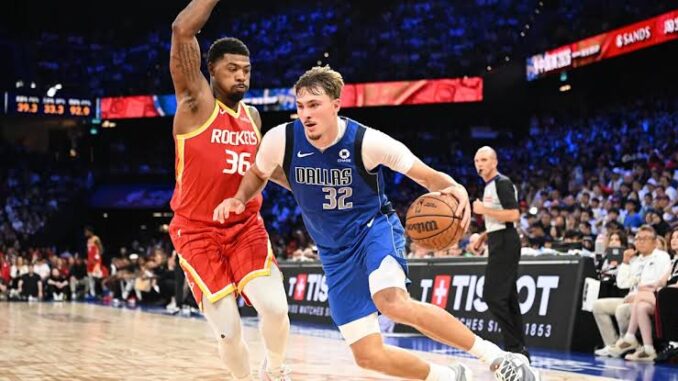
The Houston Rockets opened their 2026-27 NBA season with an impressive 128-110 victory over the Dallas Mavericks on Wednesday, October 21, at Toyota Center in Houston. Despite a spectacular performance from rookie Cooper Flagg, who finished with a game-high 32 points, the Mavericks struggled to contain Houston’s explosive offense and suffered a disappointing season-opening defeat.
Kevin Durant and Jabari Smith Jr. led the Rockets with 30 points apiece, helping Houston establish control through fast-break opportunities, strong rebounding, and efficient scoring. A dominant second quarter proved decisive in the Mavericks vs Rockets matchup, as Houston built a commanding lead that Dallas could not overcome.
While the Mavericks showed improvement after halftime, the Rockets maintained their advantage to secure a 1-0 start to the season.
Mavericks vs Rockets: Game Result and Highlights
The Houston Rockets defeated the Dallas Mavericks 128-110 in their season opener, using a dominant second quarter to take control of the contest.
Final Score:
- Houston Rockets: 128
- Dallas Mavericks: 110
Cooper Flagg was the standout performer for Dallas, leading all scorers with 32 points. However, his individual success was not enough to overcome Houston’s balanced attack, led by Kevin Durant and Jabari Smith Jr.
The Rockets’ defensive pressure forced Dallas into turnovers and difficult perimeter shots. Houston capitalized on those mistakes by running the floor and converting opportunities before the Mavericks could organize their defense.
The result gave Houston an encouraging start to its campaign, while Dallas was left searching for answers after a difficult opening night.
Cooper Flagg Shines Despite Mavericks’ Defeat
Cooper Flagg delivered one of the biggest individual performances of the opening night, scoring 32 points against the Houston Rockets. The young Mavericks star demonstrated his scoring ability and offensive confidence even as his team struggled to keep pace.
Flagg’s performance was an important positive for Dallas, particularly considering the team’s difficulties during the second quarter. He provided a consistent scoring threat and helped the Mavericks improve their offensive production in the second half.
However, Houston’s size, defensive intensity, and ability to generate transition points made it difficult for Dallas to turn its improved play into a genuine comeback.
For the Mavericks, Flagg’s performance offers encouragement heading into their next game. The team will need more consistent contributions from its supporting cast, better ball security, and improved rebounding if it hopes to convert individual performances into victories.
Kevin Durant and Jabari Smith Jr. Lead Houston Rockets
Kevin Durant made an immediate impact in his Rockets debut, finishing with 30 points and helping Houston establish offensive control. His scoring versatility gave Dallas problems throughout the game, while his ability to operate in different positions helped the Rockets create favorable matchups.
Jabari Smith Jr. also scored 30 points, matching Durant’s total and providing another major scoring threat. His contribution highlighted Houston’s offensive depth and prevented the Mavericks from focusing exclusively on stopping Durant.
The Rockets benefited from a combination of perimeter scoring, interior opportunities, and transition offense. Rather than relying on one player to generate every possession, Houston moved the ball and took advantage of defensive breakdowns.
Head coach Ime Udoka’s approach emphasized turning defensive stops and rebounds into quick scoring opportunities. That strategy was particularly effective in the second quarter, when the Rockets created separation and put Dallas under significant pressure.
The Second Quarter That Decided Mavericks vs Rockets
The defining stretch of the game came in the second quarter, when Houston outscored Dallas 38-12.
That 26-point difference transformed a competitive contest into a one-sided matchup. The Rockets attacked aggressively in transition, while the Mavericks struggled with turnovers and missed three-point attempts.
Houston eventually built a lead of as many as 37 points. Although Dallas played better in the second half, the deficit proved too large to erase.
The Mavericks actually outscored Houston across the first, third, and fourth quarters combined. However, their second-quarter collapse ultimately determined the outcome.
Houston finished with 29 fast-break points, repeatedly punishing Dallas whenever it lost possession or failed to establish its defense. The Rockets’ ability to turn defensive pressure into immediate offense was one of the clearest differences between the teams.
Marcus Sasser Provides a Bright Spot for Dallas
Marcus Sasser delivered an encouraging performance in his Mavericks debut, scoring 17 points on 6-of-8 shooting from the field.
Sasser was particularly effective from beyond the arc, making four of his five three-point attempts. His shooting offered Dallas a much-needed offensive spark on a night when the team struggled to find consistency from long range.
The Mavericks finished 11-of-37 from three-point territory, shooting approximately 30 percent. Sasser accounted for four of those 11 successful attempts, making his performance especially valuable.
His quick release, confidence, and ability to score while moving in transition gave Dallas another potential offensive option.
Although one game is not enough to determine his long-term role, Sasser’s performance could strengthen his case for additional playing time as the season progresses.
Houston Rockets Dominate the Rebounding Battle
Rebounding was another major factor in the Rockets vs Mavericks matchup. Houston finished with a 44-33 advantage on the boards, including 17 offensive rebounds.
Those extra possessions allowed the Rockets to maintain pressure and create additional scoring opportunities. The offensive rebounds also made it more difficult for Dallas to get into transition and establish control of the game.
Daniel Gafford played 22 minutes for the Mavericks and recorded only two defensive rebounds, while P.J. Washington collected three defensive rebounds in 31 minutes.
Gafford’s performance on the glass will be an area to monitor in upcoming games. Dallas has a sizeable frontcourt, but its players must do a better job of securing defensive rebounds and preventing opponents from extending possessions.
Cooper Flagg and Washington combined for nine rebounds, but the Mavericks needed greater contributions across the rotation.
For Houston, the rebounding advantage complemented its defensive intensity and fast-paced offense, helping the team turn stops into easy points.
Dallas Mavericks vs Houston Rockets Match Player Stats
The leading individual statistics from the season opener highlighted the difference between Cooper Flagg’s scoring performance and Houston’s collective offensive production.
| Player | Team | Points |
|---|---|---|
| Cooper Flagg | Dallas Mavericks | 32 |
| Kevin Durant | Houston Rockets | 30 |
| Jabari Smith Jr. | Houston Rockets | 30 |
| Marcus Sasser | Dallas Mavericks | 17 |
Key team statistics:
| Statistic | Houston Rockets | Dallas Mavericks |
|---|---|---|
| Final score | 128 | 110 |
| Second-quarter points | 38 | 12 |
| Total rebounds | 44 | 33 |
| Offensive rebounds | 17 | — |
| Fast-break points | 29 | — |
| Three-pointers made | — | 11 |
| Three-point attempts | — | 37 |
The available figures show that Houston’s advantage came from more than individual scoring. Its rebounding, transition offense, and dominant second quarter helped create the decisive margin.
For readers searching for Dallas Mavericks vs Houston Rockets match player stats, Cooper Flagg’s 32-point outing, the 30-point performances from Durant and Smith, and Sasser’s four three-pointers were among the most notable individual contributions.
What the Result Means for the Mavericks
The Mavericks have several areas to address after their season-opening defeat. Their second-quarter struggles exposed problems with ball security, perimeter shooting, and defensive transition.
Dallas cannot afford to give opponents extended scoring runs, particularly against teams capable of converting turnovers into fast-break points. The Mavericks will also need stronger collective rebounding to reduce second-chance opportunities.
There were positives, however. Flagg demonstrated his offensive potential, and Sasser showed that he could provide valuable perimeter shooting. Those performances give Dallas reasons for optimism despite the result.
The next step is finding greater consistency across all four quarters and establishing a more reliable rotation.
Why the Rockets Can Build on This Win
The Houston Rockets have several reasons to be encouraged by their opening performance. Durant and Smith supplied 60 combined points, while the team’s defensive activity created opportunities to score before Dallas could set up its defense.
Houston’s 29 fast-break points illustrated the benefits of playing with pace and attacking immediately after securing possession. Its rebounding advantage also helped create additional opportunities.
Durant’s ability to score both on and off the ball could become increasingly important as the Rockets develop their offensive system. Moving him into different positions allows Houston to create mismatches and makes it more difficult for opponents to concentrate their defensive attention on him.
If the Rockets continue combining efficient scoring with strong rebounding and defensive pressure, they could become a difficult matchup throughout the season.
Mavericks vs Rockets: Where to Watch
Fans looking for Mavericks vs Rockets where to watch information should check the official NBA schedule, NBA League Pass, and the teams’ official broadcast announcements for upcoming meetings.
In the United States, game availability may depend on national or regional television coverage and local blackout restrictions. International viewers should check the NBA’s official streaming options and authorized broadcasters in their region.
The next Mavericks game and Rockets game can also be found through the NBA’s official schedule, which provides updated dates, tip-off times, and broadcast information.
Mavericks vs Rockets: Final Takeaway
The Houston Rockets began their season in convincing fashion, defeating the Dallas Mavericks 128-110 behind 30 points each from Kevin Durant and Jabari Smith Jr. Cooper Flagg led all players with 32 points, while Marcus Sasser added 17 points in an encouraging debut for Dallas.
Houston’s 38-12 second quarter, 44-33 rebounding advantage, and 29 fast-break points ultimately decided the contest.
For the Mavericks, the priorities are clear: protect the basketball, improve perimeter shooting, and secure more defensive rebounds. For the Rockets, the opening victory demonstrated how pace, defensive pressure, and balanced scoring can produce an effective offensive performance.
Although it is only the first game of the season, the Mavericks vs Rockets opener offered an early look at two teams with different strengths and plenty of storylines to follow in the months ahead.


Leave a Reply