
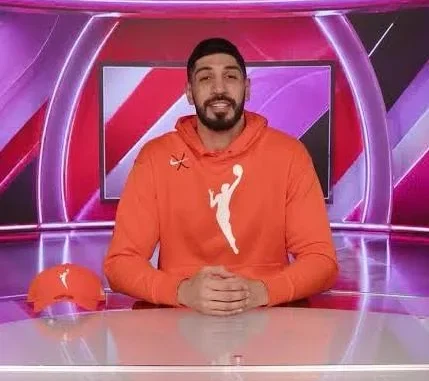
Former NBA player Enes Kanter Freedom left the WNBA Finals in Atlanta on Wednesday night after refusing to watch Game 3 from a private luxury suite arranged by State Farm Arena for security reasons. The incident has sparked fresh debate surrounding his protests, transgender athletes in women’s sports, and the growing controversy surrounding the WNBA.
Kanter Freedom had planned to attend the matchup between the Atlanta Dream and the Golden State Valkyries on October 21, 2026. However, arena officials said he would need to watch the game from a designated suite rather than his purchased seat because of concerns about his personal safety.
Why Did Enes Kanter Freedom Leave the WNBA Game?
The controversy began before the WNBA game when Kanter Freedom announced his intention to attend Game 3 of the Finals. According to State Farm Arena, he had contacted federal, state and local authorities, along with the WNBA and Atlanta Dream officials, to discuss concerns about his safety.
Following consultations with the league, team ownership and security personnel, arena officials offered him a private luxury suite with additional security. A state police officer was also assigned to him at his request.
Kanter Freedom rejected the arrangement because he wanted to sit in the seat he had purchased.
In a video shared on social media, he was told at the entrance that he could enter the arena only if he agreed to watch the game from the suite. He responded that he had purchased a ticket and wanted to use his assigned seat.
An arena public relations official later explained that the suite had been offered for his protection and that he had declined it.
Kanter Freedom subsequently left the venue and claimed on social media that he had been kicked out of a WNBA game for the second time.
Enes Kanter Freedom’s WNBA Controversy Explained
The latest incident follows another confrontation involving Kanter Freedom at a WNBA game in August 2026. He attended a matchup between the Chicago Sky and Indiana Fever, where he became involved in a heated exchange with Sky guard Natasha Cloud.
Following that incident, he was ejected and banned from the arena, according to reports.
The disagreement was connected to his public opposition to transgender athletes participating in women’s sports. Kanter Freedom wore shirts featuring messages about the definition of a woman and used his appearances at WNBA games to draw attention to his views.
Cloud, meanwhile, has publicly expressed support for transgender people and their inclusion in the wider community.
The confrontation turned a basketball event into a broader debate about gender identity, inclusion, and the treatment of athletes and spectators at professional sporting events.
Why Did Enes Kanter Freedom Want to Attend the WNBA Finals?
Kanter Freedom said his decision to attend the Atlanta game was motivated partly by comments from Golden State Valkyries star Gabby Williams. Williams had expressed support for transgender athletes being able to play alongside or against other athletes in the league.
Kanter Freedom referenced those comments in a social media post and used them to explain his interest in attending the WNBA Finals.
His appearance also came amid an ongoing dispute over his stated intention to enter the 2027 WNBA Draft alongside former NBA player Royce White.
Both men publicly declared their intention to enter the draft while claiming to identify as women. However, a person familiar with the league’s decision previously told The Associated Press that they were ineligible.
WNBA Commissioner Cathy Engelbert subsequently addressed the matter publicly.
In a letter responding to Indiana Representative Marlin A. Stutzman’s questions about eligibility, Engelbert stated that only women are eligible to play in the WNBA and described Kanter Freedom and White as men.
Kanter Freedom criticized the response on social media, arguing that the league’s position exposed what he considers an inconsistency in its approach to gender.
What Is the WNBA’s Position on Eligibility?
The dispute has placed the WNBA’s eligibility rules under renewed public scrutiny. The league’s stated position, as described in Engelbert’s letter, is that only women are eligible to participate as players.
Kanter Freedom’s proposed draft entry has therefore become part of a wider political and cultural argument about women’s sports.
Supporters of restrictions on transgender participation often emphasize competitive fairness and the protection of women’s sporting opportunities. Advocates for transgender inclusion argue that transgender people should be treated fairly and that sports policies should be based on evidence, appropriate eligibility standards, and respect for individual athletes.
The debate extends beyond the WNBA, with sporting organizations across the world facing questions about eligibility, fairness, inclusion, and how their rules should be applied.
Enes Kanter Freedom and the Growing Debate Around Women’s Basketball
The WNBA has attracted increasing attention in recent seasons, with prominent players, expanding audiences, and greater media coverage helping raise the league’s profile.
That visibility has also brought increased scrutiny of social and political issues connected to women’s basketball.
Kanter Freedom’s appearances have generated headlines beyond the action on the court. His dispute with Natasha Cloud, his public comments about transgender athletes, and his planned draft entry have repeatedly drawn attention to the intersection of sports and politics.
Critics of his actions argue that these appearances distract from the players and the competition. His supporters may view his actions as a way to raise questions about fairness and eligibility in women’s sports.
The Atlanta incident added another dimension to the discussion because it involved a disagreement over arena security and seating arrangements, rather than an on-court confrontation between players.
What Happened at WNBA Finals Game 3?
The central issue on Wednesday night was the decision by State Farm Arena officials to require Kanter Freedom to watch from a private suite.
Officials said the arrangement was designed to address his safety concerns and protect other guests and team members. Kanter Freedom rejected the condition because he wanted to occupy his purchased seat.
The disagreement meant he did not watch the WNBA Finals game from inside the arena.
His social media posts presented the incident as an attempt to prevent him from attending a game because of his support for women. Arena officials, by contrast, said they had offered him an alternative viewing location specifically for security reasons.
Those differing explanations have become a key part of the public discussion surrounding the incident.
Conclusion
Enes Kanter Freedom’s departure from the WNBA Finals in Atlanta has renewed attention on his protests, the league’s eligibility rules, and the debate over transgender participation in women’s sports.
The former NBA player said he wanted to watch the game from his purchased seat, while State Farm Arena maintained that a private suite was offered to address safety concerns. His refusal to accept that arrangement ended his attempt to attend Game 3.
As the WNBA continues to grow in popularity, controversies involving its players, fans, and policies are likely to attract significant attention. The Atlanta incident demonstrates how discussions about security, gender, and sports eligibility can quickly become major stories beyond the basketball court.


Leave a Reply