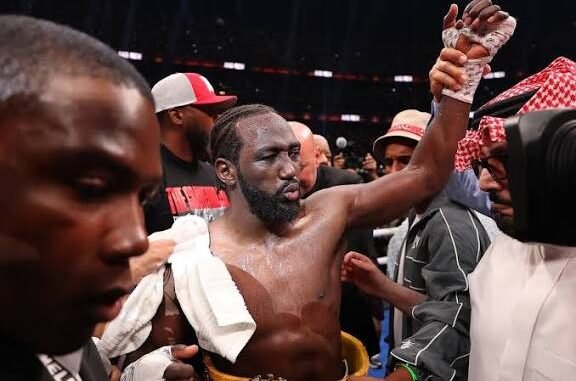
Introduction

Terence Crawford — widely regarded among boxing’s elite — has long been celebrated for his mastery across multiple weight divisions and an undefeated record. However, in a shock move on December 3, 2025, World Boxing Council (WBC) stripped Crawford of his super-middleweight title. The reason? Not a loss in the ring — but failure to pay required sanctioning fees.
In this article, we’ll explore: why Crawford was stripped, what that says about boxing politics, his career statistics and record, and what this development means for his legacy and the sport.
Why Was Terence Crawford Stripped of His Belt
What Happened
-
On 3 December 2025, the WBC officially stripped Crawford of its super-middleweight title.
-
The reason given: Crawford failed to pay the mandatory sanctioning (or “boxing-bout”) fees for his last two championship fights — his September 2025 win over Canelo Alvarez and a prior fight in August 2024 against Israil Madrimov.
The Numbers Behind the Decision
-
The WBC revealed that Crawford’s purse for the Canelo fight was roughly US$50 million.
-
Because of that large purse, the WBC reduced its usual sanctioning fee from 3% to 0.6%, which translated to about US$300,000.
-
Despite multiple notices sent to Crawford, his manager, and legal counsel, WBC reported receiving no acknowledgment or payment.
-
The WBC’s board voted to vacate the title — stating they “had no choice” after non-compliance and lack of response.
Crawford’s Response
Crawford didn’t stay silent — he publicly rebutted the WBC’s decision, labeling their demand as unfair and implying bias. His message was blunt: he declined to pay what he viewed as excessive fees, declared that the “real belt is The Ring belt,” and made it clear he wouldn’t bow to the WBC’s demands.
In his own words, Crawford asked: “What makes you so much better than the other sanctioning bodies?”
Context: Sanctioning Fees, Boxing Politics & Belt Stripping
To many outside the boxing world, the idea of being stripped of a title for non-payment of fees might sound absurd. But sanctioning fees are a long-established (though controversial) practice.
-
Sanctioning bodies — like WBC, International Boxing Federation (IBF), World Boxing Association (WBA), and World Boxing Organization (WBO) — levy fees on boxers for title fights.
-
Critics argue these fees give sanctioning bodies disproportionate power over fighters. As the WBC itself noted, a portion of the fee typically funds boxer-support charities.
-
Especially in high-profile fights with large purses, sanctioning bodies may reduce fees, as WBC did in Crawford’s case — but still expect compliance.
-
When boxers ignore or refuse to pay, political consequences follow: belts are stripped, titles vacated, and contenders re-shuffled.
This incident lays bare the tension between athletes — who risk life and limb in the ring — and governing bodies that demand payment just to sanction fights. Crawford’s outspoken reaction highlights a wider debate in boxing: who controls the sport — fighters or federations?
Terence Crawford: Career Stats & Record
Here’s a snapshot of Crawford’s professional boxing résumé (as of late 2025):
| Category | Details |
|---|---|
| Pro record | 42–0 (31 KOs) |
| Notable recent fights | • Sept 13, 2025 – Defeated Canelo Alvarez (UD) to become undisputed super-middleweight champion. • Aug 3, 2024 – Defeated Israil Madrimov (UD) at junior middleweight. |
| Championship history | Multi-division world champion — light-welterweight, welterweight, super-welterweight, and super-middleweight. Historic unification of titles across divisions. |
| Undisputed titles | First male boxer to unify all 4 major belts (WBC, WBA, IBF, WBO) in two different divisions (welterweight in 2023, and super-middleweight in 2025). |
Note: The four-belt crown he held at super-middleweight is now partially dismantled — WBC belt stripped. But he still holds the other major belts (WBA, IBF, WBO) as of the latest reports.
Even his earlier title losses or stripping were mostly administrative — e.g., vacating or being stripped by IBF when moving weight classes or for mandatories.
What This Means for Crawford’s Legacy & the Boxing World
Impact on Crawford
-
Despite losing the WBC belt, Crawford remains undefeated — meaning his in-ring legacy remains intact.
-
His outburst at the WBC reflects a growing frustration among top fighters toward sanctioning bodies. It may fuel demands for structural reforms in boxing governance.
-
His refusal to pay — even after discount — suggests principle over profit: Crawford appears more interested in legacy and fairness than simply holding another green belt.
For the Super-Middleweight Division
-
The WBC title is now vacant. Its next fight is slated between Hamzah Sheeraz and Christian Mbilli for the 168-lb crown.
-
That reshuffles contenders, rearranges rankings — and might create opportunities for stars to emerge.
Broader Boxing Governance Questions
-
The stripping reignites debate around sanctioning fees, perceived favoritism, and fairness to fighters.
-
Fans and pundits may view this as a tipping point: prize-fighting is not just about what happens in the ring, but behind-the-scenes politics, payments, and bureaucracy.
FAQs
Q1: Is Terence Crawford still undefeated?
Yes. Despite being stripped of the WBC title, Crawford’s professional record remains 42 wins, 0 losses (with 31 knockouts).
Q2: Did Crawford lose the belt because he lost a fight?
No. Crawford was stripped because he failed to pay mandatory sanctioning fees, not because of a defeat in the ring.
Q3: What was the amount he owed to the WBC?
The WBC claimed the sanctioning fee for his Canelo fight (and the prior bout) was approximately US$300,000 — a reduced rate of 0.6% on his roughly $50 million purse.
Q4: Does Crawford still hold other world titles?
Yes — as of December 2025, Crawford retains his other major belts from the WBA, IBF, and WBO in the super-middleweight division.
Q5: Who will fight for the now-vacant WBC title?
The WBC has ordered a bout between Hamzah Sheeraz and Christian Mbilli to vie for the vacant super-middleweight belt.
Conclusion
The stripping of Terence Crawford’s WBC belt in December 2025 proves that in modern boxing, what happens outside the ring — behind forms, payments, sanctioning fees — can be just as consequential as performance inside it.
Even though Crawford remains unbeaten and widely considered one of the greatest pound-for-pound fighters of his era, this episode underscores systemic tensions in boxing: between fighters, sanctioning bodies, and the complex bureaucracy that governs the sport.
Whether you see Crawford as a principled champion standing up to institutional demands — or as someone careless with obligations — one thing is certain: this moment will be debated for years, and will likely shape how elite fighters negotiate with sanctioning bodies going forward.