Introduction

Ryan Nembhard is a rising Canadian basketball talent who has quickly gained attention after making the jump from college basketball to the NBA. Known for his elite vision, playmaking, and calm leadership on the court, Nembhard offers a blend of passing, court IQ, and shooting that make him a compelling player to watch. This article dives into his background, college career, transition to the NBA, statistical profile, fantasy potential, and what the future could hold for him.
Early Life & Background
-
Born: March 10, 2003 — Aurora, Ontario, Canada
-
Height / Weight: 5′11″ (180 cm), 180 lb (≈ 81 kg)
-
High School: Montverde Academy (Montverde, Florida)
At Montverde Academy — a powerhouse in high school basketball — Ryan played alongside other top prospects. He reclassified from the class of 2022 to 2021, accelerating his path to college basketball. As a senior, he helped Montverde win the 2021 GEICO High School Basketball Nationals, posting 12 points, 7 assists, 3 rebounds and 2 steals in the championship game and earning game MVP honors.
Coming out of high school, he was regarded as a four-star recruit, ranked No. 68 nationally and the No. 11 point guard in his class according to 247Sports.
In June 2020, he committed to Creighton Bluejays, choosing them over Ohio State, Stanford, Florida and Seton Hall.
College Career
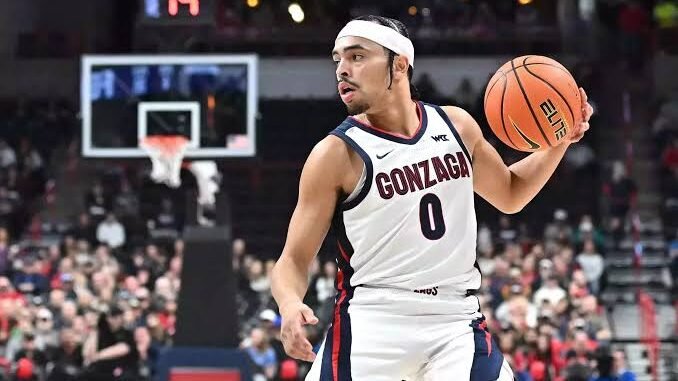
Ryan’s college journey is split between two programs — first at Creighton, then at Gonzaga Bulldogs.
Creighton (2021–2023)
-
2021–22 (Freshman): Averaged 11.3 points per game, with 3.1 rebounds and 4.4 assists, playing 34.8 minutes per game. Shooting splits: FG% .404, 3PT% .311, FT% .732.
-
2022–23 (Sophomore): Improved to 12.1 points, 4.0 rebounds, and 4.8 assists per game, across 34.0 minutes on average. Shooting improved to FG% .432 and 3PT% .356. Free throw accuracy reached .871.
Throughout his time at Creighton, Nembhard established himself as a reliable scoring guard with growing confidence and ball-handling maturity.
Gonzaga (2023–2025)
After two seasons at Creighton, Ryan entered the transfer portal and joined Gonzaga.
-
2023–24 (Junior): Started every game, logging 35.8 minutes per contest. Averaged 12.6 points and 6.9 assists, along with 4.0 rebounds. Shooting splits: FG% .445, 3PT% .321.
-
2024–25 (Senior): His senior season culminated with him leading the NCAA in assists per game — a testament to his elite playmaking and court vision.
During his Gonzaga tenure, Nembhard was named to the First-team All-WCC twice (2024, 2025).
In total, across his college career:
-
Games Played: 134
-
Overall Averages: ~11.7 points per game, ~3.5 rebounds, ~6.6 assists — a stat line showcasing his balanced scoring and elite facilitation.
His style — pass-first, high-IQ guard with a shooting touch and excellent decision-making — attracted attention from scouts and laid the groundwork for a pro career.
Transition to NBA — Mavericks & Pro Career
Draft & Signing
Despite his strong college résumé, Nembhard went undrafted in the 2025 NBA Draft.
Shortly after the draft, however, he was signed by Dallas Mavericks on a two-way contract — granting him a spot on the Summer League roster and a chance to prove himself among elite competition.
The Mavericks’ decision showed that while size and scoring explosiveness might limit him by traditional NBA scouting standards, his playmaking, shooting, and maturity earned him a real shot at the pros.
Rookie Season (2025–26) & Early Impact
-
NBA Debut: October 22, 2025.
-
2025–26 Regular Season (so far): Reports list him averaging 3.0 points, 0.7 rebounds, and 2.7 assists per game, with a field goal percentage of 36.4%.
-
His rookie status and two-way contract imply a split role: some time in the NBA with Dallas, and likely additional development with the affiliate Texas Legends in the G League.
Given his skill set — ball distribution, court vision, decision-making — Nembhard could carve out a role as a backup or rotational point guard, especially in lineups needing playmaking rather than scoring punch. Many analysts view him as a “floor-general in the margins” — not a flashy star, but a stabilizing presence and facilitator.
Playing Style & Strengths
-
Elite playmaking & court vision: Nembhard often uses his passing ability as his biggest weapon — reading defenses, anticipating cuts, and threading precision passes. During his senior season at Gonzaga, he led the NCAA in assists per game.
-
Smart decision-making & composure: Scouts describe him as a “crafty, high-IQ point guard,” with a patient, controlled style built around controlling tempo, managing possessions, and minimizing mistakes.
-
Shooting & floor spacing: Though not elite, he has shown shooting ability — capable of hitting open threes and stretching the floor, making him more than just a pass-first guard.
-
Leadership & maturity beyond his years: Coming from a top high-school program and through two major college programs, Nembhard’s exposure to high-pressure games and different systems adds polish to his game, which helps in NBA transitions.
Potential limitations / challenges:
-
Size: At 5′11″ and 180 lb, size and defense are common concerns when projecting him to the NBA level.
-
Scoring explosiveness: While he can hit shots, he is not necessarily a high-scoring guard — his value leans heavily on facilitation and game management, which may limit his upside compared to athletic, high-scoring guards. Ryan Nembhard.
Fantasy Basketball Outlook
Given his playing style and current role, here’s a breakdown of how Nembhard might fit into a fantasy basketball context (points, assists, steals, turnovers, FG%, etc.):
Pros:
-
Assists & Playmaking: His primary value lies in assists and facilitating the offense. If he earns meaningful minutes, assists could be his strongest fantasy contribution.
-
Efficiency / Low turnovers: Known for being a careful ball-handler — low turnovers are attractive in roto and points-per-game leagues.
-
Upside if role increases: If he gains a stable rotation spot with regular playing time, his counting stats (assists, possibly steals, some threes) could make him a sleeper value.
Cons / Risks:
-
Limited scoring upside: His points per game are modest, which constrains fantasy value in scoring-heavy formats.
-
Minutes uncertainty: As a two-way rookie, his playing time may fluctuate, sometimes staying in G League or coming off the bench.
-
FG % / 3PT inconsistency: Shooting may not always be reliable — this can affect efficiency-based fantasy formats.
Bottom Line: Nembhard is a speculative fantasy pick. He’s not a lock for high points, but if you target assists-heavy or balanced categories leagues — and if he cracks rotation — he might deliver value as a low-cost guard with upside. Ryan Nembhard.
What’s Next: Potential & Outlook
-
With a two-way contract, the short-term path likely involves splitting time between the NBA and G League.
-
If he consistently demonstrates his strengths — passing, composure, decision-making — he could earn a standard NBA contract and a stable backup/rotation point guard role.
-
For a team like the Mavericks, rebuilding or retooling their backcourt, Nembhard represents a low-risk, high-upside bet: not flashy, but potentially a floor general who can stabilize offense and manage tempo.
As one analyst put it, he’s a “floor general in the margins.”
Frequently Asked Questions (FAQ)
Q: Who is Ryan Nembhard’s brother?
A: Ryan’s older brother is Andrew Nembhard — also an NBA guard.
Q: Which colleges did Ryan Nembhard play for?
A: He played two seasons at Creighton (2021–2023) and then transferred to Gonzaga (2023–2025) where he finished his college career.
Q: What are his career college averages?
A: Over 134 career college games — roughly 11.7 points, 3.5 rebounds, and 6.6 assists per game.
Q: Why did he go undrafted despite solid college stats?
A: Despite his playmaking and court IQ, concerns about his size (5′11″), physical limitations, and limited scoring explosiveness likely influenced NBA teams. Still, his strengths earned him a two-way deal with the Mavericks.
Q: What’s his role with the Dallas Mavericks now?
A: As of 2025, he’s on a two-way contract with the Mavericks and their G League affiliate, the Texas Legends. Early NBA appearances show some minutes as reserve guard, with modest per-game stats (approx. 3.0 pts, 2.7 ast).
Q: What are his strengths and weaknesses?
A: Strengths: elite playmaking, court vision, composure, shooting touch, high basketball IQ. Weaknesses: limited size, scoring explosiveness, and uncertain defensive impact at NBA level. Ryan Nembhard.
Conclusion
Ryan Nembhard represents a classic example of a modern “floor general” — not the prototype athletic two-guard, but a cerebral, pass-first point guard with a feel for tempo, spacing, and playmaking. His college career — first at Creighton, then at Gonzaga — built a foundation of reliability, balance, and elite assists numbers.
His transition to the NBA with the Dallas Mavericks (via a two-way contract) is a smart low-risk move for both sides: Nembhard gets a chance to learn and grow, while Dallas gets a potentially valuable playmaker for the future.
For fans and fantasy players alike, Nembhard is a name to watch — not necessarily for breakout scoring, but for consistent contributions in assists, efficient passes, and steady growth. If he can leverage his strengths and earn consistent minutes, he could quietly become a key role-player in rotation, or even more.