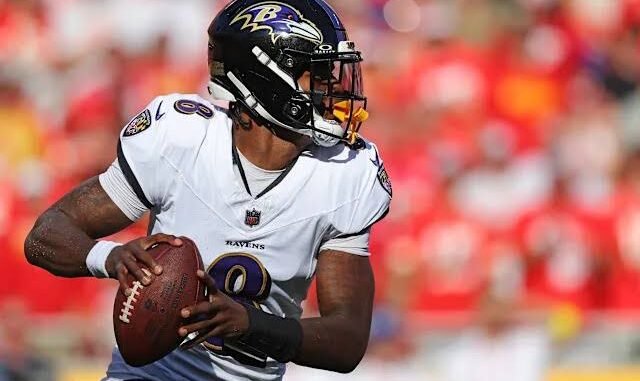
Lamar Jackson Injury: Today’s Update on His Hamstring & Impact on the Ravens

The Baltimore Ravens’ 2025 season has turned into a nerve-wracking ride, and the latest blow comes from their star quarterback. Lamar Jackson exited Sunday’s game with a hamstring injury, prompting concern across the NFL community. Here’s everything we know so far — the latest updates, medical possibilities, team implications, and outlooks for his return.
1. What Happened: The Injury Event
In Week 4, during the Ravens’ road game against the Kansas City Chiefs, Jackson left the game in the third quarter after suffering a hamstring injury. At the time of departure:
-
Baltimore was trailing 30–13.
-
Jackson had completed 14 of 20 passes for 147 yards with one touchdown and one interception.
-
He also rushed 6 times for 48 yards.
-
The injury reportedly happened during a third-down play, where Jackson was sacked for a 2-yard loss.
-
He did not return for the remainder of the game.
Coach John Harbaugh said that he did not yet know the severity of the injury. He noted that “nothing looks season-ending” at this stage.
Later reports from Pro Football Talk (PFT) suggested that Jackson “felt a grab” in his hamstring, and that it’s being evaluated further in Baltimore.
In short: Jackson’s hamstring has a strain or injury that merits further medical evaluation, and until full tests are conducted, the exact severity remains undetermined.
2. Hamstring Injuries in Athletes: What to Know
To understand the implications of Jackson’s condition, it helps to look at hamstring injuries in general, especially as they affect elite athletes.
2.1 Types and Grades of Hamstring Injuries
Hamstring injuries commonly occur when a muscle is overstretched or partially torn. They are often graded on the following scale:
-
Grade I (Mild strain): Minimal tearing, slight discomfort, mild stretching. Recovery is often within a few days to 1–2 weeks.
-
Grade II (Moderate strain/partial tear): More significant tissue damage, swelling, pain with motion. Recovery often takes 3–6 weeks.
-
Grade III (Severe tear/complete rupture): Full muscle tear or detachment. Surgery may sometimes be needed, and recovery can span months.
Given that Jackson is being further evaluated, the team will want to rule out anything more serious than a Grade II strain.
2.2 Risk Factors & Mechanisms
Some common risk factors in football (and for quarterbacks) include:
-
High-intensity running, abrupt direction changes, sudden acceleration or deceleration
-
Previous hamstring history
-
Fatigue, inadequate warm-up or muscular imbalance
-
Sudden forceful contraction of the hamstring muscle while the leg is extending
Quarterbacks can be vulnerable due to twisting, scrambling, and high-velocity movement under pressure.
2.3 Recovery and Rehabilitation
Rehab protocols typically include:
-
Immediate rest, ice, compression, elevation (RICE)
-
Gentle stretching and flexibility work (once tolerated)
-
Progressive strengthening (eccentric loading, hamstring curls, etc.)
-
Neuromuscular control, dynamic drills, and eventually sport-specific movements
-
Gradual return to full activity and monitoring for re-injury
Even with the best medical care, re-injury or lingering weakness is a risk if return-to-play is rushed.
3. What the Ravens & Jackson Might Be Facing
3.1 Timeline & Possible Return
At this point, it’s speculative to pin down an exact return date, but scenarios can be outlined:
-
Mild strain (Grade I): Jackson might miss 1–2 weeks.
-
Moderate strain (Grade II): He could be out for 3–6 weeks.
-
Severe or more complicated injury: Extended recovery, possible missed months or partial season impact.
The fact that the team is awaiting more evaluation back in Baltimore suggests they are not ruling out a longer absence.
3.2 Backup Plans & Alternatives
If Jackson is unavailable, the Ravens must turn to their backups:
-
Cooper Rush came in to relieve Jackson in the Chiefs game.
-
The Ravens may also consider other quarterbacks on their roster (or via trade) depending on Jackson’s recovery timeline.
3.3 Season Implications & Team Morale
Jackson’s injury comes at a tough juncture for Baltimore:
-
The Ravens have started 1–3, their worst beginning in a decade.
-
Other injuries also afflicted Baltimore in the same game: Ronnie Stanley (ankle), Roquan Smith (hamstring), Marlon Humphrey (calf), Nate Wiggins (elbow).
-
A prolonged absence by Jackson would test the depth of the roster and could sway playoff hopes.
-
The offense must adapt: rely more on the run game, conservative play-calling, or alternative quarterbacks.
3.4 Past Durability & Context
Jackson has been relatively durable in recent seasons. The last time he missed multiple regular season games was in 2022 when he had a knee injury. This injury raises concern but is not unprecedented in the NFL.
Also, Jackson has handled pressure well historically but has never faced a recurring hamstring issue — this will be a new test of his physical resilience.
4. What We Don’t Yet Know (Uncertainties)
Despite the information available, there are still several unknowns:
-
The exact grade of the hamstring injury
-
Whether imaging (MRI) will reveal complications (e.g. tendon involvement)
-
How Jackson will respond to rehab — pain, setbacks, re-aggravation
-
The point at which the Ravens will clear him for full practice
-
The team’s contingency plan if Jackson can’t return quickly
Until the medical staff issues updates, anything beyond speculation is premature.
5. What to Watch For: Updates & Milestones
To follow Jackson’s recovery, keep an eye on:
-
Official injury reports from the Ravens (e.g. “questionable”, “out”, “day-to-day”)
-
Imaging results (MRI, ultrasound)
-
Reports of Jackson’s mobility in practice (e.g. jogging, cutting)
-
Snap counts in preseason or practice games
-
Backup quarterback performance in weeks ahead
Once the team releases more news, the picture will become clearer. Lamar Jackson injury update.
6. Impact on Ravens’ Strategy
6.1 Offensive Adjustments
Without Jackson, the Ravens may:
-
Lean more heavily on the running game (e.g. Derrick Henry, etc.)
-
Simplify passing schemes, reduce reliance on deep shots or scramble plays
-
Increase short passes, screens, and quick release plays
-
Adopt a more conservative approach to minimize turnovers
6.2 Roster and Trade Considerations
Baltimore might explore:
-
Bringing in a veteran short-term backup
-
Activating a developmental QB or promoting from practice squad
-
Adjusting roster allocations to support protection and injury mitigation
6.3 Fans, Media & Morale
Jackson’s injury will dominate coverage, speculation will rise, and team morale may dip — how the Ravens manage public relations and team psychology could matter as much as Xs and Os. Lamar Jackson injury update.
7. Prognosis: Best-Case, Baseline, Worst-Case
| Scenario | Description | Return Estimate | Implications |
|---|---|---|---|
| Best-Case | Mild strain, smooth rehab | 1–2 weeks | Jackson returns quickly, minimal impact |
| Baseline / Moderate | Partial tear, careful progression | 3–6 weeks | Miss several games, offense struggles without him |
| Worst-Case / Complicated | Severe tear, tendon involvement or setbacks | Several weeks to months | Major hit to Ravens’ season, may require long-term backup plan |
Given early reporting, many analysts lean toward a moderate strain scenario as plausible.
FAQ (Frequently Asked Questions)
Q1: Is Lamar Jackson’s injury season-ending?
Answer: At this time, there is no indication that Jackson’s hamstring injury is season-ending. Coach Harbaugh said “nothing looks like it’s season-ending” as of now. But until full medical evaluations and imaging are done, we cannot rule out longer-term consequences.
Q2: Which hamstring grade might he have sustained?
Answer: The media is reporting that Jackson “felt a grab” in his hamstring and that further evaluation is needed, which suggests a strain. It could be a Grade I or Grade II injury, but the precise grade will depend on imaging and medical assessment.
Q3: How long will he be out?
Answer: If it’s a mild strain, Jackson might miss 1–2 weeks. For a moderate strain, he could be out 3–6 weeks. If complications arise, it could stretch longer. The Ravens’ medical staff will determine the timeline.
Q4: Who will play quarterback if Jackson can’t suit up?
Answer: Cooper Rush replaced Jackson in Sunday’s game. If necessary, Baltimore may activate or acquire additional QB depth depending on Jackson’s status.
Q5: What are the biggest risks with rushing his return?
Answer: Rushing return can lead to re-injury, lingering weakness, reduced mobility, or compensatory injuries (e.g. in hip, knee). It is crucial the rehab protocol is gradual, and that Jackson is cleared fully before resuming full gameplay. Lamar Jackson injury update.
Q6: How will this affect the Ravens’ playoff chances?
Answer: The absence of Jackson could reduce offensive efficiency, increase turnovers, and lead to more conservative game plans — all of which likely weaken Baltimore’s chances. With a shaky 1–3 start, every game becomes critical.
Conclusion
Lamar Jackson’s hamstring injury is the latest twist in the Ravens’ tumultuous early season. While the full severity remains unknown, early reports suggest a hamstring strain requiring further evaluation. The coming days and official medical updates will be key in shaping Baltimore’s strategy and expectations.
For Ravens fans, this is a moment of tension. Jackson’s health is pivotal not just to wins and losses, but to the identity of Baltimore’s season itself.