Introduction
Jordan Davis is one of the most physically imposing and athletically gifted defensive tackles in the NFL. Drafted by the Philadelphia Eagles in 2022, Davis has drawn praise not only for his strength and ability to anchor the defensive line, but also for explosive plays, speed, and moments of game-changing impact. In this article we’ll explore Davis’s profile: his weight, his 40-yard dash time, how he blocks field goals, and a signature moment that cemented his reputation.
Background: Who is Jordan Davis
Jordan Davis was born January 12, 2000 in Charlotte, North Carolina. He played college football at Georgia (2018-2021), where he compiled a resume that included national championships, decisive performances against the run, and awards like the Outland Trophy.
The Philadelphia Eagles selected him with the 13th overall pick in the 2022 NFL Draft. From early on, expectations were high for Davis: could he translate his dominance at the collegiate level into NFL impact? So far, the answer has been leaning firmly toward “yes.”
Physical Profile: Weight, Height, and Athleticism
Weight & Height
-
Davis is listed at 6 feet 6 inches tall and around 330-336 pounds.
-
He has worked on his conditioning; during a recent offseason/training camp, Davis reportedly dropped about 26 pounds to be more explosive.
This weight is massive even by NFL defensive tackle standards, but Davis’s frame, combination of size and athleticism, gives him a rare profile.
40-Yard Dash Time
One of the most impressive measurements for Davis came at the 2022 NFL Combine: he ran the 40-yard dash in 4.78 seconds.
To put that in perspective: very few players over 330 pounds have broken 5 seconds in the 40 at the Combine. Davis’s time places him among an elite, freak athletic group. This speed—not just straight-line but in movement, agility, burst—has shown in moments on the field.
The Game-Changer: Field Goal Block & Walk-off Touchdown
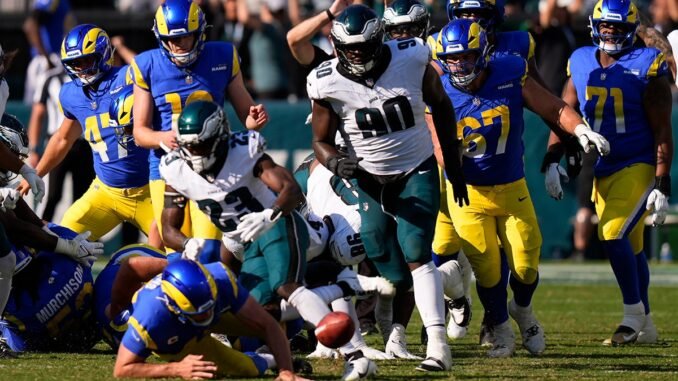
One moment that brought Jordan Davis into a new level of public awareness came in Week 3 of the 2025 NFL season, when the Eagles faced the Los Angeles Rams. This play combined several aspects of his profile: size, speed, field awareness, conditioning, and clutch performance.
What Happened
-
As the game clock expired, the Rams lined up a 44-yard field goal attempt by kicker Joshua Karty. If it went through, the Rams would have won.
-
Jordan Davis blocked the kick. He then scooped up the ball and returned it 61 yards for a touchdown, sealing a 33-26 win for the Eagles.
This was not just a regular defensive play. It was a walk-off special teams play that reversed the outcome of the game in dramatic fashion.
Speed on the Play
During the return, it was recorded that Davis reached a top speed of 18.59 miles per hour—the fastest recorded by a player over 330 pounds since at least 2017 (per Next Gen Stats).
This statistic underlines how dropping weight, maintaining good conditioning, and maximizing athletic traits can produce unexpected bursts—even for linemen. That kind of speed, especially while holding the ball and in a pressured moment, is rare and was decisive.
How Davis’s Profile Impacts His Role with the Eagles
Run Defense & Pass Rush
Davis is first and foremost a defensive tackle who assumes critical responsibility on every down. His size means he can clog gaps, occupy multiple blockers, and disrupt inside running plays. When he adds in speed and quickness, it gives the Eagles options: he can pursue, close, or collapse the pocket from the middle.
Special Teams & Game Situations
Though linemen don’t often play big roles in special teams (outside of field goal/extra point block units), Davis’s energy on special teams paid off in that Rams game. Timing, angle, anticipation, and explosion—all played part. The ability to block kicks and contribute directly to scoring in non-standard plays gives the Eagles an extra edge.
Conditioning & Durability
Dropping weight in his offseason suggests Davis is focusing on strength + speed balance. Improved stamina, agility, and reduced fatigue in later quarters are often underrated in defensive front-men. Given his physical profile, weight management is key to reducing injury risk and maximizing playing time. Davis seems to understand this.
The 40-Time & Why It Matters
That 4.78-second 40-yard dash at the Combine is more than just a number—it’s a signal. Here’s why scouts, coaches, analysts care:
-
Burst Off The Line: For defensive tackles, the first few yards off the snap are usually most important in disrupting plays. A faster 40 often implies better short-area burst.
-
Closing Speed: When quarterbacks or running backs escape into the second level, the ability to close gaps makes a difference. Davis’s speed helps there.
-
Mismatches: Heavy linemen who are also fast force offenses to adjust blocking schemes, double teams, or chip blocks. They can create mismatches, especially in stunts or twist schemes.
Though in game situations 40-yard dash times don’t always translate perfectly (because of pads, game speed, reaction, etc.), Davis has shown that his athleticism is game-useful. The blocked field goal return is a prime example.
Game Film: What Makes That Block & Return Work
Breaking down the block & return vs. the Rams gives insight into Davis’s skills:
-
Recognition and Prep: The Eagles saw key clues—angle, snap, the kicker’s launch point—and shifted their rush accordingly. Davis positioned himself well.
-
Execution: Not just brute force. The block required timing, technique—hand up, gap penetration, etc.
-
Scoop & Return Vision: Once the kick was blocked, Davis reacted quickly, scooped it up cleanly, and committed to returning it. His speed carried him downfield.
-
Team Support: Blocked kicks and returns usually need blocks, lanes, or just effective avoidance of tacklers. His teammates’ blocking and clearing helped. Also, the opponent’s possibly broken blocking due to injuries (the Rams had guard injuries) contributed.
Stat Snapshot & Recent Highlights (2022-2025)
Here are key stats and moments that help illustrate Davis’s trajectory:
-
Combine 40-Time: 4.78 seconds.
-
Weight: ~330-336 lbs, with offseason drop of about 26 lbs.
-
Recent Big Play: Blocked field goal returned 61 yards for a touchdown vs. Rams to seal win as time expired in 2025.
-
Speed During Return: 18.59 mph top speed in that play.
Davis also consistently contributes in standard defensive work: run stops, pass rush (though DTs often don’t rack up huge sack numbers), occupying blockers, and freeing others to make plays. His trajectory shows increasing impact in high-leverage moments.
Challenges & Areas for Growth
Even with all these strengths, there are always areas a player of Davis’s profile must refine:
-
Maintaining Leverage & Hand Technique: Against double teams or power runs, pad level and hand usage matter. Big men sometimes struggle with low leverage, which offenses try to exploit.
-
Consistency Through Season: Stamina over 17 regular season games + playoffs is demanding. Conditioning and injury prevention are vital. His recent weight drop helps, but demands persist.
-
Pass Rush Moves: While Davis has burst and power, refining a wider range of pass rush moves (swim, rip, bullrush, spin etc.) can make him more disruptive on passing downs.
-
Special Teams Awareness: Plays like blocked kicks are rare; being positionally aware, studying opponent tendencies, and being ready can maximize those opportunities.
Still, most of these are refinements rather than shortcomings. Given his age (born in 2000), there is room to improve further.
Why The NFL and Eagles Should Take Notice
Players like Jordan Davis change games in ways that go beyond conventional defensive stats. Here’s why his profile is uniquely valuable:
-
Game Momentum Plays: Blocks, touchdowns, big tackles etc. – plays that shift momentum. Davis has already delivered one in dramatic fashion.
-
Flexibility: With speed, power, and size, he can adapt to various schemes: anchors in inside run, press the pocket, stunt rush, even special teams.
-
Durability Potential: His weight management shows a maturity. If he stays healthy and conditioned, the Eagles have an anchor in the trenches for years.
-
Psychological Impact: When opponents know a 330-lb man can run down a blocked kick, or chase the QB, or collapse pockets, their blocking assignments, decision-making change. That creates advantages for his whole unit.
Comparing Davis to Other Elite Defensive Tackles
To better appreciate where Davis stands, it helps to compare his profile with other top DTs.
| Player | Size (approx.) | Notable Athletic Measurements | Signature Plays / Moments |
|---|---|---|---|
| Jordan Davis | 6′6″, ~330-336 lbs | 40-yard dash 4.78s; reached 18.59 mph in game return; field goal block return TD | Walk-off blocked kick returned for TD vs Rams; strong run defense; positional flexibility |
| Dontari Poe | ~342 lbs | One of the few over 330 lb players to run sub-5s at the Combine in past years | Known for interior push, occasional big plays |
| Other top DTs (like Aaron Donald, Chris Jones, etc.) | Less bulky but more refined moves / pass rush counters | Excellent lateral movement, multiple pass rushing tools | Regularly disrupt games via sacks, pressures, run-stops |
While Davis may not yet have the sack totals of some prime pass rush DTs, his blend of size + speed + special plays suggests a ceiling very high.
Conclusion
Jordan Davis is not just another defensive tackle. He represents a rare combination: mammoth size, legitimate speed, game awareness, willingness to condition, and ability to deliver in clutch moments. The 2025 blocked field goal return touchdown vs. the Rams isn’t just a highlight—it’s a statement: Davis is more than a trench anchor; he can change outcomes.
As the Eagles continue their season, keeping him healthy, conditioned, and used in ways that maximize his athletic upside will be key. For fans, analysts, and opponents, Jordan Davis is a player to watch—not just when the opponent is running inside, but when it’s field goal time with seconds ticking away.