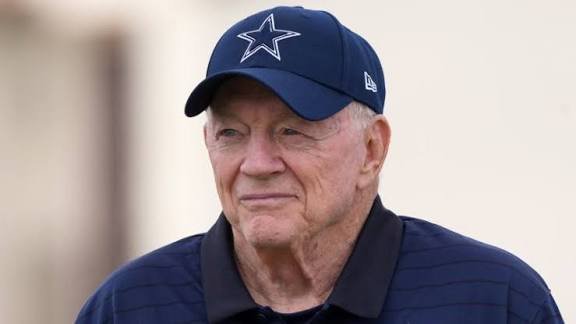
Jerry Jones: How Old Is the Cowboys Owner?
Early Life and Rise to Prominence
Jerral Wayne “Jerry” Jones Sr. was born on October 13, 1942 in Los Angeles, California. His family moved to North Little Rock, Arkansas in 1945, where his parents operated grocery stores. In high school, Jones played as a running back before attending the University of Arkansas, where he was co-captain of the 1964 national championship football team.
He later earned a master’s degree in business (MBA) and ventured into oil, gas, and other business pursuits. Over time, Jones leveraged his business successes to enter the sports world.
Acquisition of the Dallas Cowboys
In 1989, Jones made his biggest leap: he purchased the Dallas Cowboys franchise for approximately $140 million, acquiring both the team and the stadium from Bum Bright. One of his first controversial moves was to remove longtime head coach Tom Landry, a storied figure in Cowboys history, and replace him with Jimmy Johnson. Under Jones’s ownership, the Cowboys entered a golden era, winning three Super Bowls (XXVII, XXVIII, XXX) in the 1990s.
Current Age and Status
As of 2025, Jerry Jones is 82 years old, having turned 82 on October 13, 2024. Because he was born in 1942, that arithmetic is straightforward.
He remains actively involved as owner, president, and general manager of the Dallas Cowboys — one of the rare NFL team owners who also exerts direct influence over football operations. Over the decades, he has become a polarizing figure: lauded by many for building the Cowboys into a global brand, yet criticized by others for meddling, controversial personnel decisions, and his dual roles that sometimes blur lines of governance.
Recently, Jones revealed that he had privately battled stage 4 melanoma for more than ten years but currently claims to have no tumors after treatment. He credits experimental immunotherapy (a PD-1 drug) and aggressive surgical interventions (involving lungs and lymph nodes) for his survival.
Thus, when someone asks, “How old is Jerry Jones of the Cowboys?” the simple answer is 82. But behind that number is a lifetime of business, football, controversy, and innovation.
Cold Sore: A Brief Medical Guide
Because your title asked for “Cold sore,” here is a high-quality, SEO-friendly treatment of that subject.
What Is a Cold Sore?
A cold sore (also called a fever blister or herpes labialis) is a cluster of small, fluid-filled blisters that typically appear on or around the lips and surrounding skin. The cause is the herpes simplex virus type 1 (HSV-1) in most cases, though sometimes HSV type 2 can also be involved.
Once a person is infected, the virus remains latent in nerve cells and may reactivate later, leading to recurrent cold sores—especially under triggers such as stress, sun exposure, fever, or a weakened immune system.
Signs, Symptoms, and Phases
A typical cold sore outbreak follows these stages:
-
Prodrome / Tingling: You may feel tingling, itching, burning, or a stinging sensation before the visible sore appears.
-
Blister formation: Small blisters cluster together, often on the lip border.
-
Weeping / Ulceration: The blisters break open and may ooze clear fluid.
-
Crusting / Scabbing: The sore dries, forms a crust, and eventually sloughs off.
-
Healing: Usually the lesion heals within 7 to 10 days, though some sources say up to 2 to 3 weeks, depending on severity.
Some individuals also experience mild systemic symptoms (especially on first infection) such as fever, swollen lymph nodes, fatigue, or sore throat.
Transmission and Contagion
Cold sores are contagious. The virus spreads by direct contact — for example, kissing, sharing utensils, razors, or towels. The contagious period is greatest when the blisters are open and fluid is present, but one may transmit even before the sore is visible (during tingling).
Diagnosis
Typically, diagnosis is clinical—based on appearance and history. In uncertain cases, swabs for viral culture, PCR, or antigen testing may be done.
Treatment Options
There is no cure for HSV, but treatments can reduce severity, healing time, and discomfort. Key approaches:
-
Over-the-counter topical creams / ointments (e.g. docosanol) can help.
-
Antiviral drugs (acyclovir, valacyclovir, famciclovir) may be prescribed, especially for frequent or severe outbreaks.
-
Symptomatic relief: Applying a cold, damp cloth; using lip balms with sunblock; avoiding trauma to the area; keeping it moisturized.
-
Preventive measures / triggers: Manage stress, avoid excessive sun exposure, maintain strong immunity, and avoid contact when a sore is present.
Most outbreaks resolve without scarring, and severity tends to decrease over time as immunity matures.
Key Takeaway
A cold sore is a painful, contagious blistering lesion around the mouth caused by latent herpes simplex virus. Though it’s not curable, it is treatable and manageable. Recognizing the early tingling stage and starting therapy promptly often yields better outcomes.
Micah Parsons: From Cowboys Star to Blockbuster Trade
Early Life and Rise
Micah Aaron Parsons was born on May 26, 1999 in Harrisburg, Pennsylvania. He attended Penn State University and emerged as a standout defensive player, earning Consensus All-American honors and Big Ten accolades.
In the 2021 NFL Draft, the Dallas Cowboys selected Parsons 12th overall. He quickly made an impact, winning Defensive Rookie of the Year and rapidly establishing himself as one of the league’s premier pass rushers.
Career with the Cowboys
During his tenure in Dallas, Parsons became a key part of the defensive front. He posted impressive sack totals nearly every season, made Pro Bowl rosters, and earned All-Pro distinctions.
However, by 2025, tensions arose. Parsons and the Cowboys’ front office (led by Jerry Jones) failed to reach an agreement on a long-term contract. On August 1, 2025, Parsons publicly requested a trade, stating he “no longer wants to be here.”
The Blockbuster Trade
Just weeks later, the Cowboys traded Parsons to the Green Bay Packers in exchange for two first-round picks and defensive tackle Kenny Clark. At the same time, Parsons inked a 4-year, $188 million contract with Green Bay, becoming the highest-paid non-quarterback in NFL history at that time. The new deal reportedly includes $136 million guaranteed.
Sports analysts quickly compared this trade to acquisitions of legends like Reggie White, praising the Packers for landing a generational defensive talent. Some viewed the Cowboys’ willingness to part ways with Parsons as a franchise setback — losing a cornerstone pass rusher in exchange for draft capital and a veteran player.
Return to Dallas: A Tense Reunion
In late September 2025, Parsons returned to AT&T Stadium (Dallas’ home) as a member of the Packers. The game was emotionally charged: Parsons recorded a sack on his first series against his former team. Despite that, the Cowboys’ defense struggled overall, and Dallas allowed some big plays, while the crowd showed a mixture of boos and cheers.
Jerry Jones had previously stated there would be no tribute video honoring Parsons, contrasting with how past Cowboys legends were celebrated. Jones also defended the trade publicly, saying it was “based on mathematics,” though that framing drew criticism and scrutiny.
Implications and Outlook
-
For Green Bay: Acquiring Parsons gives the Packers a transformational edge rusher, one who can shift pressure dynamics and reinvigorate their defense.
-
For Dallas: Losing Parsons leaves a void in pass rush and puts more pressure on the front office to rebuild. The acquisition of picks and Kenny Clark gives Dallas future flexibility, but replacing such elite talent is no small task.
-
On the narrative level: The trade underscores the complex relationship between Jones and Parsons — balancing loyalty, contract constraints, personality, control, and team-building philosophy. Whether this move will be vindicated or regretted depends on performance and outcomes in the next few seasons.
As of now, Parsons is 26 years old and in the prime of his career — exactly at the age where a player seeks stability, leverage, and long-term positioning.
Intersecting Themes: Age, Longevity & Legacy
Though on the surface, Jerry Jones, cold sore, and Micah Parsons seem unrelated, we can draw a few interesting thematic connections:
-
Aging and longevity:
-
Jerry Jones at 82 continues to shape a modern NFL franchise.
-
Micah Parsons, at 26, faces the early crossroads of maximizing his prime years.
-
In the medical realm, cold sore virus (HSV) is lifelong — once acquired, the virus persists, reemerging periodically — much like how legacy figures endure challenges over decades.
-
-
Investment vs. risk:
-
Jones invested heavily in the Cowboys and in his approach as owner/GM; sometimes that entails risk (e.g. coaching changes, big contracts).
-
The Cowboys’ decision to trade Parsons — a rising star — is a bet on capital and team architecture over individual retention.
-
In medicine, outbreaks (like cold sores) are managed via prevention, risk reduction, and timely action — balancing treatment costs with recurrence risk.
-
-
Control and agency:
-
Jones exerts tight control over operations.
-
Parsons sought more control over his destiny (via contract/trade).
-
With cold sores, individuals have limited control over the underlying virus, but can influence triggers, outbreaks, and manifestations.
-