Introduction
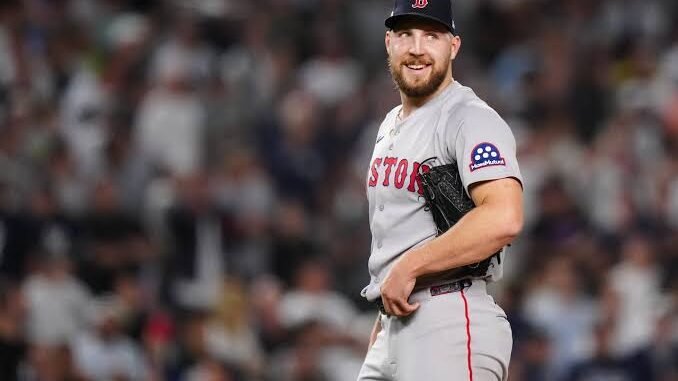
Garrett Crochet has become one of the most intriguing young arms in Major League Baseball. Known for his blazing fastball, he draws attention not only for what he throws, but also for how he got to Boston, and the long-term contract he’s now signed. In this article, we explore (1) what his “first pitch speed” looks like today, (2) his contract and financials as listed on Spotrac, (3) the trade that brought him to Boston, and (4) how all these pieces fit together into his career arc.
Who Is Garrett Crochet? A Brief Overview
Garrett Crochet is a left-handed pitcher (throws left, bats left) born on June 21, 1999. He was drafted by the Chicago White Sox in the first round (11th overall) in 2020 out of the University of Tennessee.
Early in his MLB career, Crochet primarily worked out of the bullpen with the White Sox before transitioning into a starting role. His fastball velocity and strikeout ability have made him a high-upside arm with ace potential.
In December 2024, in a marquee move, the Boston Red Sox acquired Crochet from Chicago in a trade involving several top prospects. Shortly thereafter, Boston locked him into a long-term extension beginning in 2026.
First Pitch Speed Today: What Does That Mean?
Why “First Pitch Speed” Matters
In baseball analytics, the first pitch speed often refers to the velocity on the first pitch of an at-bat—especially when it’s a fastball. It can set the tone, help a pitcher get ahead, and often is one of his more aggressive offerings. For fireballers like Crochet, it becomes part of their aura. Thus, many fans and analysts keep tabs on how hard his first-pitch heater comes in.
However, a nuance: “first pitch speed” is not always publicly broken out distinct from average fastball velocities or maximum velocities. So to evaluate his first-pitch speed today, one typically looks at his fastball velocity trends, max recorded fastballs, and situational highlights.
Fastball Velocity Trends & Max Readings
-
In 2024, Crochet’s fastball averaged about 97.1 mph.
-
In 2025, there has been a slight dip. His fastball has averaged closer to 96.3 mph in some outings.
-
He still shows bursts well above that in-game. For example, in one outing he struck out Marcus Semien on a cutter (not the fastball) at 90.1 mph, but elsewhere his fastball readings have shown 97.8 mph or above.
-
In a wild-card game, he reportedly threw a 100.2 mph fastball on his final pitch—matching his top velocity of the season.
Given the data, we can infer that Crochet’s first-pitch fastball today would likely fall in the 96–99 mph range, with occasional bursts up toward triple digits (100+). If he leans on his max, he could flash 100+ mph even on a first pitch.
Recent Anecdotes & Situational Notes
-
In a highlight from May 10, 2025, Crochet struck out Bobby Witt Jr. with a 97.8 mph four-seam fastball in a jam. That shows his fastball is still firmly in striking range.
-
In the opener vs. the Rangers, he used a cutter at 90.1 mph for a strikeout. That’s not his fastball but shows the usage of other pitches in counts.
-
Some observers have noted that his velocity is down slightly from previous years, but not to a worrying degree.
-
Interestingly, Crochet has given up home runs on first-pitch fastballs in games—such as to Jackson Chourio.
So while “first pitch speed today” is not a fixed metric, the weight of evidence suggests it remains elite among pitchers.
Spotrac: Contract, Salary & Financials
Spotrac is a go-to source for public contract data, salaries, and team payrolls. Using their insight, here’s an up-to-date breakdown of Garrett Crochet’s contractual and financial situation.
Current Contract & Extension
-
Crochet is currently under a one-year contract with the Boston Red Sox for the 2025 season, earning $3,800,000.
-
Starting in 2026, Crochet is signed to a 6-year, $170 million extension that runs 2026 through 2031.
-
That extension includes an opt-out clause after 2030 (i.e. he could exit after 2026–2030 if performance or context allows).
-
The extension is notable for being one of the largest guarantees for a pitcher in his service class (4+ years).
Spotrac Figures & Team Payroll Context
-
According to Spotrac, Crochet’s 2025 cash salary is $3,800,000 (no bonuses or deferred amounts publicly listed).
-
His career earnings to date are listed at approximately $14,098,650.
-
In the Red Sox’s 2025 payroll, Crochet is listed among their starting pitchers with that salary allocation.
-
In Spotrac’s “contracts by team” listing, Crochet’s extension places him among the top-paid starters in Boston’s roster.
Comparisons & Value
-
Spotrac’s “starting pitcher contracts” rankings show Crochet’s extension slots among high-end deals.
-
His Spotrac listing also details the history of his previous contracts (from pre-arbitration to arbitration and now extension).
-
The extension is often characterized in media as a strong value if Crochet delivers on his potential.
Thus, Spotrac gives us a clear picture: Crochet is financially locked into Boston for the long haul (barring opt-out), and is now among the better-paid arms relative to his service time.
Trade That Brought Him to Boston
To fully understand Crochet’s journey, we need to revisit the trade that exchanged him from Chicago to Boston.
The Trade Details
-
In December 2024, the Boston Red Sox acquired Garrett Crochet from the Chicago White Sox in exchange for four prospects: catcher Kyle Teel, outfielder Braden Montgomery, infielder Chase Meidroth, and pitcher Wikelman Gonzalez.
-
At the time of trade, Crochet was controlled by the White Sox under a one-year deal (for 2025) and had team control through 2027.
-
Boston’s strategy was to bolster their rotation with a high-upside lefty, and they believed that with his potential, investing in him long-term was worth the cost in prospects.
Why the Trade Made Sense
-
For Boston, the trade represented an aggressive commitment to build around young starting pitching. Crochet came with elite velocity and strikeout upside.
-
The White Sox, meanwhile, received top-tier prospects to restock their pipeline. The trade thus balanced immediate bullpen/rotation value (for Boston) with long-term talent (for Chicago).
-
After the trade, Boston immediately committed to the extension, signaling they viewed Crochet not as a rental but as a cornerstone.
Aftermath & Early Boston Performance
-
Crochet made his Red Sox debut on March 27, 2025, allowing two runs in five innings (in a 5–2 win).
-
Media outlets have noted that Boston sees Crochet “here to stay,” underscoring confidence in his long-term role.
-
With the extension in place, Boston also acquired stability in their rotation for years to come.
Thus, the trade is integral to Crochet’s path: it shifted him to a home where he has long-term backing and the platform to reach ace status.
Putting It All Together: Career Arc & Future Outlook
Strengths & Potential
-
Raw Velocity & Strikeouts: Crochet’s four-seam fastball remains among the more explosive in MLB. Even with modest dips, it’s a weapon that commands respect.
-
Left-Handed Rarity: Elite lefty pitchers are in high demand; Crochet’s handedness gives him added value.
-
Team Confidence: The six-year extension signals that Boston believes in his long-term durability and promise.
-
Upside for Cy Young Conversations: If he remains healthy and maintains his form, Crochet could be in the conversation for elite awards.
Challenges & Risks
-
Velocity Decline: Slight drops in average velocity are being tracked. Sustaining or regaining peak outputs will be key.
-
Injuries & Workload: As with any young pitcher, health and managing innings are pivotal.
-
Command & Consistency: Flashy velocity helps, but consistent strikes and pitch sequencing often decide success.
-
Expectation & Pressure: The massive contract brings expectations; failure could be magnified.
Out to 2031 & Beyond
-
The extension gives Crochet six seasons of financial security (2026–2031).
-
The opt-out after 2030 allows flexibility: if Crochet becomes elite earlier, he could depart for another big deal.
-
Boston’s willingness to trade top prospects and commit long-term indicates they plan to rely on him as a rotation anchor.
-
If all goes well, Crochet’s contract could be remembered as one of Boston’s best investments—or a cautionary tale if injuries or decline intervene.
Summary & Key Takeaways
-
Garrett Crochet’s first pitch speed today likely hovers in the 96–99 mph range, with potential bursts above 100 mph in ideal situations.
-
His Spotrac-verified contract includes a one-year $3.8 million 2025 salary, followed by a 6-year, $170 million extension (2026–2031), with an opt-out after 2030.
-
The trade that brought him to Boston in December 2024 involved four prospects; Boston traded for him to build pitching for the future.
-
Combining velocity, potential, team commitment, and long-term security, Crochet’s career trajectory is one to watch over the next half-decade.