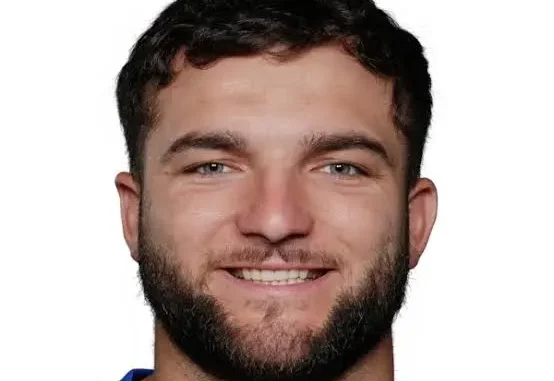
In recent seasons, Cam Skattebo, a talented running back, has drawn attention not only for his on-field performance, but also for a curious habit: a frequent head shake. The repetitive motion has sparked questions — is it a medical issue, a tic, a twitch, or even a manifestation of Tourette’s Syndrome? In this article, we will explore what’s publicly known, what experts might say, and how to interpret such behaviors without leaping to conclusions.
1. Introduction: Who Is Cam Skattebo?
Cam Skattebo is a running back who has gained attention both for his playing skills and, more recently, his pre- and post-snap head movement. His name came to the spotlight in college football and now in professional leagues. While many athletes can have quirks or idiosyncratic gestures, Skattebo’s head shake is unusually consistent, prompting curiosity and speculation from fans and media.
Because the head-shake is so conspicuous, people often wonder whether it is more than a personal habit — whether it could reflect something neurological.
2. Observations: The Head Shake Pattern
Frequency & Timing
-
The head shake tends to occur very frequently, often before or after nearly every play.
-
It sometimes appears almost as a ritualistic gesture instead of being tied to contact or stress.
-
Some fans and commentators wondered whether it happens more in plays with heavy contact, but it also appears in plays without obvious force.
Visual Characteristics
-
The motion is a forceful back-and-forth shake of the head.
-
It can look like a rhythmic “no” gesture, but with more vigor and repetition.
-
It’s not subtle — it’s readily noticed during game broadcasts.
Context: Helmet, Sweat, and Conditions
-
Some observers propose that sweat, moisture, or helmet fit may exacerbate the movement.
-
One common suggestion: the helmet sticking slightly to his face or hair, prompting him to shake his head to free or reposition it.
-
Others wonder whether it intensifies under hot or sweaty conditions, or when his face is damp.
Because of this pattern, many casual spectators raise the question: is it a medical condition or just a strong habit?
3. Possible Explanations: Sweat, Helmet Fit, Habit
Before assuming anything neurological, several non-pathological (i.e., “normal”) explanations merit consideration:
Sweat and Moisture
Skattebo himself addressed the head shakes in a social media post, saying:
“During the game I sweat and it causes my face to be wet. While my sweat dries on my face it causes my pads on the inside of my helmet to stick to my cheeks …”
This suggests that moisture and friction between his skin (or facial hair) and his helmet pads may cause mild sticking or discomfort, prompting him to shake his head to relieve tension.
Helmet Fit, Pressure, or Discomfort
-
The interior fit and alignment of a helmet matter; even slight misalignment could cause small pressures or drag.
-
Over time, what starts as a mechanical adjustment (shaking to loosen or shift the helmet) could evolve into a habitual movement.
-
The shake may have begun when his helmet or facial hair changed, leading to occasional discomfort, which he addressed via head movement; then the behavior could have generalized.
Habit Formation and Reinforcement
-
Humans sometimes develop habitual gestures in response to recurring minor stimuli (e.g., itch, pressure, mild irritation).
-
Once the habit becomes ingrained, it may persist even when the original trigger is reduced or absent.
-
With regular repetition, it might take on a ritualistic character — somewhat independent of conscious control.
In sum, the head shake need not imply any medical or neurological disorder — but we should also consider those possibilities fairly and carefully.
4. Medical Concepts: Tic, Twitch, Tourette’s
To evaluate whether a condition like Tourette’s or a neurological tic is plausible, we need clarity on definitions and criteria.
Twitch
-
A “twitch” generally denotes a small, involuntary, muscle contraction — often brief and localized.
-
Twitches (myoclonic jerks) are common (for example, eyelid twitching) and usually benign.
-
A twitch is typically isolated in region and brief; repeated rhythmic head shakes go beyond what most would call a simple twitch.
Tic
-
A tic is a sudden, rapid, recurrent, nonrhythmic motor movement or vocalization.
-
Tics can be simple (e.g., eye blinking, head jerking) or complex (coordinated movements).
-
Tics often come and go, vary in intensity, and may worsen under stress or fatigue.
Tourette’s Syndrome
-
Tourette’s, or Tourette Syndrome (TS), is diagnosed when both multiple motor tics and at least one vocal tic persist for more than 1 year (though the exact diagnostic criteria may vary).
-
Tics in TS often start in childhood (usually between ages 5-10).
-
TS involves waxing and waning symptoms: periods of relative calm, periods of increased tic activity.
So, for someone like Cam Skattebo, a diagnosis of Tourette’s would require not just a head-shaking movement, but also vocal tics, a long history, and other characteristics consistent with the disorder.
Distinguishing Characteristics & Clues
-
Onset age: TS typically begins in childhood; a late onset in adulthood is less compatible (though not impossible).
-
Vocal tics: If no vocal tics (e.g. involuntary sounds, throat clearing, grunting) are present, that weighs against TS.
-
Variability: Tics often change over time, intensify or reduce under stress, fatigue, emotional states.
-
Suppressibility: Many tic sufferers can suppress tics temporarily (often at subconscious effort), though sometimes at cost of discomfort.
-
Associated conditions: TS often coexists with ADHD, OCD, anxiety disorders, or other neuropsychiatric features.
Given these parameters, a repetitive head-shake alone, especially beginning in adulthood or athletic settings, is not strong evidence for Tourette’s.
5. What Cam Skattebo Has Said
The athlete himself has publicly commented on the head shake behavior:
-
As quoted earlier, he attributed the movement to sweat and helmet pad friction causing slight sticking.
-
He clarified that if it were a genuine head injury, he would address that openly — implying he does not view the shakes as a sign of concussion or injury.
-
Media outlets point out that the head shake is not new — he showed it in college and it continued into his professional career.
In sum, Skattebo denies that the movement is a medical or traumatic issue and frames it as a mechanical / comfort-related response.
6. What the Media & Analysts Think
Media commentary and fan speculation have produced a range of hypotheses:
-
Some fans have wondered whether the head shake signals possible concussions or head trauma from repeated hits.
-
Others speculate it could be an OCD-style tick or habit, an uncontrolled yet non-pathological gesture.
-
Some journalists and sports analysts, after investigating, conclude that there is no credible evidence to tie the head shake to injury or neurological disorder; rather, they interpret it as part of his idiosyncratic pre-play ritual.
-
BroBible framed it as not a concern and not an “injury.”
-
Yahoo Sports wrote that despite popular belief, the shake is not a medical emergency.
Thus, reporting tends to lean toward a non-pathological, behavioral explanation rather than a serious medical condition.
7. Why Jumping to Conclusions Is Risky
When observing unusual physical behaviors in public figures, it’s tempting to assign medical labels. However, several pitfalls caution us:
-
Observer bias & confirmation bias: Once someone suspects “he has a disorder,” they may selectively observe or interpret behaviors to confirm that belief.
-
No clinical examination: Without a medical evaluation, diagnosis is speculative. External observers have no access to neurological history, imaging, interviews, or objective tests.
-
Overpathologizing: Many people have tics, habits, or quirks that are benign and non-disabling; not every unusual movement is a sign of pathology.
-
Stigma & privacy concerns: Public speculation about medical or neurological conditions can cause undue stigma, stress, or embarrassment for the individual.
-
Coexistence of multiple causes: A movement could be partially mechanical (helmet/sweat), partially habit, partially mild neurological predisposition. But assuming it is full-blown Tourette’s or a severe disorder may mischaracterize the nuance.
Hence, we should stick to what is reasonably supported and withhold definitive diagnosis without evidence.
8. How to Judge: What Evidence Matters
If one seeks to evaluate whether Skattebo’s head shake might be a tic or part of a syndrome, the following evidence would be relevant:
-
Medical history: Did the behavior begin in childhood? Is there a history of tics or other involuntary movements?
-
Vocal tics: Are there any involuntary vocalizations or throat movements?
-
Neurological assessment: MRI, EEG, neurological exam would help rule out lesions, tremor disorders, or other movement disorders.
-
Temporal patterns: Do the shakes worsen under stress, fatigue, or certain situations? Do they wax and wane over time?
-
Suppressibility & discomfort: Can he suppress the shakes temporarily? Is there any internal discomfort when not allowed to shake?
-
Impact on function: Are these shakes interfering with performance, focus, or quality of life?
-
Family or coexisting conditions: Any known neurological or behavioral conditions in him or relatives?
Because none of this is publicly available (to our knowledge), any diagnosis remains speculative.
Given what is publicly known, the more plausible explanations — sweat/helmet mechanics, habit formation — appear more consistent with his statements and observations.
9. Similar Cases in Sports & Public Figures
It’s not uncommon for athletes or public figures to develop repetitive gestures or movements:
-
Some quarterbacks have habitual verbal cues or physical gestures pre-snap (e.g., head nods, jaw chewing, glove adjustments).
-
In sports, players sometimes develop tics under stress (though rarer) — and those are sometimes misinterpreted by fans.
-
Public personalities have also had involuntary movements misinterpreted by audiences; only careful medical history reveals whether it’s a tic disorder, dystonia, or benign habit.
Thus, Skattebo’s case is not unique in raising curiosity, but each case demands individual evidence.
10. Conclusion: What We Can Reasonably Conclude
-
Cam Skattebo’s frequent head shaking is a noticeable and consistent behavior, occurring pre- and post-play, and observed by many commentators.
-
He himself attributes it to sweat, moisture, and helmet pad friction, denying any direct injury or neurological issue as the cause.
-
Medical definitions distinguish between twitches, tics, and Tourette’s Syndrome; a head shake alone does not meet the full criteria for Tourette’s (especially lacking vocal tics, early onset, etc.).
-
Observers and media generally lean toward non-pathological explanations — e.g., mechanical irritation or habitual movement — rather than disease.
-
Without clinical evaluation and deeper medical data, assigning a diagnosis (tic, TS) is speculative and potentially unfair.
-
Based on available evidence, the most plausible explanations are: a combination of helmet/sweat-induced irritation, and habit formation reinforced over repeated use.
In short: there is no strong public evidence that Cam Skattebo’s head shake is a tic or a manifestation of Tourette’s. The behavior is intriguing and unusual, but the simplest explanations consistent with his statements and media analyses are mechanical/comfort-based plus habit.