Introduction
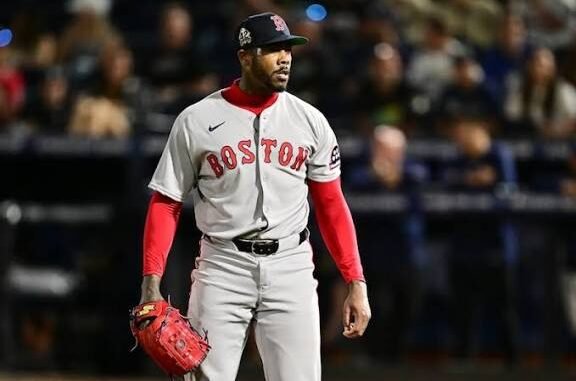
Aroldis Chapman is among the most electrifying relief pitchers in modern Major League Baseball (MLB). Known for his triple-digit fastball, long career, and resilience, he continues to defy expectations even in his late 30s. In this article, we explore four key facets of Chapman’s legacy:
-
Domestic (that is, his controversies, personal life, and off-field issues)
-
Salary (his MLB contracts and annual earnings)
-
Hall of Fame prospects
-
Career earnings (total MLB income and net worth estimates)
By delving into these topics, we aim to present a comprehensive, up-to-date portrait of Chapman’s professional and personal path.
1. Domestic — Controversies, Personal Life, and Off-Field Issues
Early Life & Defection from Cuba
Born on February 28, 1988, in Holguín, Cuba, Aroldis Chapman played in the Cuban National Series for Holguín (Sabuesos) from about 2005-06 through the 2008–09 seasons. During that period, he pitched as both a starter and reliever. His Cuban stats include roughly 327 innings, a 24–19 record, a 3.74 ERA, and 365 strikeouts. In the 2008–09 season alone, he recorded an 11–4 record with 130 strikeouts in 118⅓ innings.
Chapman defected from Cuba in 2009 while in Europe, reportedly via a World Port Tournament in Rotterdam. After establishing residency outside Cuba, he became eligible to sign with an MLB team.
Personal Life & Family
When he left Cuba, Chapman initially left behind his parents, sisters, a girlfriend, and a newborn. Over time, he helped arrange for their relocation to the United States, though the details are largely private. He also became a U.S. citizen in 2016.
Chapman has at least two children: a daughter born in Cincinnati in 2014 and a son born afterward.
The 2015 Domestic Violence Incident
One of the most significant and controversial episodes in Chapman’s personal life involved allegations of domestic violence. On October 30, 2015, Chapman was accused of pushing and choking his girlfriend, and allegedly firing eight gunshots, in Davie, Florida, at his home. The matter drew baseball’s and media scrutiny, delaying a trade and triggering an MLB investigation under the league’s personal conduct policy.
Chapman was suspended for the first 30 games of the 2016 MLB season due to violation of Major League Baseball’s domestic violence policy. No criminal charges were ultimately filed, reportedly due to inconsistent or insufficient evidence.
While the episode has cast a lasting shadow over his public image, many teams and media outlets have since balanced it with continued evaluation of his on-field performance and conduct.
Reputation, Redemption, and Legacy
Chapman’s domestic controversy remains a persistent part of his narrative. While he has sought to maintain a professional image and has continued performing at a high level, critics and fans alike continue to weigh his off-field behavior in assessing his legacy. His career and personal redemption arc remains incomplete—some will always judge him through the prism of those allegations, others will focus predominantly on his performance and longevity.
Nevertheless, his resilience and ability to continue to deliver elite pitching late into his career have contributed to a nuanced public profile: a player of exceptional talent, yet human and fallible.
2. Salary — Contracts, Annual Income, and Recent Deals
In professional sports, salary data is often among the most scrutinized metrics. Chapman’s career has seen several high-profile contracts, reflecting his value as one of the premier relievers in his time.
Early MLB Contract with the Reds
Shortly after defecting, Chapman signed a six-year deal with the Cincinnati Reds in January 2010. While the exact annual breakdowns for all years may not always be publicly broken out, this deal anchored his earnings in the first phase of his MLB tenure.
Trades and Short-Term Deals
Over time, Chapman shifted between teams via trades and shorter-term agreements. In December 2015, the Reds traded Chapman to the New York Yankees.
In early 2016, he signed a one-year contract with the Yankees worth $11.325 million to avoid arbitration.
Later in 2016, the Yankees traded Chapman to the Chicago Cubs mid-season, where he contributed to their postseason run.
Five-Year, $86 Million Return to the Yankees
In December 2016, Chapman inked a five-year, $86 million contract to return to the New York Yankees. At that time, it was one of the richest contracts ever given to a relief pitcher.
That contract anchored his earnings in the prime of his career.
More Recent One-Year Deals & Extensions
-
In late 2024, Chapman signed a one-year deal with the Boston Red Sox worth $10.75 million.
-
In 2025, he and the Red Sox agreed to an extension for 2026. That deal is reportedly $13.3 million, which includes a $1 million signing bonus, a $12 million base salary, and a mutual/vesting option for 2027 worth $13 million (or a $300,000 buyout if the option is not exercised) under certain conditions.
-
If the option is not exercised, Chapman’s 2027 salary becomes guaranteed if he pitches at least 40 innings in 2026 and passes a physical.
-
Some reports state that his 2026 base salary will be $13 million, with possible escalation into 2027.
Recent Salary Snapshot & Projections
Per online contract trackers like Spotrac, Chapman’s contract details reflect these values. For instance, Spotrac lists a one-year deal for Chapman with a $13.3 million guaranteed contract with Boston.
In sum, Chapman has shifted from long multi-year contracts toward shorter deals and performance-based extensions as he ages. Yet his ability to command double-digit millions per season underscores that he remains one of baseball’s most valuable relief arms.
3. Hall of Fame Prospects — Can Chapman Make It?
Aroldis Chapman’s Hall of Fame case is a fascinating debate among fans, analysts, and sabermetricians. As a reliever, his path is more challenging than that of many starters, but his résumé does offer persuasive elements.
Career Metrics & Milestones
-
ERA and Performance: Chapman’s career ERA hovers around 2.53 (as of 2025), ranking among the best for relievers with sufficient innings.
-
Strikeout Rate & Whiff Rates: His strikeout rates and whiff-inducing ability have consistently been elite, contributing to his reputation as a dominant closer.
-
Saves Total: As of recent seasons, Chapman ranks among the top in career saves lists (e.g. 13th on all-time saves as of 2025).
-
Peak and Longevity: His peak performance years, combined with sustained effectiveness late into his 30s, strengthen his candidacy.
-
Sabermetric Rankings: Using metrics like JAWS (which blends a player’s peak performance with career totals), Chapman is ranked around 13th all-time among relievers, behind only Hall of Famers such as Mariano Rivera, Dennis Eckersley, Goose Gossage, Bruce Sutter, Rollie Fingers, and Trevor Hoffman.
Challenges & Hurdles
-
Relievers Are Harder to Elect: Historically, bullpen pitchers have had a steeper climb to Hall of Fame induction than starters, partly due to perceptions of their impact and innings volume.
-
Off-Field Controversies: The 2015 domestic violence incident will likely be scrutinized by voters, particularly in an era of increased emphasis on conduct and character.
-
Counting Stats vs. Dominance: While Chapman has excellent rate metrics, he may lack some counting stats (e.g., extremely high innings pitched, complete game dominance) that sway traditional voters.
-
Competition Among Relievers: He is competing with other relievers of his era for limited ballots; voters often have to choose among many worthy bullpen candidates.
Verdict: A Strong Case with Some Uncertainties
Given his elite skill set, longevity, and key achievements (saves, strikeouts, ERA), Chapman arguably belongs in the conversation for Hall of Fame induction. If he continues to perform well, adds to his save totals, and maintains a clean professional image, he stands a legitimate chance—though the off-field issues and the nature of relief pitching will remain complicating factors.
4. Career Earnings & Net Worth — How Much Has Chapman Made?
Estimating a professional athlete’s full earnings is tricky—contracts are public, but endorsements, taxes, agent fees, and after-tax net worth calculations often are not. However, we can approximate based on known contracts and publicly disclosed numbers.
Contract Earnings and Public Estimates
One source, Celebrity Net Worth, estimates Chapman’s career earnings at “a bit over $130 million.” Their breakdown includes multi-year contracts, including his five-year, $86 million Yankees deal and his peak single-season salaries (e.g. as high as $19.5 million in 2018). They place his net worth around $50 million.
However, that $130 million figure may undercount some recent contracts or incentives, and may exclude non-salary sources of income.
Another public contract tracker, Spotrac, lists Chapman’s contract values, including the $13.3 million guarantee for 2026.
Rough Aggregation
A rough aggregation of Chapman’s major contracts over his career includes:
-
The initial multi-year Reds contract
-
The one-year $11.325 million Yankees deal
-
The five-year, $86 million Yankees contract
-
Various shorter high-value contracts, such as $10.75 million with Boston in 2024
-
The 2026 extension of $13.3 million (with bonus/option structure)
-
Other mid-season trades and partial seasons with teams like the Cubs, Royals, Rangers, and Pirates
These collectively would suggest a total in the low- to mid-hundreds of millions in gross MLB earnings (pre-tax).
Net Worth & Adjusted Take-Home
The $50 million net worth estimate cited earlier rests upon subtracting taxes, agent fees, living costs, and investments. In context, for a player with over a decade and a half of high-level performance, that is within a plausible range.
That said, such figures should be treated with caution—they are approximations and rely on publicly estimated data. Many athletes also have endorsements, media deals, investments, and other income streams that may not be fully captured.
Conclusion
Aroldis Chapman has lived a career defined by raw power, resilience, and evolution. On the mound, he has consistently delivered among the fiercest fastball speeds in baseball, transitioned between clubs, and earned lucrative contracts even into his late 30s. Off the field, his domestic violence controversy continues to color discussions of his legacy. In the Hall of Fame debate, Chapman has a strong but complex case: elite metrics, longevity, and signature achievements push in his favor, while his role as a reliever and the stain of off-field issues may count against him.
When it comes to money, Chapman has likely earned well over $100 million in his career, with net worth estimates in the tens of millions. But the stark contrast between gross earnings and personal legacy shows how a player’s story in the modern age is about much more than fastballs and saves.