
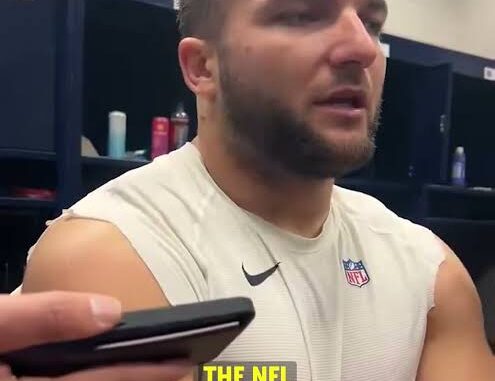
Cam Skattebo is making headlines after receiving an unnecessary roughness penalty during the New York Giants’ Week 7 matchup against the Houston Texans on Sunday, October 25, 2026. The rookie running back was flagged for lowering his helmet into a Texans defender, but the controversial call has not changed his approach to the game.
Following the Giants’ victory, Skattebo made it clear that he intends to continue running with the physical style that has become a defining part of his game. He also questioned the NFL’s approach to promoting hard-hitting plays while penalizing players for similar moments on the field.
The Cam Skattebo unnecessary roughness incident has sparked discussion about player safety, officiating consistency and how much physicality the NFL should allow from offensive players.
Why Was Cam Skattebo Penalized for Unnecessary Roughness?
The penalty occurred during the first quarter of the Giants’ game against the Houston Texans. Skattebo lowered his body and delivered a forceful blow to Texans safety M.J. Stewart while attempting to advance the football.
Officials called unnecessary roughness for improper use of the helmet, resulting in a 15-yard penalty against New York.
Helmet-related penalties are often associated with defensive players making contact with offensive players, so the call against a running back attracted additional attention. However, ball carriers are also subject to rules governing how they use their helmets during contact.
The incident raised questions among fans about the balance between allowing running backs to protect themselves and preventing dangerous collisions.
Cam Skattebo Responds to the Unnecessary Roughness Call
Skattebo was clearly unhappy with the decision and showed little interest in changing his physical running style after the game.
He declined to reveal the details of his conversation with the official but criticized what he sees as a contradiction in the NFL’s approach to hard-hitting plays.
“I’m going to run the ball like I want to run the ball,” Skattebo said after the game, explaining that he would continue playing aggressively even if the league imposed additional penalties or fines.
He also suggested that the NFL benefits from promoting his physical plays in its promotional content while potentially punishing him for the same style of football.
Skattebo made his position clear when he said he would keep playing hard and doing everything possible to contribute to the Giants, even if financial penalties followed.
His comments have made the Skattebo unnecessary roughness controversy one of the notable talking points from the Giants’ Week 7 performance.
Cam Skattebo’s Performance Against the Texans
Despite the controversy, Skattebo delivered an impressive performance against Houston. He finished with 124 rushing yards on 17 carries and scored a touchdown, providing a significant boost to the Giants’ offense.
His biggest scoring moment came on a powerful 16-yard touchdown run. The play showcased the combination of strength, determination and acceleration that has made him an important part of New York’s rushing attack.
Quarterback JJ McCarthy also contributed through the air, completing 20 of 28 passes for 252 yards. The Giants’ defense helped secure the victory as the team continued to build momentum under head coach John Harbaugh.
According to the supplied report, New York improved to 4-2-1 after the win, marking a significant improvement from its 4-13 finish the previous season.
Skattebo’s production demonstrated why the Giants value his physical approach, even as the latest penalty raises questions about how that style fits within the NFL’s rules.
Will the NFL Fine or Suspend Cam Skattebo?
The immediate concern following the penalty is whether the NFL will take further disciplinary action against Skattebo.
An unnecessary roughness flag does not automatically mean a player will receive an additional fine or suspension. The league can review certain plays after games and determine whether further discipline is warranted.
Skattebo’s public comments suggest that financial penalties alone are unlikely to persuade him to abandon his aggressive running style. However, repeated violations could create a bigger problem if the league determines that his actions warrant escalating discipline.
A suspension would be particularly costly for the Giants if Skattebo continues to play a central role in their rushing offense.
The running back must therefore balance his desire to finish runs aggressively with the league’s rules on helmet use and player safety.
How Does Drew Brees Fit Into the Cam Skattebo Debate?
The mention of Drew Brees alongside the Cam Skattebo unnecessary roughness controversy brings attention to a broader discussion about how NFL rules and expectations have changed over time.
Brees, a former NFL quarterback and Super Bowl champion, played during an era when the league was increasingly emphasizing protections against dangerous contact. His career also spanned a period in which the NFL continued adjusting its approach to player safety.
However, the supplied reports do not establish a direct connection between Brees and Skattebo’s penalty, nor do they identify a specific comment from Brees about the incident.
The comparison is best understood as part of the wider debate about the evolution of physical football. Fans often compare the hard-hitting style associated with earlier generations to today’s more closely regulated game.
For running backs such as Skattebo, the challenge is finding ways to maintain a powerful playing style while complying with rules intended to reduce dangerous helmet contact.
Why the Cam Skattebo Penalty Is Drawing Attention
The controversy highlights a difficult issue for the NFL. Running backs regularly lower their pads to absorb contact, protect the football and gain additional yards. At the same time, the league has introduced and enforced rules designed to limit dangerous use of the helmet.
That creates a fine line between legal physical running and an illegal collision.
Some fans may view the penalty as an example of the league limiting the toughness that makes power running exciting. Others will argue that consistent enforcement is necessary to protect both offensive and defensive players.
The question is not simply whether Skattebo should run aggressively. It is whether he can maintain that approach without making prohibited helmet contact.
The consistency of officiating will also remain part of the discussion, particularly when similar-looking plays do not always result in penalties.
What’s Next for Cam Skattebo and the Giants?
Skattebo’s response suggests that the controversy will not immediately change his approach. His performance against Houston showed how effective he can be when he establishes momentum and forces defenders to make difficult tackles.
For the Giants, the priority will be to continue using his strengths while ensuring that his technique remains within the NFL’s rules.
If Skattebo can preserve his physical identity without drawing additional penalties, he could remain a major contributor to New York’s offense throughout the season.
For now, the Cam Skattebo unnecessary roughness incident has created a debate that extends beyond one penalty. It raises questions about player safety, the interpretation of helmet rules and the future of physical running in professional football.
Skattebo has made his position clear: he intends to keep playing hard. Whether the NFL’s officials and disciplinary process allow that approach to continue without further consequences remains to be seen.


Leave a Reply