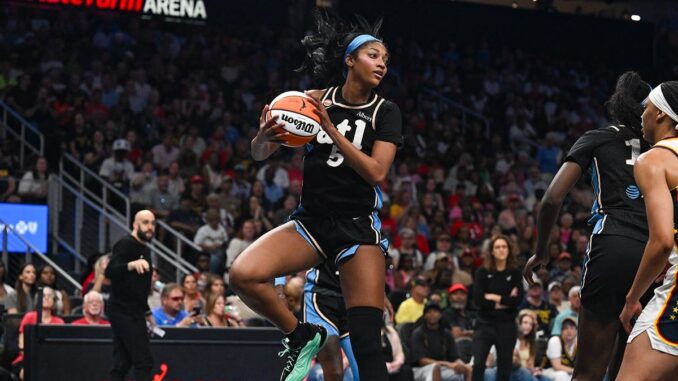
Angel Reese’s rebounding has become one of the biggest talking points surrounding the WNBA star, and ESPN recently put that strength under an even brighter spotlight.
During Sunday’s Indiana Fever vs. Atlanta Dream matchup, ESPN repeatedly referenced a feature focused on Reese’s rebounding ability. The discussion highlighted her remarkable production on the glass while also sparking debate about how her numbers should be interpreted.
Angel Reese’s Rebounding Numbers Stand Out
Reese has established herself as one of the WNBA’s most productive rebounders since entering the league. According to the information highlighted in ESPN’s feature, she reached 1,000 career rebounds in just 79 games, doing so 10 games faster than Tina Charles.
Her current rebounding production is also among the best in the league. Reese has continued to make her presence felt around the basket, using positioning, persistence and physicality to create additional possessions for her team.
One of the more unusual statistics highlighted in the ESPN feature involves what Reese refers to as “mebounds” — rebounds she collects after missing her own shots.
She reportedly had 49 such rebounds this season, 25 more than the next-highest player in the WNBA at the time of the report.
That statistic illustrates both sides of the conversation surrounding Reese. Her ability to stay with a missed shot and secure another opportunity is an important part of her rebounding value, while critics argue that some of those opportunities are created by her own struggles finishing around the rim.
ESPN Compares Reese With Legendary Rebounders
ESPN’s profile drew comparisons between Reese and former NBA rebounding stars Dennis Rodman and Charles Barkley.
The feature explored the instincts and techniques that have helped Reese become such a productive rebounder. It examined her positioning, timing and ability to anticipate where the ball might fall after a missed shot.
Those qualities have helped Reese build a reputation as one of the WNBA’s elite players on the glass.
However, the comparisons also generated discussion because Reese’s overall offensive profile remains more complicated than her rebounding statistics alone suggest.
The “Mebounds” Debate Adds Another Layer
Reese’s 49 “mebounds” have become a notable statistic in discussions about her game.
Second-chance scoring is another important part of her production. The ESPN feature reported that 148 of Reese’s points this season had come from second-chance opportunities, representing about 30% of her total scoring at that point.
That shows how much value she can create after missed shots. Instead of ending a possession, Reese’s offensive rebounds can give her team another chance to score.
At the same time, the statistics provide context for critics who question her finishing efficiency.
The report cited Reese shooting 46.0% in the paint, the lowest mark among the 27 WNBA players with at least 175 paint attempts in the referenced group.
The contrast is what makes Reese such an intriguing player. She can struggle to convert opportunities close to the basket while simultaneously creating additional opportunities because of her ability to rebound her own misses.
Reese’s Latest Game Adds to the Conversation
The Fever-Dream matchup provided another example of Reese’s all-around impact.
Reese finished with 15 points, 14 rebounds and six assists. She also recorded six turnovers and five fouls while shooting 5-for-16 from the field.
The Atlanta Dream ultimately fell to Indiana 95-91 in overtime, with the game receiving significant national attention because of the matchup between Reese and Caitlin Clark.
Clark finished with 26 points and nine assists, while Reese once again demonstrated why her rebounding remains one of the defining elements of her game.
Reese also had a late opportunity to potentially change the outcome but missed a layup with less than five seconds remaining in regulation.
Why Angel Reese Remains One of the WNBA’s Biggest Storylines
Reese’s rebounding numbers have made her one of the most recognizable young players in the WNBA.
Her combination of offensive rebounding, second-chance opportunities and relentless work around the basket gives her a unique statistical profile. Few players can turn missed shots into additional possessions at the same rate.
At the same time, evaluating Reese requires more than looking at one category.
Her rebounding is clearly an elite part of her game, but her shooting efficiency, turnovers and finishing around the rim remain areas that continue to generate debate.
That balance is important when assessing her long-term potential.
ESPN’s Coverage Fuels the Discussion
ESPN’s repeated promotion of its Angel Reese rebounding feature during the Fever-Dream broadcast made the topic even more prominent.
The network highlighted the story more than once during the game, drawing attention to the research behind Reese’s rebounding success.
The coverage reflects the broader interest surrounding Reese, whose performances continue to attract attention well beyond the box score.
Whether fans view her as a historically great rebounder or believe her statistics need additional context, there is little doubt that rebounding has become a defining part of Reese’s WNBA identity.
For now, the numbers tell a clear story: Angel Reese is one of the league’s most prolific rebounders, and her ability to create extra possessions remains one of the biggest reasons she continues to command attention across the WNBA.