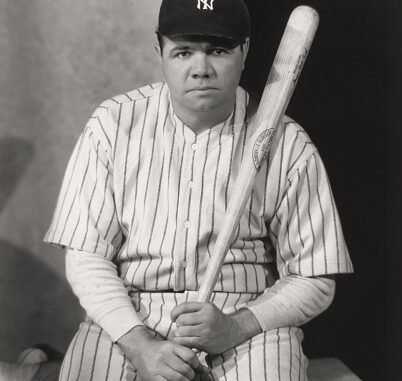
Who was Babe Ruth
Babe Ruth (born George Herman Ruth Jr.) is one of the most iconic figures in baseball history. He revolutionized the sport with his unmatched power hitting — retiring with 714 home runs — and earned legendary nicknames like “Sultan of Swat” and “The Great Bambino”.
He played for teams like the Boston Red Sox and the New York Yankees, and remains one of the greatest baseball hitters ever.
Final Years & Illness
-
In 1946, Babe Ruth began suffering from troubling symptoms: severe pain over his left eye, difficulty swallowing, and swelling. Medical tests at French Hospital in New York revealed a malignant tumor at the base of his skull and in his neck. Doctors eventually diagnosed him with nasopharyngeal carcinoma (NPC), also known as lymphoepithelioma — a rare form of head and neck cancer affecting the nasopharynx.
-
His history of heavy smoking and drinking is believed to have contributed to his disease, according to a later review of his autopsy.
-
Because the tumor was in a difficult location (around major arteries and deep in the skull base), surgery alone couldn’t remove it safely. He underwent radiation therapy and surgery — but doctors couldn’t remove the entire mass.
Treatment & Medical Legacy
As his condition worsened, Ruth became one of the first patients in medical history to receive sequential radiation + chemotherapy — a pioneering step in modern cancer treatment protocols.
-
Beginning in June 1947, Ruth agreed to daily injections of an experimental drug called teropterin (a precursor to what’s now known as methotrexate), even though it had only been tested on animals.
-
For a short time, the treatment showed results — swelling subsided, and he regained some strength and weight. But the improvement was temporary.
Despite aggressive therapy, the cancer proved relentless. Over the next months, his health gradually declined again.
Cause of Death & Confusion Around It
-
On August 16, 1948, Babe Ruth died at Memorial Hospital in New York City at age 53.
-
The official cause was complications of nasopharyngeal carcinoma (metastatic cancer) — though some early reports simplistically called it “throat cancer.”
-
In the final days of his life, he also developed pneumonia — a common complication given his weakened state — which contributed to his death.
Because of outdated diagnosis language and evolving medical understanding, many older sources refer to his illness as “throat cancer,” which contributed to lingering confusion about his true ailment.
The Movie: “The Babe Ruth Story”
-
Released in 1948, “The Babe Ruth Story” is a biographical film depicting Ruth’s life, career, and final illness.
-
In the film’s final act, his character is shown receiving an “experimental serum” — a dramatic representation of the real-life chemotherapy and radiation treatments Ruth underwent toward the end of his life.
-
While the movie captures the broad outline — rise to fame, struggles with illness, final downfall — it takes creative liberties and simplifies medical complexities for dramatic effect.
Why The “Hunting” Angle Shows Up
Some lesser-known later accounts mention that during periods of relative recovery (for example, after his initial radiation therapy in 1947), Ruth attempted to resume parts of a more normal life, including leisurely activities like golf and hunting.
However, these outings were brief and unsuccessful in restoring his health — today, they’re sometimes referenced to illustrate how desperately he tried to cling to normalcy before cancer ultimately overcame him.
Legacy: More Than a Baseball Legend
Babe Ruth remains immortalized not only for his home runs and larger-than-life persona — but also for his inadvertent role in medical history. His participation in early chemo-radiation therapy trials helped pave the way for treatments that millions benefit from today.
While many remember him for the “bat, the ball, and the home run,” it’s worth noting that beneath the legend was a man whose final years contributed meaningfully to advances in cancer treatment.