Introduction
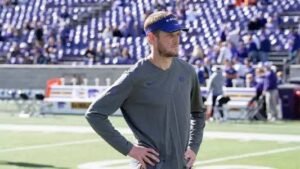
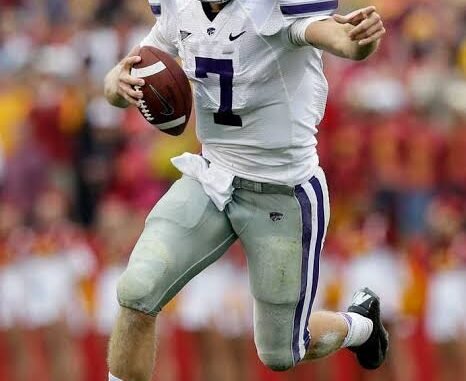
Collin Klein is one of the more intriguing figures in recent college football history. A dominant dual-threat quarterback at Kansas State Wildcats (2009–2012), Klein earned national attention for his rushing and passing prowess — yet his professional career never materialized as many expected. Since then, he has forged a successful coaching career, culminating recently in major coaching news. In this article, we cover Klein’s playing career (with stats), his ESPN/NFL record and contract history, his time at Kansas State, and what he’s doing now — plus context around his earnings, opportunities, and legacy.
Early Life & College Career at Kansas State
Born on September 19, 1989, Klein hails from Loveland, Colorado. He began his college football journey at Kansas State, joining in 2008 — initially as a walk-on wide receiver before switching to quarterback in 2009.
Rise to Starting Quarterback & Dual-Threat Style
-
In 2009, as a redshirt freshman, Klein played mostly at receiver/special teams: he recorded 6 receptions for 38 yards and one touchdown that season.
-
By 2010, Klein began seeing time at quarterback. His first career start was a notable win over the Texas Longhorns, where he rushed for 127 yards and two touchdowns, highlighting his rushing ability even in a “passing” role.
-
In 2011, he became the full-time starter. That season, he passed for 1,918 yards and 13 touchdowns, while rushing for 1,141 yards and an extraordinary 27 rushing touchdowns — a school record for a quarterback and one of the most prolific rushing seasons by a QB in FBS history.
-
His run-first, dual-threat approach made him a nightmare for defenses, especially in the red zone and on read-option plays.
Senior Year & Peak Performance (2012)
In 2012 — Klein’s senior season — he delivered arguably the finest season in Kansas State history for a quarterback:
-
Passing: 2,641 yards, 16 touchdowns, with a 64.8% completion rate.
-
Rushing: 920 yards and 23 rushing touchdowns (in the regular season), showcasing his ability to dominate on the ground.
-
Total Offense & Dual Production: His dual-threat production — both through the air and on the ground — made him one of the most versatile QBs in college football at the time. Earned multiple accolades:
-
Johnny Unitas Golden Arm Award (2012)
-
Kellen Moore Award (2012)
-
Big 12 Offensive Player of the Year (2012) and Big 12 Athlete of the Year (2012)
-
Second-team All-American honors (2012) and two-time First-team All-Big 12 (2011, 2012)
Klein helped lead Kansas State to an 11–2 record in 2012, including a share of the conference title and a berth in the Fiesta Bowl.
Despite his exceptional college performance, his rushing-heavy style and unconventional throwing motion raised questions about his transition to the pro level — more on that below.
Career Stats — College (Per Sports Reference)
| Season | Pass Yards | Pass TD | Rush Yards | Rush TD |
|---|---|---|---|---|
| 2010 | 138 | 1 | 432 | 6 |
| 2011 | 1,918 | 13 | 1,141 | 27 |
| 2012 | 2,641 | 16 | 920 | 23 |
| Career (2009-12) | 4,724 | 30 | 2,523 | 56 |
Other career highlights:
-
Completion percentage: 61.3%
-
Total offense place in school history: among top QBs in total yards and dual-threat production.
-
One of the few quarterbacks in the BCS-era (at a major conference school) to rush for at least 20 touchdowns and pass for at least 10 touchdowns in multiple seasons.
Klein’s balanced production — both passing and rushing — made him a classic “dual-threat” QB, capable of making defenders account for both dimensions on each play.
Pro Prospects & NFL / Professional Contract Attempts
Given his success, many expected Klein to transition to the NFL. However, his path to the pros was rocky.
-
Despite being a Heisman finalist in 2012, Klein went undrafted in the 2013 NFL Draft.
-
He was signed by the Houston Texans as an undrafted free agent, but did not make the final roster.
-
There were considerations for him to change position (e.g., tight end) due to his athletic traits (6’5″, 226 lbs), but Klein was intent on staying at quarterback.
-
He also signed briefly with the Montreal Alouettes (CFL), but was released in June 2014.
As a result, Klein never played a down in the NFL regular season — a surprising outcome given his college credentials.
ESPN / NFL Stats Page
According to his profile on ESPN, his NFL career has no accumulated statistics.
Contract / Earnings
Because he never played a regular-season game in the NFL, his career earnings from the NFL are minimal. Data from Spotrac lists him as “inactive,” reflecting his status after unsuccessful tryouts.
In short: outstanding college star — but limited to attempted NFL/AFL contracts and never broke through.
Coaching Career — Kansas State, Texas A&M & Beyond
After his playing career ended, Klein pivoted to coaching — and found early success.
Coaching Timeline
-
2014–2015: Returned to Kansas State as an assistant (recruiting/quality control).
-
2016: Quarterbacks coach at Northern Iowa Panthers.
-
2017–2023: Back at Kansas State — first as QB coach (2017), then co-offensive coordinator/QB coach (2018), later promoted to full-time offensive coordinator (2022–2023).
-
2024–2025: Joined Texas A&M Aggies as offensive coordinator and quarterbacks coach.
Coaching Impact & Style
Klein’s offensive schemes draw heavily from his dual-threat background: balanced attack, mobile quarterbacks, option-read plays, and emphasis on rushing — combined with efficient passing.
Under his guidance:
-
At Kansas State, the offense had improved rushing attacks, impressive red-zone efficiency, and more consistent passing from QBs.
-
At Texas A&M, the 2025 offense averaged 36.3 points per game, ranked 16th nationally in scoring, and was among the top offenses in the Southeastern Conference (SEC) in total offense.
New Developments — Return to Kansas State?
As of December 2025, reports indicate that Klein is set to return to Kansas State, this time as head coach, following the retirement of longtime head coach Chris Klieman.
If confirmed, this will mark Klein’s first head coaching role — a major milestone and a return “home” to the program where he starred as a player.
Legacy & What Went Wrong — NFL Expectations vs Reality
Klein’s case is often used to illustrate how even elite college quarterbacks — especially dual-threat, run-heavy QBs — may struggle to translate their game to the NFL. A few key reasons for his failure to stick in the pros:
-
Throwing mechanics and passing style: Despite his athleticism and rushing strength, Klein’s throwing motion was criticized as “unorthodox,” which discouraged many NFL teams from seeing him as a long-term QB option.
-
Positional uncertainty: Some teams reportedly tried to project him as a tight end or other position given his size (6’5″, 226 lbs), but Klein declined — choosing to remain a quarterback instead.
-
Scheme fit: In college, Kansas State often ran an offense tailored to Klein’s strengths — hybrid rushing/passing, designed QB runs, option-based schemes. The NFL at that point was less accommodating of that style (though today’s game has evolved).
-
Limited opportunity and timing: Going undrafted in 2013 meant he had to fight for a roster spot against entrenched pros and top draft picks. The lack of game film at QB (on pro level) and lack of a clear positional home made it hard.
In that sense, Klein remains a “what could have been” — widely respected at college level, but never given a sustained shot in the NFL.
Nevertheless, his legacy at Kansas State endures. Among school greats, Klein is remembered for his dual-threat excellence, rushing records, and leadership. Collin Klein.
Coaching Achievements & Future Outlook (2025 and Beyond)
With the likely return to Kansas State as head coach, Klein’s trajectory appears more promising than ever:
-
At Texas A&M (2024–2025), the offense flourished under his guidance, ranking among the best in the SEC — suggesting strong coaching acumen beyond just playing talent.
-
His familiarity with Kansas State — as a former star player and longtime assistant — could make him a good cultural and strategic fit as head coach, bridging past traditions with new offensive ideas.
-
For many Wildcats fans, Klein’s hiring represents a “full circle” — from walk-on receiver to star quarterback to potential head coach.
Of course, head coaching at a major program brings new challenges: recruiting, program management, pressure to win, handling defense and special teams staff. But given Klein’s football IQ and history of adaptability, many see him as a promising hire.
Frequently Asked Questions (FAQs)
Q: Did Collin Klein ever play in the NFL?
A: No. Although Klein signed with the Houston Texans as an undrafted free agent in 2013 and later had a brief stint with the Montreal Alouettes (CFL), he never played in a regular-season NFL game.
Q: What were Collin Klein’s college stats at Kansas State?
A: Over his college career (2009–2012), Klein passed for 4,724 yards and 30 passing touchdowns, while rushing for 2,523 yards and 56 rushing touchdowns — showcasing a rare dual-threat skill set.
Q: Why was Collin Klein not drafted into the NFL despite college success?
A: Several factors contributed: concerns over his unconventional throwing motion and passing mechanics; doubts about his long-term viability as an NFL quarterback; some teams considered converting him to other positions; and ultimately, lack of projection compared to NFL-standard QBs.
Q: What is Collin Klein doing now (2025)?
A: As of December 2025, reports indicate Klein is set to become head coach of Kansas State’s football program, following the retirement of Chris Klieman. He has been serving as offensive coordinator / quarterbacks coach at Texas A&M.
Q: Did Collin Klein ever have an NFL contract?
A: Yes — after going undrafted, he signed a free-agent contract with the Houston Texans; he also signed briefly with the Montreal Alouettes in the CFL. However, he remained “inactive” in the NFL and did not make a regular-season roster. Collin Klein.
Conclusion
Collin Klein’s story is one of contrasting arcs — stellar college success, thwarted NFL dreams, and a resurgence as a promising coach. As a dual-threat quarterback at Kansas State, he posted memorable stats and earned national recognition. But a variety of factors prevented him from taking off in the NFL, relegating his pro career to brief contracts and tryouts.
Yet, football often offers second chances — and for Klein, coaching has provided a renewed purpose. With a likely return to Kansas State as head coach, he stands poised to impact a program he once led on the field. For fans of the Wildcats (or college football in general), this “full circle” moment underscores the unpredictable, often redemptive arc of football careers.