Introduction
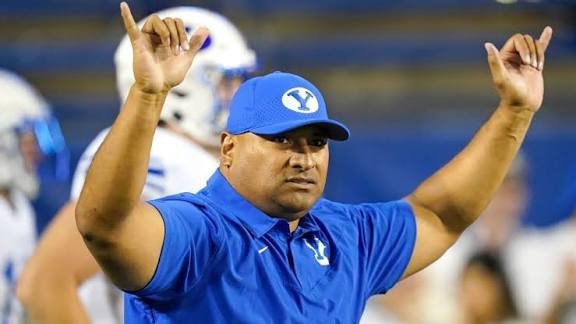
Kalani Sitake stands as one of the most compelling figures in modern college football — a trailblazer, leader, family man, and cultural pioneer. As the head coach of BYU Cougars, he’s carved out a reputation built on character, discipline, faith, and performance. In this comprehensive profile, we explore Sitake’s journey: from his origins in Tonga to his playing days, coaching ascent, and the rumors linking him to Penn State Nittany Lions. Along the way, we detail his personal life, heritage, physical attributes, and what his role could mean for college football.
Early Life & Ethnicity
Kalani Sitake was born on October 10, 1975, in Nukuʻalofa, Tonga. His family — carrying strong Polynesian roots — immigrated to the United States when he was a child, relocating first to Laie, Hawaii, before settling elsewhere.
His ethnicity is Tongan; today, he identifies as Tongan–American. This heritage isn’t just a footnote: it defines his role in college football history. He is the first person of Tongan descent to become a head coach at the NCAA Division I Football Bowl Subdivision (FBS) level.
His name — “Kalani” — holds cultural significance. According to his family, it means “gift from heaven,” a nod to his blend of heritage, faith, and journey.
Growing up, Sitake imbibed values of faith, family, resilience, and community — attributes that would later shape his coaching ethos.
Playing Career: From Fullback to Scholar-Athlete
Sitake’s collegiate playing career began at Brigham Young University (BYU) in 1994. Shortly afterward, he paused football to serve a two-year mission (for his faith) in California.
He returned in 1997, redshirted that year, and then became a three-year starter at fullback from 1998–2000 under coaching legend LaVell Edwards.
During his BYU tenure:
-
In 1998, he was named BYU’s Football Scholar Athlete of the Year.
-
In 1999, he helped the Cougars to the first Mountain West Conference championship for the school, and earned the Impact Player of the Year.
-
In 2000, he was named team captain and BYU’s most valuable running back.
Across his college career, he amassed 373 rushing yards on 86 carries (4.3 yards per carry) and 536 receiving yards on 62 receptions, scoring one touchdown.
He graduated in 2000 with a Bachelor of Arts degree in English.
Following college, Sitake signed a free agent contract in 2001 with the Cincinnati Bengals, an opportunity cut short by a back injury that ended his pro football aspirations.
Though his playing career didn’t extend into the NFL, those formative years as a scholar-athlete and fullback laid the groundwork for a deeper football journey — one guided by both mind and character.
Coaching Journey: Rise Through the Ranks
Transitioning quickly from player to coach, Sitake began his coaching career in 2001 as defensive backs and special teams coach at Eastern Arizona College. The next year, he returned to his alma mater BYU as a graduate assistant working defense.
From 2003 to 2004, he coached at Southern Utah University (RB/FB/TE in 2003; OL/FB/TE in 2004) before moving on to the University of Utah in 2005. At Utah, he started coaching linebackers. Over time, he rose to defensive coordinator in 2009, becoming the first native Tongan to hold a defensive coordinator role at an FBS school.
In December 2014, Sitake joined Oregon State University as defensive coordinator and assistant head coach — a brief stint before his calling back to BYU.
On December 19, 2015, Sitake was named head coach of BYU — becoming the 14th head coach in program history and only the fourth since 1972.
Success at BYU
Under Sitake’s leadership, BYU has seen consistency, culture-building, and competitiveness. As of 2025, his overall record stands at 83–44.
He’s guided the Cougars through multiple bowl games, conference transitions, and a reshaping of identity — balancing performance on the field with personal development and faith-based values.
In January 2025, Sitake’s achievements were formally recognized when he was inducted into the Polynesian Football Hall of Fame.
Former players, colleagues, and analysts often point to his ability to build “culture beyond the scoreboard” — emphasizing joy, discipline, mental toughness, and a strong sense of community.
Wife & Family Life
Behind every coach’s public persona is often a private support system. For Sitake, that’s his wife, Timberly Sitake. The two have been married since May 4, 2002.
Timberly studied at BYU as well — their shared background likely providing a foundation for strong mutual understanding.
They are parents to four children — two daughters and two sons. Commonly mentioned names include Skye, Sadie, Kelaokalani (KK), and Sylvia Jo Lata (the youngest, born July 2022).
Timberly has been vocal as a pillar of support in Sitake’s journey. In a 2025 speech at an entrepreneurship gathering, Sitake credited her as instrumental in preparing him and securing his role at BYU. “I wouldn’t be here if it wasn’t for her,” he said.
According to public records and media sources, Timberly, though not a football expert, understood his dreams, ambitions, and the familial impact, making sacrifices alongside him.
Their partnership, balancing faith, family, and football, has often been cited as a cornerstone of Sitake’s resilience and leadership style.
Height, Physical Stats & Early Life Physicality
While public sources extensively cover Sitake’s career, exact metrics like height and playing weight are not widely documented in an official capacity. Unlike many modern players or coaches whose pre-draft measurements are public, Sitake’s profile focuses more on his role, background, and values rather than physical stats.
However, his playing role — fullback at BYU from 1998–2000 — suggests that he had the size, strength, and versatility required for a physically demanding position. His ability to rush and receive (as evidenced by his stats: 373 rushing yards and 536 receiving yards) confirms that he was more than a short-yardage blocker; he contributed as a dual-threat fullback during his tenure.
Given the lack of verified height or weight data, any specific figure would be speculative. Many public bios and hall-of-fame entries emphasize his film study, leadership, faith, and career trajectory rather than physical attributes.
Salary / Contract & Penn State Rumors
Is Sitake heading to Penn State?
In recent weeks (as of late 2025), speculation has surged linking Sitake to the head coach vacancy at Penn State. A recent article pegged his chances at 24% to land the job.
Analysts argue that Sitake’s track record, success at BYU, and ability to lead a program through conference transitions make him a viable candidate.
However — at the time of writing — no official offer or confirmation has emerged. The rumors stem from his rising profile and the search committee’s widening search field.
Sitake himself has publicly emphasised focus on his current program, indicating a preference to keep attention on his team rather than job speculation.
What about Salary / Market Value?
Publicly available records do not confirm a precise current salary for Sitake’s contract with BYU. However, his societal value — both as a coach and speaker — gives a rough benchmark. For speaking engagements, Sitake reportedly commands a fee between US $25,000 – $40,000.
Given his long tenure, success, and market demand (especially in a rumored head-coach search at a major program), it’s reasonable to assume his contract — or potential new contract — would reflect a competitive figure in the college-football coaching market.
Still, without an official contract disclosure, any exact figure remains speculative.
Cultural & Historic Significance
-
Pioneer for Polynesian/Tongan coaches: As the first person of Tongan descent to become a head coach at the FBS level, Sitake has broken barriers and opened doors for future Polynesian coaches.
-
Faith and values as foundation: His identity as a member of The Church of Jesus Christ of Latter-day Saints and the values instilled from childhood continue to shape his coaching philosophy — emphasising community, mentorship, discipline, and moral grounding.
-
Leadership beyond the field: Through coaching, mentorship, and public speaking, Sitake has become a voice for resilience, representation, and holistic development — not just of athletes, but of people.
-
Legacy-building at BYU: His success over nearly a decade — including guiding BYU through their transition into the Big 12 — underscores his ability to adapt, strategize, and lead under changing circumstances. Kalani Sitake.
FAQs — Frequently Asked Questions
Q1. What is Kalani Sitake’s ethnicity and where is he from?
A1. Sitake is Tongan–American. He was born in Nukuʻalofa, Tonga, and moved to the United States as a child, eventually growing up in Laie, Hawaii, among other places.
Q2. Who is Kalani Sitake’s wife and how many children does he have?
A2. His wife is Timberly Sitake. They have been married since May 4, 2002. Together, they have four children — two daughters and two sons.
Q3. Did Kalani Sitake ever play in the NFL?
A3. After graduating from BYU, Sitake signed with the Cincinnati Bengals as a free agent in 2001. However, a back injury ended his professional playing career before it could take off.
Q4. What is Sitake’s coaching record and achievements?
A4. As of 2025, Sitake’s record as head coach of BYU stands at 83–44. He has led the team to multiple bowl games, witnessed their move into the Big 12, and earned induction into the Polynesian Football Hall of Fame in January 2025.
Q5. Is Kalani Sitake likely to become head coach at Penn State?
A5. Recent speculation links Sitake to the Penn State head coaching vacancy, with some sources putting his odds around 22–24%. However — as of now — there is no official confirmation. Sitake has emphasized his commitment to BYU, and the speculation remains just that: speculation.
Q6. What about his height and physical profile?
A6. Public records and major bios for Sitake do not list a verified height or playing weight. While he played fullback at BYU and contributed as both a rusher and receiver, his modern profile centers on coaching, leadership, and cultural impact rather than physical stats. Kalani Sitake.
Why Sitake Matters — Beyond Wins and Losses
In an era when college football often feels like a business of stats, rankings, and revenue, Sitake offers something deeper and more resonant. He represents:
-
Cultural inclusion — as a Tongan-American, he brings Polynesian representation to a sport where diversity in leadership remains limited.
-
Faith-based identity — his background and beliefs inform a coaching philosophy grounded in discipline, respect, mentorship, and community.
-
Holistic leadership — he values not just athletic performance, but the growth of young men as people — academically, spiritually, ethically, and personally.
-
Resilience and adaptability — from immigrant roots to college athlete, from injury and early retirement to building a storied coaching career, his journey reflects determination, humility, and perseverance.
Whether at BYU or potentially at a powerhouse program like Penn State, Sitake’s influence — on players, families, and the broader cultural landscape — goes well beyond the scoreboard. Kalani Sitake.
Conclusion
Kalani Sitake’s story is more than a résumé. It’s a narrative of identity, faith, leadership, and legacy. From Tonga to Hawaii, from fullback to head coach, from student-athlete to mentor — Sitake’s journey reminds us what sport can be when grounded in values.
His link to Penn State adds intrigue: could this cultural pioneer take his ethos to one of college football’s historic programs? Only time will tell. What’s sure is that, wherever he coaches, Sitake’s impact will be felt — both on the field and off.