Introduction
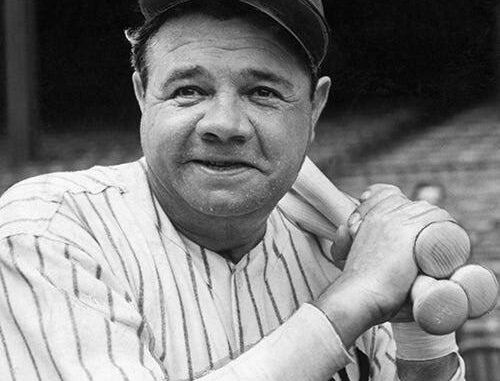
George Herman “Babe” Ruth Jr., better known simply as Babe Ruth, remains one of the most iconic figures in the history of sports. His name is synonymous with power, charisma, and an unparalleled impact on baseball. In pop culture, his legend was brought to life on screen by John Goodman in the 1992 biopic The Babe. But what makes Ruth so famous, and how much is his memorabilia — especially his baseball cards — worth today? This article dives deep into Ruth’s legacy, his portrayal by John Goodman, and the staggering value of his baseball cards in the modern collectors’ market.
1. Babe Ruth and John Goodman: The Connection
1.1 The Movie “The Babe” (1992)
-
In 1992, Universal Pictures released The Babe, a biographical film that traces Ruth’s extraordinary journey from a troubled youth to baseball legend. John Goodman portrays George Herman “Babe” Ruth Jr. in this film.
-
Goodman’s performance was widely noted for capturing both Ruth’s larger-than-life presence and his vulnerability.
-
The film explores Ruth’s personal life: his childhood in Baltimore, his days at St. Mary’s Industrial School for Boys, his rise as a pitcher, his transition into a home-run slugger for the New York Yankees, and his off-field struggles.
1.2 Why Goodman as Ruth Was Significant
-
John Goodman brought a physical and emotional heft to the role; his build and acting style made him a compelling choice to play the powerful, sometimes reckless Babe.
-
On The Dick Cavett Show, Goodman talked about how he trained to swing a bat left-handed (as Ruth did) to more authentically portray him.
-
His portrayal helped introduce a new generation to Ruth’s life story, bridging sports history and Hollywood.
2. Why Babe Ruth Is So Famous
To understand why Babe Ruth remains a legend, we need to examine three key aspects: his on-field achievements, his cultural impact, and his enduring legacy.
2.1 Record-Breaking Baseball Career
-
Dual Threat: Ruth started his Major League Baseball (MLB) career as a pitcher with the Boston Red Sox. He was a highly effective left-handed pitcher before becoming a full-time hitter.
-
Slugging Power: After joining the New York Yankees in 1920, Ruth transformed into a slugger. He shattered home run records; in 1927, he famously hit 60 home runs in a single season, a record that stood for decades.
-
Career Totals and Legacy: Over his career, Ruth hit 714 home runs, a number that stood as the MLB record until the 1970s. He also had a .690 career slugging percentage — one of the highest in history.
-
Team Success: Ruth helped lead his teams to multiple World Series titles.
-
Hall of Fame: In recognition of his incredible contributions, he was among the first five players inducted into the Baseball Hall of Fame in 1936.
2.2 Revolutionizing Baseball & The “Live-Ball Era”
-
Before Ruth’s dominance, baseball was often characterized by what was called “inside baseball” — a style emphasizing small hits, bunts, and strategies rather than power hitting.
-
Ruth’s unprecedented power hitting ushered in a new era — the live-ball era — where swinging for the fences became a dominant strategy.
-
His popularity also helped revive baseball’s image after the Black Sox Scandal (1919), when several White Sox players were banned for fixing the World Series.
-
According to Smithsonian commentary, Ruth was magnetic: he managed his public persona skillfully and became a hero not just for his play, but for his charisma.
2.3 Cultural Icon & Enduring Legacy
-
Ruth transcended sports — he became a pop culture icon. His nicknames, like “Sultan of Swat” and “The Bambino,” entered common usage.
-
He was among the first athletes to have nationwide fame.
-
His personality — big appetite, larger-than-life presence, and humble roots — resonated with the American public.
-
There’s also a religious-cultural dimension: to some, Ruth took on a quasi-saintly status in American civil religion, especially among children.
-
Even after his retirement, his legacy continued: the Babe Ruth Award (for postseason MVP) was established in his honor.
-
His impact is still felt: the term “Ruthian” is used to describe exceptional performances.
2.4 Legendary Moments: The “Called Shot”
-
One of Ruth’s most famous moments came in the 1932 World Series against the Chicago Cubs. According to lore, on that at-bat, he pointed his bat to center field — “calling his shot” — and then hit a home run to that very spot.
-
Whether the pointing was intentional or part of legend is still debated.
-
Nevertheless, the myth of the “called shot” has become a central part of Ruth’s folklore and has been referenced in films and popular culture.
3. How Much Is a Babe Ruth Baseball Card Worth Today?
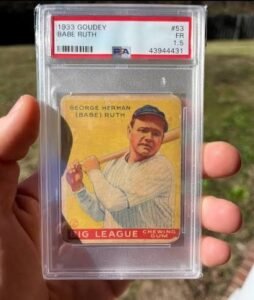
Perhaps one of the most intriguing parts of Babe Ruth’s legacy today is the value of his memorabilia — especially his baseball cards. Collectors across the world covet Ruth cards, and rare ones can sell for mind-boggling amounts.
3.1 What Determines the Value of a Babe Ruth Card
Several factors influence how much a Babe Ruth card is worth:
-
Condition / Grade: Cards are graded by professional agencies (e.g., PSA) — mint or near-mint cards fetch much higher prices.
-
Authenticity: Signed cards, or ones with proper provenance, are significantly more valuable.
-
Rarity: Cards from certain years (especially early ones) or limited sets are much scarcer.
-
Historical Significance: Cards tied to key moments in Ruth’s career (like rookie years) or special editions fetch more.
-
Market Demand: The collector market fluctuates — recent auctions, trends, and collector sentiment all matter.
3.2 Examples of High-Value Babe Ruth Cards
-
A 1914 Baltimore News Babe Ruth rookie card — one of his earliest known issues — recently sold for $4.026 million at auction.
-
In a 2025 auction, three 1933 Goudey Babe Ruth cards (all graded PSA 8) together drew nearly $700,000, with one (#149 red background) selling for $316,736.
-
According to a collectibles price guide, signed 1933 Goudey Ruth cards (near mint) are estimated to be worth between $150,000 and $350,000 depending on grade and authentication.
-
Another rare example is the 1921 Oxford Confectionary Ruth card. Despite a modest grade (PSA 6), its rarity fetches a very high value.
3.3 Recent Market Trends & Notable Sales
-
Some modern Ruth cards (e.g., 2025 Topps) are being tracked by price guides.
-
The collectibles market saw rare vintage Ruth cards powering a $7.1 million auction by Memory Lane Inc. in 2025.
-
On the flip side, the high-end market can be volatile: a 1914 Ruth card sold for $4.02M in 2025, but reports suggest the consignor bought it earlier for much more, implying risks even at the top tier. > “The 1914 Baltimore News Ruth … sold … for $4.02 M … the consignor bought it in 2023 for $7.2 M … That’s a $3.18 million loss.”
4. Why This All Matters — Legacy, Culture & Value
Putting together everything we’ve discussed — Ruth’s career, his portrayal by John Goodman, and the value of his cards — we can see a few lasting insights into why Babe Ruth endures as a symbol:
-
Cultural Bridge: John Goodman’s film keeps Ruth’s story alive for non-baseball fans, connecting his historical impact with contemporary audiences.
-
Historical Impact: Ruth wasn’t just a great player — he was a transformative figure in baseball, pivoting the game’s strategy and winning over the public during a crucial era.
-
Monetary Legacy: The skyrocketing value of his baseball cards underscores how his legacy still resonates. Collectors view Ruth not just as a sports star, but as a piece of American history.
-
Myth & Legend: Iconic moments — like the “called shot” — have become mythic, blending fact and folklore in a way that few athletes achieve.
-
Economic Risk & Reward: For collectors, investing in Ruth cards can be rewarding, but as recent sales show, even high-end memorabilia is not immune to market correction.
Frequently Asked Questions (FAQs)
Q1: Did John Goodman really play Babe Ruth?
A: Yes. John Goodman portrayed Babe Ruth in the 1992 biographical film The Babe.
Q2: Why is Babe Ruth so famous in baseball history?
A: Ruth is famous for his record-breaking home runs, his role in ushering in the “live-ball era,” his charismatic personality, and his profound influence on baseball’s popularity.
Q3: How much can a Babe Ruth baseball card fetch today?
A: It depends on the card. Some extremely rare ones, like a 1914 rookie card, have sold for over $4 million, while others (even newer/less rare ones) may be worth thousands or tens of thousands, depending on grade and rarity.
Q4: What makes a Babe Ruth card valuable?
A: Key factors include condition (grade), rarity, authenticity, historical significance, and market demand.
Q5: Is the “called shot” real?
A: The “called shot” is part of baseball lore. During the 1932 World Series, Ruth allegedly pointed to center field before hitting a homer there. While many believe the story, its exact truth remains debated.
Q6: Did Ruth receive any awards named after him?
A: Yes — the Babe Ruth Award, named in his honor, is given annually to the MLB player judged most valuable in the postseason.
Conclusion
Babe Ruth’s name still echoes across fields, auction houses, and cinemas. Thanks to John Goodman’s memorable portrayal in The Babe, his story remains accessible and emotionally resonant. His impact on the game — from changing how baseball was played to cementing its place in American culture — is immense. On top of that, the extraordinary value of his baseball cards underscores how his legacy is not just remembered, but invested in. Whether you are a sports fan, a history buff, or a memorabilia collector, Babe Ruth remains one of the greatest legends ever.