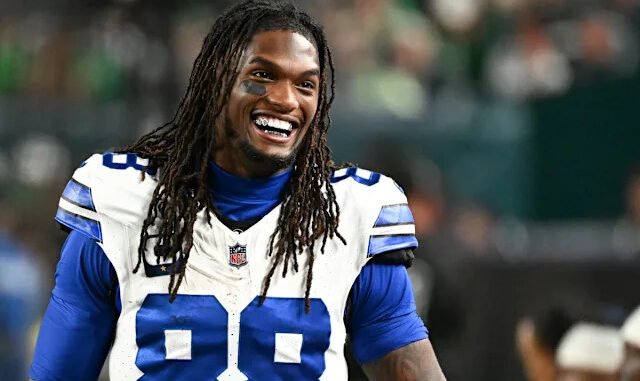
CeeDee Lamb is one of the brightest stars in the NFL — a Pro Bowl wide receiver for the Dallas Cowboys. So when he sits out or is benched, fans and analysts immediately take notice. In recent times, several incidents have raised the question: Why is CeeDee Lamb not playing? Let’s unpack the reasons — from injury to coaching decisions — and explore the implications of his absence.
1. Injury Issues: High Ankle Sprain
One of the primary reasons Lamb has “dropped off” the field is injury. In Week 3 of the 2025 season, Lamb sustained a high ankle sprain during a game against the Chicago Bears.
-
Lamb was tackled awkwardly after taking a handoff, and his ankle rolled.
-
After being evaluated by trainers, he walked to the medical tent, and later in the game he limped back to the bench.
-
Head coach Brian Schottenheimer confirmed that Lamb would miss “some time” because of the sprain.
-
According to NFL reports, Lamb is expected to be out at least two games while he recovers.
These injury setbacks provide a strong, concrete reason for why Lamb might be sitting out or not playing at full strength.
2. Bench Decision: Not Just Injury
Beyond physical injury, Lamb was benched at certain moments in games — and it wasn’t always due to health.
-
In a recent “Monday Night Football” game, Lamb (and teammate George Pickens) were absent from the opening drive, which raised eyebrows.
-
The Cowboys described the decision as a coaching call, not due to injury.
-
According to coach Schottenheimer, some “things were missed” during preparation, but he did not elaborate publicly.
-
Both Lamb and Pickens came back into the game very soon — Lamb on the first play of the second drive, and Pickens shortly after.
This suggests that at least sometimes, benching was more a disciplinary or tactical decision than a medical one.
3. Mental and Physical Strain: Impact of Sitting Out
Missing games — whether because of injury or coaching – has both mental and physical effects on a player like Lamb:
-
Lamb himself admitted that rehabbing the ankle was “tough mentally and physically.”
-
He said he feels “itching” to return and contribute, underscoring how difficult it is for a top player to be sidelined.
-
The decision to delay his return (even when he felt he might have been ready earlier) was deliberate: the training staff and Lamb prioritized stability and explosiveness.
Such caution underscores that the team is not just thinking short-term but long-term health — trading quick returns for sustained performance.
4. Performance Pressure: Drops and Criticism
When a star player is benched or sidelined, any drops or mistakes get amplified. Lamb has faced criticism over dropped passes in past games, putting extra pressure on him whenever he returns.
-
These drops have fueled fan frustration and raised questions about consistency.
-
When he does come back, it’s not just about his health — there’s also the expectation to perform flawlessly.
This kind of scrutiny can further affect a player’s mental state, making it harder to shake off the “drop” narrative.
5. Strategic Implications for the Cowboys
Lamb’s absence or limited playtime isn’t just a personal setback — it has major strategic consequences for Dallas:
-
The Cowboys clearly miss his playmaking ability. As head coach Schottenheimer noted, Lamb is a key player they chart plays around.
-
Without him, Dallas needs other skill players to step up. In his absence, George Pickens and tight end Jake Ferguson have taken on more responsibility.
-
The team’s offensive planning likely needs to be adjusted week-to-week, depending on Lamb’s availability — which could affect game flow, target distribution, and scoring potential.
6. Outlook: When Will Lamb Return?
-
According to the Cowboys, Lamb is ready to return after missing three games.
-
He emphasized the importance of being fully explosion-ready before returning, rather than just playing injured.
-
While the sprain recovery timeline is uncertain, he’s being managed week to week.
-
The fact that the team is not pushing him to return too soon suggests that they value his long-term health and want him back at full strength.
Conclusion
CeeDee Lamb’s absence from the field — whether “not playing,” being benched, sitting out, or being dropped — is a complex mix of injury, coaching decisions, and performance pressure. While his high ankle sprain is the most immediate and tangible reason, it’s not the only factor at play. The Cowboys appear to be balancing short-term needs with long-term health, and Lamb himself is committed to coming back fully ready.
For fans, there’s optimism: with his return, Dallas regains one of its most explosive weapons. For Lamb, it’s a chance to reaffirm his resilience and reclaim his role as a go-to playmaker. But until he’s back on the field at 100%, every game without him will continue to feel like a strategic gamble.