Introduction
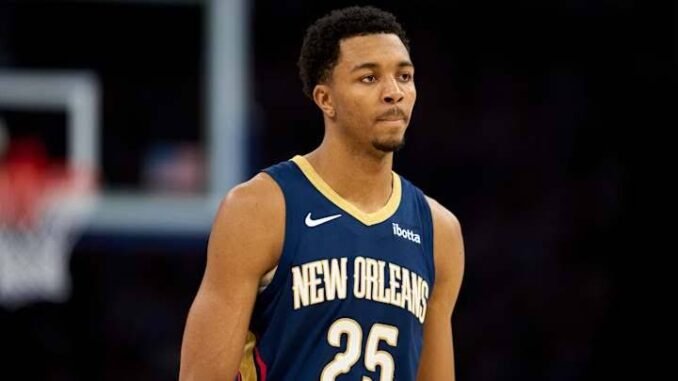
Trey Murphy III has emerged as one of the more intriguing young wings in the NBA. With a versatile skill-set, a strong three-point shot, and promising athleticism, he’s drawn attention across the league. In this in-depth article we’ll cover:
-
His contract details
-
Injury history and current status
-
Statistical breakdown
-
Defensive evaluation (Is he a good defender?)
-
His height and physical profile
If you’re interested in an up-and-coming NBA player, or tracking the roster of the New Orleans Pelicans, this article serves as your comprehensive guide.
Physical Profile & Height
Trey Murphy III stands at 6′8″ (203 cm) and weighs roughly 206 lbs (93 kg).
Such size for a wing is a notable asset: being 6-8 gives him the length to guard multiple positions, contest shots, and also employs his size in the post or on the perimeter.
That height places him in the modern “3 + stretch 4” mold: tall enough to play forward, agile enough to play wing. His build complements his shot-making and allows him to project as a two-way contributor.
Contract Details
Murphy’s contract status is a key part of his profile: the investment his team has made and how it impacts his role and expectations.
-
He signed a 4-year, US$112 million contract extension with the Pelicans in October 2024.
-
The extension carries an average annual salary of about US$28 million.
-
Breakdown:
-
2025-26: ~$25 million cap hit
-
2026-27: ~$27 million
-
2027-28: ~$29 million
-
2028-29: ~$31 million
-
-
Prior to the extension, his rookie scale contract was modest (~US$14.8 million total) built from his 2021 draft slot.
-
The size of the extension signals the Pelicans view him as a core piece for the future, not just a role player.
Why this matters: Big contract = big expectations. His role is elevated; impact (on both ends) is expected to match.
Injury History & Current Status
Health is always a critical factor for players with rising roles. Murphy has had some setbacks which need context.
-
In October 2024 he suffered a right hamstring strain during training camp, sidelining him for at least three weeks.
-
In March 2025, he suffered a season-ending right shoulder labrum tear (and partial rotator cuff involvement) during a game vs Detroit Pistons.
-
By July 2025 he was reportedly making “steady progress” in his rehab.
Implications:
-
The shoulder labrum/rotator cuff injury is serious; recovery and return to full strength are key.
-
The hamstring strain is less serious in isolation but adds to injury-concern narrative.
-
Given his upcoming role (thanks to the big extension), staying healthy will be a major factor in whether he lives up to expectations.
Stats Breakdown
Let’s dive into his numbers — both to date and projected — to evaluate his performance progression.
College & Draft
-
At University of Virginia (2020-21) he achieved a rare 50/40/90 season (50.3 FG%, 43.3 3P%, 92.7% FT) in 25 games.
-
Drafted 17th overall in 2021 by the Memphis Grizzlies, then traded to the Pelicans.
NBA Regular Season
From his NBA career so far:
-
Career averages: 13.7 points per game, 3.9 rebounds, 1.8 assists (over 251 games).
-
In 2023-24: 57 games, 23 starts, averaged ~14.8 points.
-
In 2024-25: before injury, he averaged ~21.2 points, ~5.1 rebounds, ~3.5 assists.
-
Early 2025-26 sample: 8 games, 35.5 minutes, 14.9 points, 6.4 rebounds, 3.6 assists (albeit with shooting holes)
Shooting & Efficiency
-
3-point shooting career ~38.3% (good mark for a wing).
-
Free throw shooting in college: outstanding; in NBA has dipped slightly but still above average.
-
His usage increased dramatically in 2024-25 before the injury, showing the team’s confidence in him.
Interpretation
-
The jump to ~21 points per game is significant; indicates he can handle a bigger role.
-
Rebounding and assists numbers show growth beyond “just a shooter.”
-
Shooting efficiency is solid but will need to be sustained under heavier defensive focus.
-
The limited sample (and injury cut-off) means some caution is warranted — consistency and durability still in question.
Defensive Ability — Is He a Good Defender?
One of the big questions around Murphy is whether he can deliver on the defensive end — vital for a wing expected to be a two-way player.
Strengths
-
His height (6′8″) and wingspan provide the physical tools to guard multiple positions (wings, forwards).
-
He shows the ability to move his feet, step out to switch, and contest three-point shots.
-
Approved defensive metrics: also averaged over 1 steal per game in his 2024-25 season (before injury) which shows active hands.
-
His rebounding numbers (5+ per game at his best) help on the glass, an often-undervalued defensive contribution.
Areas for Improvement
-
While his tools are there, his defensive consistency is still a question. Young players often struggle with positioning, help-defense reads, and closing out under fatigue.
-
The injury history may impact his lateral mobility or stamina, which are crucial for wing defenders.
-
Switching demands vs elite perimeter players is a different level; he needs to show he can hold up against high-end offensive wings.
-
Team defence context: his team’s defensive performance sometimes suffers; individual defence is harder to isolate without team support.
Verdict
Yes — I’d say he has the potential to be a good defender, perhaps a very good one, but he’s not yet proven at the highest level consistently. His physical profile and glimpses in limited sample size point to upside. But expectation management: he’s still young and learning.
What’s Next & Outlook
-
With a large contract and elevated role in New Orleans, Murphy’s next challenge is durability and consistency.
-
If he returns from the shoulder injury strong, 2025-26 may be a breakout season.
-
Offensively, expect him to continue taking more shots, playmaking responsibilities may increase.
-
Defensively, growth into a more reliable two-way wing will boost his value significantly.
-
For fans and fantasy players: if healthy, he could be a high-value sleeper pick given his combination of size, shooting, and improving all-around game.
FAQs
Q1: How tall is Trey Murphy III?
A: He is 6′8″ and weighs around 206 lbs.
Q2: What contract does Trey Murphy III have?
A: He signed a 4-year, US$112 million extension with the Pelicans in October 2024, averaging about US$28 million per year.
Q3: What injuries has he had?
A: He dealt with a hamstring strain in October 2024 and later suffered a right shoulder labrum tear (and partial rotator cuff injury) in March 2025 that ended his season.
Q4: What are his career stats so far?
A: Career NBA regular season average is ~13.7 points, 3.9 rebounds, 1.8 assists per game. In 2024-25 before injury he was averaging ~21.2 points, ~5.1 rebounds, ~3.5 assists.
Q5: Is Trey Murphy III a good defender?
A: He has the physical tools (length, size, mobility) and has shown positive glimpses. But he’s still developing on the defensive end — not yet elite, but with strong upside.
Q6: What type of player is he offensively?
A: He’s a forward/wing with strong shooting ability (especially from three), capable of driving, creating off the bounce, rebounding, and contributing as a secondary playmaker.
Q7: What should we watch for next season?
A: Key things will be his health and how he recovers from the shoulder injury, his consistency in shooting, his role expansion (usage rate), and his development on the defensive end in terms of switching and guarding elite wings.
Conclusion
Trey Murphy III is at a pivotal moment in his career. With size, shooting, and budding playmaking he looks like a modern wing who can impact both ends of the floor. The four-year, US$112 million contract extension signals the New Orleans Pelicans’ commitment and the expectations placed on him. His injury history raises caution flags — durability matters — but if he stays healthy, the trajectory is very promising. Defensively, he’s not yet locked in as a top-tier stopper, but the tools and glimpses are there. For fans of analytics, fantasy players, or Pelicans watchers, Murphy is one to keep a close eye on.