Introduction
When people hear Brazil vs Japan, they think of two very different footballing worlds colliding. One is the legendary Brazil national football team, often called simply Brazil, a powerhouse in global football. The other is Japan, increasingly respected, disciplined, tactically smart, and no longer content to just learn—they want to win. A recent friendly match showed just how much the gap is narrowing.
In this article, we explore the rivalry between Japan vs Brazil from multiple angles: history, culture, recent matches, tactics, and what the future could hold. Along the way we’ll use plenty of key phrases like Brazil national team, Brazil soccer, Brazil vs Japan, Brasil vs Japan, and more, to make sure this reads strong, deep, and SEO-optimised.
Brazil: The Myth, The Magic, The Legacy
The story of the Brazil national team is one of almost mythical prominence. Brazil has won the FIFA World Cup five times — 1958, 1962, 1970, 1994, and 2002 — more than any other country. Brazil has played in every World Cup finals tournament since its inception; never missing out.
Brazil soccer is known for flair, creativity, individual brilliance, technical skills, dribbling, attacking prowess, and an almost poetic way of embracing the unpredictable. Players like Pelé, Garrincha, Romário, Ronaldo, Ronaldinho, Neymar — all carried Brazil’s brand on the global stage. Their style is as much about joyous improvisation as about winning.
But like all legends, the Brazil national football team has had moments of struggle, moments of expectation not met, and—as recent matches suggest—challenges from outside their traditional stronger rivals. One area where that is becoming visible is in Asia, and specifically Japan.
Japan’s Rise: Discipline, Growth & Tactical Maturity
Japan’s football story is perhaps less romantic but equally compelling: a nation that has invested in youth, infrastructure, coaching, and discipline. Over recent decades, Japan has moved from being an underdog in Asia to being a regular in World Cups, doing well in continental tournaments, and showing that Japan vs Brazil matches are no longer mere exhibitions—they’re real tests.
Japan’s strengths are organization, work ethic, teamwork, tactical flexibility, and mental toughness. While Brazil often relies on individual moments of magic, Japan tends to do the fundamentals well—defense, pressing, transition, fitness, and structure. Those attributes make Brazil vs Japan games increasingly tense and unpredictable.
Head to Head: Brazil vs Japan & Japan vs Brazil
Historically, Brazil has dominated in head-to-head meetings. But there have been signs of change, especially in recent years. Let’s look at what the record says and why the recent match truly marks a turning point.
-
Before the most recent match, Japan had never beaten Brazil in men’s senior international football. Draws and losses were common.
-
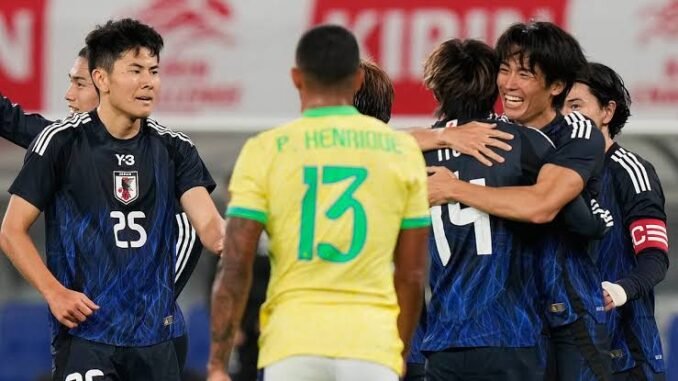
On 14 October 2025, in a friendly at Tokyo Stadium, Japan made history by defeating Brazil 3-2 — their first ever win over Brazil in 14 meetings. Brazil had gone up 2-0 in the first half via goals from Paulo Henrique and Gabriel Martinelli. Japan came back after halftime, with Takumi Minamino scoring in the 52nd minute, an own goal by Fabricio Bruno tying the game, and finally Ayase Ueda heading in the winner from a corner.
-
Japan’s comeback was built on Brazilian defensive errors, but also on Japan’s persistence, substitute impact (Junya Ito’s corner leading to Ueda’s goal), and mental resilience.
This result matters: Japan vs Brazil is no longer symbolic; it’s competitive. It shows that Brazil too can be vulnerable—especially in matches where complacency or lack of focus sets in.
The Most Recent Match: Japan’s Breakthrough
The Japan vs Brazil game on 14 October 2025 is worth digging into:
-
First half: Brazil dominated, taking a 2-0 lead. Japan looked out of sorts, unable to unlock Brazil’s defense, conceding on two well executed attacks.
-
Second half: Japan came out with more energy, looked sharper, forced key errors. Minamino capitalized on a defensive mishap; then an own goal and finally Ueda’s header from a corner sealed it.
-
Tactical notes: Brazil had been rotating their squad under coach Carlo Ancelotti. After the match, Ancelotti emphasized mental resilience, saying that despite Brazil’s strengths, their concentration lapsed.
For Japan, this win is a huge boost. Their confidence, self-belief, and proof that their systems work at the highest level. For Brazil, it’s a warning: traditional strength may no longer guarantee results.
Brazil National Team Today: Strengths & Vulnerabilities
To understand Brazil vs Japan fully, one needs to understand where Brazil stands now. What are their strengths, and what edges are Japan exploiting?
Strengths:
-
Depth of Talent: Brazil has a vast pool of skilled players in global club football — from Europe’s top leagues to South America. Players like Vinícius Júnior, Casemiro, Gabriel Martinelli, Bruno Guimarães bring quality.
-
Attacking Flair & Individual Brilliance: Brazil’s ability to create moments of magic is still unmatched. A quick counter, a dribble, a surprising pass — these are part of their identity.
-
Experience & Big-Match Pedigree: Winning five World Cups, numerous Copa Américas, and performing in big tournaments lends Brazil knowledge of how to handle pressure.
Vulnerabilities:
-
Defensive Fragility & Concentration Lapses: As seen in the recent match vs Japan, defensive errors at crucial moments can undo lead.
-
Over-reliance on individual brilliance: When that spark is missing, Brazil sometimes lacks alternative strategies.
-
Mental Resilience under Pressure: Losing control, losing concentration, or being complacent are dangers when expectations are high. Japan exploited that.
-
Tactical Rigidity at Times: Against well organized sides (Japan today, or others like European, Asian, or African teams) Brazil sometimes struggles to adapt quickly.
What Japan Does Differently: The Brasil vs Japan Dynamic
“Brasil vs Japan” (using the Portuguese “Brasil” emphasizes the Brazilian side of the matchup) reveals what Japan is doing right:
-
Preparation and Discipline: Japan often studies opponents deeply, preparing tactical schemes to counter Brazilian strengths.
-
Physical and Mental Fitness: Pressing, running, staying organized, especially when trailing—these are key traits.
-
Smart Use of Substitutes & Momentum: Japan was able to shift the momentum in the second half, using players like Junya Ito.
-
Set Pieces and Exploiting Errors: The equaliser via own goal, and the winner via a corner—it shows attention to detail.
This is no longer just about facing Brazil with respect; it’s about believing you can beat them, and preparing to do so.
Broader Trends: Asia vs South America, Changing Power Balance
The Brazil vs rest of the world narrative is changing. Several Asian teams are putting in highly competitive performances. Japan, South Korea, and others are investing heavily in youth, infrastructure, foreign coaching, analytics, and putting players in top leagues abroad.
In turn, Brazil is facing challenges: more travel, more competitive calendars, adaptation requirements, and rising expectations. With Brazil national team coaches coming under more scrutiny (e.g. Ancelotti calling for mental resilience), every match vs an opponent like Japan becomes more than just a friendly—it’s a test.
Implications for Future Matches & Global Tournaments
Given what we’ve seen in Japan vs Brazil, what should both sides think about going forward — in World Cups, in friendlies, in continental tournaments?
-
Brazil must address lapses in defense and mental focus. They cannot assume dominance; they must prepare for Japan’s tactical setups and resilience.
-
Japan will gain confidence and might continue to bridge the gap, particularly if key players keep improving, and if their domestic leagues and youth systems keep feeding talent.
-
For the global audience, Japan’s rise adds intrigue. Matches like Brazil vs Japan are becoming less predictable, more balanced, and more exciting.
-
Coaches will need to adjust: Brazil to avoid complacency; Japan to maintain momentum and consistency at a high level.
Historical Context: Brazil vs Japan Matches Before the Breakthrough
It helps to understand how extraordinary Japan’s win is by looking back:
-
Previously, Brazil had never lost to Japan in senior men’s matches. The results were heavily in Brazil’s favor: wins, draws.
-
Japan’s style and capability have improved gradually—there were draws and occasional good performances, but not wins.
-
The infrastructure in Japan (J-League, youth football, exposure to foreign leagues) has played a long game.
Conclusion
The phrase Brazil vs Japan once evoked the certainty of Brazilian dominance, the flair of South American football, and the underdog aura of Asia. But after Japan’s first ever win, that certainty has shifted. Japan vs Brazil is now a rivalry in the making—one that asks questions of Brazil’s continued supremacy and celebrates Japan’s ascension in world football.
For fans of Brazil soccer, this is a moment to reflect, adapt, and strive for renewal. For those supporting Japan, it’s confirmation that belief, hard work, and tactical discipline can topple giants. And for the wider football world, it’s a narrative change — football continues to grow more global, more competitive, and more unpredictable.