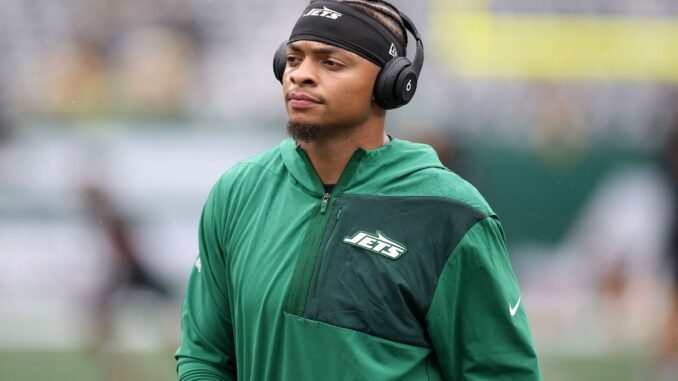
Justin Fields’ NFL journey has been defined by his dual-threat capabilities, flashes of high upside, and ongoing questions about consistency and health. As he prepares to lead the Jets in 2025, here’s a deep dive into the key metrics and narratives around interceptions, injury status, salary, future projections, and rushing touchdowns.
Interceptions: Trends, Rates & Context
Career Interception Profile
One of the more persistent critiques of Fields’ passing game has been his turnover propensity. Over his NFL career, he has thrown 31 interceptions (in passing) to accompany 49 passing touchdowns. That interception count reflects both aggressive decision-making and developmental volatility.
As for his interception rate, StatMuse tracks that Fields has had roughly 2.5–2.7% of his passes intercepted over his career. That roughly means that for every 100 pass attempts, 2.5 to 2.7 might be picked off — not an elite rate, but not catastrophic either for a quarterback with his rushing profile.
2025 & Recent Season Insights
In 2025 so far, Fields has not thrown an interception. That gives him an interception percentage of 0.0% for the year to date. While that is a small sample size, it is a positive signal for decision-making and ball security.
In 2024, during his six starts for the Steelers, Fields threw just 1 interception across 161 pass attempts. That is an encouraging rate (roughly 0.6%) for a quarterback who loves to extend plays.
His touchdown-to-interception ratio this year (4 TDs to 0 INTs) stands out in contrast to earlier seasons. In the past, that ratio has been more modest; for example, in his rookie year (2021) he threw 7 touchdowns and 10 interceptions.
Thus, the trend suggests Fields is gradually learning to temper riskier throws, especially in an offense that may be design-oriented to protect him.
Factors Behind Interception Trends
-
Scheme and play calling – If the Jets’ offense leans more on short passing, play-action, and rollout designs, Fields can reduce exposure to tight windows.
-
Receiver chemistry & reads – The comfort level with target receivers (especially Garrett Wilson, whom he knows from Ohio State) may improve his decision-making.
-
Pressure & pass rush – When under duress, Fields has sometimes forced throws. Better pass protection and quicker progressions help limit that.
-
Maturation curve – As he accumulates experience, he may learn to accept fewer flash plays and favor safer reads.
If Fields continues to cut his interception rate while maintaining his rushing upside, he becomes far more viable as a long-term starter.
Is He Hurt? Injury Status and Durability
Injury history and current health are vital when evaluating a quarterback whose value heavily depends on mobility and legs.
Recent Injury Issues: 2025 Camp & Training
During 2025 training camp, Fields suffered a dislocated toe in his right foot. He was carted off the field, though subsequent evaluations suggested the injury was not as severe as initially feared. He participated in individual drills (rollouts, throws) even while limited in full team drills.
The Jets have listed his status as “day-to-day,” and he avoided longer-term absence in camp.
Concussion & In-Season Issues
In the 2025 regular season, Fields has dealt with a concussion issue. That led to him entering and clearing the NFL’s concussion protocol, missing at least one game. Such injuries are tricky, not just in severity but in long-term effects, especially for a mobile quarterback reliant on burst and agility.
Historically, in his time with Chicago and Pittsburgh, Fields has endured groin strains, AC joint issues, and other soft tissue injuries. His body, particularly under repeated rolling or scrambling, is always at risk.
Durability Outlook & Concerns
-
Injury proneness due to playstyle — Because Fields scrambles often and is asked to extend plays, he is more exposed to hits than a pure pocket passer.
-
Recovery and conditioning — Modern strength/conditioning training and monitoring may mitigate wear, but soft tissue management is critical.
-
Missed time risk — Even small injuries (toe, ankle, groin) can sap his mobility for several weeks.
In sum, while there’s no indication of a season-ending injury at present, health remains a question mark given his playing style.
Salary: Contract, Guarantees & Cap Hit
Fields’ contract and salary structure are often under-discussed but crucial for roster decisions and long-term team-building.
The Deal with the Jets
In March 2025, Fields signed a two-year, $40 million contract with the New York Jets. Of that, $30 million is guaranteed, including a $15 million signing bonus.
-
Average annual salary: $20 million
-
2025 cap hit: $8 million
-
2025 base salary: $5 million
-
Dead cap (if cut): $30 million (if cut after 2025)
-
In 2026, his cap hit is projected to be $23 million.
Over the Cap confirms the same structure and guarantees.
Context and Evaluation of the Contract
-
The contract positions Fields as a “bridge starter” rather than a long-term lock, giving the Jets flexibility.
-
Some analysts have criticized the deal’s structure and potential risk to the Jets, calling it perhaps one of the weaker QB contracts given the $30M dead cap exposure.
-
That said, the level of guarantee ($30M) shows the Jets’ commitment in the short term.
-
The team’s front office has publicly confirmed Fields as the starter, reinforcing their financial investment.
Fields’ contract is not among the league’s elite QB deals, but it does carry weight and risk, especially if performance is inconsistent or injuries crop up.
Projections: What to Expect in 2025 & Beyond
Forecasting a dual-threat quarterback like Fields is tricky — his upside is tied heavily to ground production, but passing consistency matters. Here are projections, models, and expert forecasts.
Team Jets: Run-Heavy Projection
JetsXFactor offers a bold projection for Fields’ rushing workload in 2025:
-
180 attempts, 1,080 rushing yards, 8 rushing touchdowns (6.0 yards per carry)
-
In that same projection, they envision him as a centerpiece in a dominant run offense.
That projection would be a major leap in rushing volume (approaching his 2022 career-best) and suggests a high dependency on his legs.
Fantasy & Statistical Projections
-
Razzball projects per-game stats: ~ 48 rushing yards and ~ 0.47 rushing touchdowns in a typical game scenario.
-
ProFootballNetwork expects Fields to throw ~0.6 interceptions in a given week, ~153 passing yards, ~0.9 passing TDs, plus ~48 rushing yards and ~0.4 rushing TDs.
-
StatMuse projection: In a specific matchup, Fields could average ~202 passing yards, ~0.9 passing TD, ~53 rushing yards, ~0.4 rushing TDs.
-
Bleachernation recaps his 2024 line: 1,106 passing yards, 5 passing touchdowns, one interception, and 62 rush attempts for 289 yards and 5 rushing touchdowns.
From these, one aggregate 2025 projection might be:
-
~ 3,000 passing yards
-
~ 18–22 passing touchdowns
-
~ 6–9 interceptions
-
~ 600–1,100 rushing yards (if healthy and workload is high)
-
~ 6–10 rushing touchdowns
Such a line would make him a top-tier fantasy QB and a legitimate starting option in the league — conditional on passing consistency and health.
Expert Opinions & Bold Takes
-
ProFootballNetwork sees Fields averaging ~54.9 rushing yards/game as a starter.
-
Some fantasy analysts believe Fields can finish as a top-5 fantasy QB in 2025, counting on his rushing floor.
-
Others caution that his pass game still lacks Big Time throws and deep-ball consistency.
-
In expert projections (e.g. ESPN’s Mike Clay), Fields’ statistical forecast is more muted, reflecting caution around volume and passing ceiling.
The variance is wide: a “good” projection has him as a fringe top-10 starter; a “breakout” projection puts him in MVP conversation. But the latter depends heavily on protecting his body and reducing turnovers.
Rushing Touchdowns: His Key Edge
One of the most exciting aspects of Fields’ game is his capacity to score on the ground. Let’s examine his historical rushing TDs and what might be next.
Rushing TDs: Past Performance
-
In 2022, Fields rushed for 8 touchdowns, which remains his career high.
-
In 2023, his rushing production declined, but he still added some ground TDs in limited opportunities.
-
In 2024, for Pittsburgh, Fields had 5 rushing touchdowns over his starts (62 carries)
-
In the early part of 2025, he has accounted for 3 rushing touchdowns in limited sample games.
Thus, his rushing TD rate historically has ranged between ~5 and 8 in full seasons, though that depended heavily on usage and health.
What Could Shift in 2025?
-
Increased usage in red zone — If Jets scheme more QB keeps and option runs near the goal line, Fields could see more rushing TDs.
-
Play design & read options — If offensive design encourages Fields to choose running lanes when openings emerge, his rushing TDs may tick upward.
-
Health & durability — Injuries or wear could reduce his explosiveness near the goal line, curbing his ability to punch in ground scores.
-
Competition for touches — If run backs or other QB-designed runs compete, his share may be limited in some games.
Given the projections (e.g. JetsXFactor expecting 8 rushing TDs) and his historical ceiling, it’s reasonable to expect 5–9 rushing touchdowns in a healthy full season — assuming he remains a focal point of the offense.
Summary & Outlook
Justin Fields in 2025 is a high-upside, high-variance player. His greatest strengths come from his rushing ability, which gives him a rare floor few other quarterbacks match. Yet his long-term success hinges on mitigating interceptions, staying healthy, and evolving his passing game.
-
Interceptions: So far in 2025, Fields is off to his cleanest start, showing a maturing decision profile.
-
Health: The recent toe injury and concussion are concerns, but nothing currently seems catastrophic — durability will be a fluid narrative.
-
Salary: His 2-year, $40M deal with $30M guaranteed shows the Jets’ commitment but also carries financial risk.
-
Projections: Conservative lines place him as a borderline top-10 QB; aggressive lines see him as a fantasy monster and viable starter.
-
Rushing TDs: Historically between 5–8 in healthy seasons; 2025 could push toward the upper end of that range if usage is maximized.