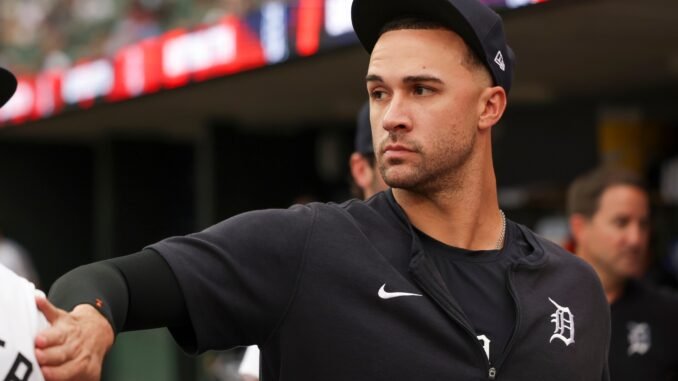
Jack Flaherty has never been the flashiest pitcher in Major League Baseball, but he is one of the most compelling. Over the years, he has carved a reputation not only as a strikeout artist but also as a thoughtful, often introspective figure whose actions sometimes speak louder than words. From moments of self-talk on the mound to his evolving public stance on social issues, from bullpen routines to high-stakes trade deadlines, Flaherty’s career is full of intriguing narratives. This article delves into five major threads: how he “talks to himself,” his private life (including partner/wife speculation), his tenure with the Dodgers, his voice on racial justice, and the trades that have defined his journey.
“Talking to Himself”: The Inner Voice on the Mound
One of the most captivating aspects of Jack Flaherty’s style is the quiet internal monologue—or what could be described as “talking to himself”—that surfaces during games. Observers and broadcasters often catch glimpses of him muttering under his breath after a pitch or during mound visits. Those moments are usually brief and inconspicuous, but they reveal an inner process of self-correction, recalibration, or calm reinforcement.
The Mound Rituals
Flaherty’s mound presence is deliberate. He often pauses between pitches, slowly surveys the catcher’s signs, takes a deep breath, sometimes glances upward, and mutters a few syllables to himself. This behavior isn’t unique to him—many pitchers have some kind of verbal self-cue—but for Flaherty, it feels more introspective than reactive. It appears he is constantly coaching himself, massaging his mechanics, re-centering his focus, or reminding himself of approach.
In interviews, he is typically reserved about this habit, not making a spectacle of it. Still, teammates and announcers have remarked that Flaherty’s internal dialog helps him recover after a mistake, stay locked in, and maintain composure. In high-leverage innings, this kind of mental self-soothing becomes crucial.
The Psychology of Self-Talk in Elite Athletes
Sports psychologists often discuss self-talk as a technique performers use to manage anxiety, reinforce positive habits, and block out distractions. What separates great self-talk from destructive chatter is its tone: supportive, process-focused, nonjudgmental. Flaherty seems to embody that balance. Rather than harsh rebuke, he seems to employ micro-adjustments, soft cues, and calm reinforcement.
In several postgame interviews, he has acknowledged the mental aspect of pitching repeatedly—that every inning demands a reset, regardless of how the previous frame went. That internal feedback loop, audible or inaudible, is part of how he stays consistent when the stakes are high.
Wife / Partner / Private Life
Flaherty is intensely private. Unlike many professional athletes, he has not prominently publicized a spouse or elaborate personal narrative. Nonetheless, curiosity persists, and some details are publicly known, even if modest.
Relationship Speculation: Natalie Buffett
Media outlets occasionally mention that Flaherty has dated Natalie Buffett, though neither party has confirmed a formal marriage or public “wife” designation. Some articles refer to her as a girlfriend, and their relationship is kept out of the limelight.
Because he keeps his personal life low-key, there is little verifiable information about how he balances family life, relationships, and the demands of a traveling MLB career. That discretion likely serves dual purposes: protecting loved ones from media scrutiny and allowing him to maintain mental focus without excessive public attention.
The Value of Privacy
For many high-profile athletes, publicizing romantic or family life introduces distractions, pressure, and unwanted scrutiny. Flaherty’s decision to remain guarded may be strategic. It aligns with his personality: introspective, disciplined, and focused on performance over personality. By drawing boundaries around personal matters, he protects his mental space.
That said, off-the-field stability can be critical in an athlete’s longevity. Whether Flaherty’s partner (if formalized) provides quiet emotional anchoring or simple normalcy, one can suppose it contributes to his ability to recharge when off the mound.
The Dodgers Chapter: A Homecoming With High Stakes
Perhaps the most dramatic and promising chapter in Flaherty’s career came in 2024, when he was traded midseason to the Los Angeles Dodgers, returning to his Southern California roots. The Dodgers, historically one of baseball’s most storied franchises, added Flaherty as a rotation boost during a postseason push.
The 2024 Trade: Context and Expectations
Heading into the trade deadline, the Dodgers were facing rotation depth concerns. Flaherty had revived his form with the Detroit Tigers, posting a 2.95 ERA over 18 starts. Detroit was willing to deal him, in part because he was on a one-year contract and the Tigers had a more modest win outlook.
The Dodgers acquired Flaherty in exchange for minor league prospects Thayron Liranzo and Trey Sweeney. Analysts graded the trade favorably, giving it an A for both clubs due to the circumstances.
Performance in Blue
Once in Los Angeles, Flaherty made 10 starts, going 6–2 with a 3.58 ERA and 61 strikeouts. While that ERA was higher than his pre-trade average, he stabilized the rotation and gave the Dodgers a postseason-capable arm.
In the postseason, he had mixed results. In the NLDS, he allowed four runs in a loss, then rebounded in the NLCS with a strong outing. In the World Series, he began Game 1 strongly, blanking the Yankees for five innings, though he allowed a two-run homer in the sixth. His second World Series start was less effective, but the Dodgers rallied to win the series.
Thus, while he did not dominate every outing, his presence added depth, especially in postseason planning. The move was a kind of homecoming: his high school was in Los Angeles, about fifteen miles from Dodger Stadium.
The Aftermath
Following the 2024 season, Flaherty entered free agency. The Dodgers declined to re-sign him, instead letting him hit the open market. Although some reports suggested mutual interest in a return to Los Angeles, Flaherty ultimately re-signed with Detroit on a two-year, $35 million contract with an opt-out after the first year.
The Dodgers move helped them clinch a 2024 World Series, making Flaherty a part of that championship rotation—even if only for half a season.
On Race, Social Justice & the “Black” Dialogue
Your title includes “Black,” so it’s important to examine how Flaherty has engaged with issues of race, social justice, and public commentary. While he is not Black himself, he has spoken out on matters of systemic racism during pivotal moments.
The George Floyd Moment and Beyond
In the aftermath of George Floyd’s killing in 2020, many athletes used their platforms to express solidarity and demand systemic change. Flaherty participated in that conversation, posting a nuanced statement on social media that “castigated and defended the police, touched on racial injustices, and pleaded with his fellow citizens to ‘educate yourself, to have a better understanding.’”
His comments reflected a cautious but earnest belief: that progress must come through dialogue, self-education, and empathy. He did not adopt radically polarizing rhetoric. Instead, he pushed for honest conversations—especially in spheres where many would avoid them.
Over time, he has continued to engage. While not vocally activist in every season, his willingness to speak when it matters reflects how he sees his role: not just as an athlete, but as a citizen and public figure. In many ways, that matches his on-field persona: consistent, reflective, and conscientious.
Amplifying Voices, Not Capturing Spotlight
What’s interesting is that Flaherty rarely tries to make himself the center of social advocacy—instead, he elevates the experience of others. By stepping cautiously yet sincerely into dialogue, he shows respect for those experiencing inequality. That restraint is both a strength and a vulnerability: it allows him to avoid performative statements, but it also means his voice sometimes fades in louder public debates.
In team settings, clubhouse settings, and through smaller gestures, his stance—privately consistent—can matter even more than a headline tweet. The fact that he was willing to weigh in publicly during a fraught national moment suggests moral conviction and maturity.
Trades That Mattered: From Cardinals to Detroit to Dodgers … and Back
Jack Flaherty’s career is bookended by notable trades and transactions that shaped not only his path but also the fortunes of several MLB franchises.
Early Years: Cardinals Roots
Flaherty was drafted by the St. Louis Cardinals in the first round in 2014, out of high school in Southern California. He steadily worked through the minors, making his MLB debut in September 2017. Over multiple seasons, he established himself as a frontline arm in the Cardinals’ rotation.
Eventually, the Cardinals’ patience and payroll constraints led to friction; by 2023, Flaherty was traded to the Baltimore Orioles midseason along with minor league compensation. That trade, though underwhelming in performance, was a pivot point—it shook up expectations, allowed Flaherty to recalibrate, and set the stage for later resurgence.
Tigers Signing, Trade, and Return
After 2023, Flaherty signed a one-year contract with the Detroit Tigers worth $14 million. He responded with one of his best stretches—posting a 2.95 ERA over 18 starts, striking out 133, and reestablishing his elite control metrics. That performance made him a trade target.
Mid-2024, he was sent to the Dodgers for prospects Thayron Liranzo and Trey Sweeney. The Tigers, in turn, benefited: Sweeney played early in Detroit, and Liranzo became a top catching prospect in the system. In hindsight, analysts continue to grade the trade highly for both sides.
After the 2024 season, rather than re-signing with the Dodgers, Flaherty accepted a two-year, $35 million deal to return to Detroit, adding an opt-out clause after year one.
Interestingly, he met the very prospects he was traded for during spring training, and the Tigers ribbed him good-naturedly about being “the gift that keeps on giving.”
Evaluating the Trades
What stands out is that these moves weren’t just about swapping players—they were narrative pivots. When he left St. Louis, it felt like a reset. The Tigers signing gave him a platform to resurrect his form. The Dodgers trade offered a high-profile stage to prove his postseason value. And his return to Detroit suggests an alignment with an organization that trusts him long-term, rather than a transient rental.
From the trade perspective, Flaherty has been the kind of player whose value fluctuates with performance and health. Teams are willing to deal for him when in demand, and cautious when injury risk looms. His own agency in deciding to return to Detroit—rather than chasing a big-market rebound—signals maturity and strategic perspective.
Looking Ahead: What’s Next for Flaherty?
At this crossroads, several key questions shape Flaherty’s near future:
-
Durability and health: Like many power arms, staying healthy remains the greatest challenge. His back has been a concern in previous seasons, and avoiding injuries will be crucial to fulfilling his multi-year contract.
-
Consistency in high leverage: He’s delivered brilliant starts and stumbled under pressure. The next step is stringing together consistent performances in big games.
-
Voice and leadership: As he matures, his internal self-talk, his quiet advocacy, and his off-field presence may merge into a more visible leadership role, perhaps mentoring younger pitchers.
-
Contract and market dynamics: The opt-out clause in his Detroit deal gives him flexibility. If he dominates in 2025, he could be looking at big returns—or a possible return to Los Angeles or another contender.
-
Legacy beyond the mound: His stance on social justice, discreet personal life, and introspective style shape his off-field identity. That balance—athlete, private citizen, thoughtful voice—could define how he is remembered.