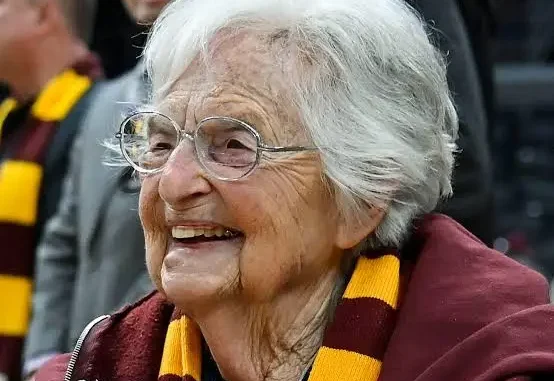
1. Introduction: A Life Remembered
On October 9, 2025, the world lost a singular figure whose spirit transcended basketball courts and university lecture halls — Sister Jean Dolores Schmidt, affectionately known to millions simply as Sister Jean. At age 106, she passed away after a life of devotion, service, mentorship, and public inspiration. Her name is deeply intertwined with Loyola University Chicago, her community work, and that unforgettable underdog run in the NCAA Tournament that turned her into a sports-world sensation.
This article explores her full story — from her early life as Dolores Schmidt to the years she became a beloved icon, her relationships with students and athletes, her retirement, and the enduring legacy she leaves behind.
2. Early Years: Dolores Bertha Schmidt’s Calling
Sister Jean was born Dolores Bertha Schmidt on August 21, 1919, in San Francisco, California.
Raised in a devout Catholic household in the Castro District, she showed early spiritual leanings and an affinity for learning. In third grade, she encountered a nun-teacher who became her role model — an encounter that planted the seed of her lifelong vocation.
At age 18, she entered the Sisters of Charity of the Blessed Virgin Mary (BVM) in 1937, taking her vows and the religious name Jean Dolores.
Her academic path included a B.A. from Mount St. Mary’s College (Los Angeles) and an M.A. from Loyola University of Los Angeles (now Loyola Marymount) in 1961.
From her early years, teaching and community were her calling — she taught in California, coached girls’ basketball, and embraced roles that combined faith and education.
3. Journey to Loyola: Education, Faith, and Service
In 1961, Sister Jean relocated to Chicago, joining Mundelein College, an all-women Catholic institution.
Mundelein later merged with Loyola University Chicago around 1991, which brought Sister Jean formally into Loyola’s fold.
Over decades, she served in multiple roles: teacher, administrator, spiritual mentor, campus minister, and more. Her commitment to students, her humility, and her approachability made her a pillar of the Loyola community.
She also engaged with social causes — in the 1960s, for instance, she was active in civil rights efforts.
Through the decades, she became ever more embedded in Loyola life — praying with students, hosting conversations, building programs, and embodying the motto “Worship, Work, Win” (which became associated with her legacy).
4. Becoming “Sister Jean” and Her Loyola Legacy
Although she was always Sister Jean in religious life, her association with Loyola’s men’s basketball program gave her a new public identity. In 1994, at age 75, she officially became academic adviser to the team, helping athletes maintain eligibility and balance academics.
Two years later, she was named the chaplain of the men’s basketball team.
In that role, she combined spiritual guidance with moral support. She would pray before games, talk to players, send personalized notes, and sometimes even offer scouting insights disguised as prayer.
She was more than a mascot or sideline figure — she was a mentor, counselor, and spiritual anchor for the team and for countless Loyola students. Her office, open door, and presence on campus made her a daily presence to many.
In 2017, she was inducted into Loyola’s Athletics Hall of Fame, cementing her place in sports as well as university history.
5. The March Madness Icon: 2018 and Beyond
Sister Jean catapulted into the national spotlight during Loyola Chicago’s Cinderella — and now-legendary — run to the Final Four in the 2018 NCAA Tournament. The Ramblers, seeded 11th, stunned opponents and captured hearts across America.
Throughout the tournament, she was ever-present: wearing maroon and gold scarves, praying pregame, greeting fans, giving interviews, and becoming a viral sensation.
A press conference was held specifically for her at the Final Four — a media event as if she were the star athlete herself.
As Loyola’s Cinderella story unfolded — with upset wins over Miami, Tennessee, and others — Sister Jean’s presence became emblematic of faith, hope, and underdog spirit.
Even after 2018, she remained an active and visible symbol in subsequent Loyola tournament runs (2021, 2022), sometimes adapting to health or safety concerns (e.g. attending from stands during COVID).
Her résumé as a sports celebrity includes bobbleheads made in her likeness, merchandise, and even LEGO statues.
But beyond the spectacle, her deeper influence was rooted in the way she connected tradition, faith, and youthful energy on and off court.
6. Connection with the Cubs: A Chicago Love Affair
Though best known for her association with Loyola basketball, Sister Jean also shared a moment with Chicago’s beloved baseball team, the Cubs. In one public appearance, she threw out a ceremonial first pitch at a Cubs game, symbolizing her integration into Chicago’s broader sports culture.
That moment was more than a publicity event — it represented how beloved she was as a Chicago icon, transcending one sport or institution. The Cubs pitch was a gesture of mutual respect: a venerable nun with a deep connection to Chicago’s athletic and spiritual life.
Although her main domain was Loyola and college basketball, her fans extended across Chicago. Her pitch at a Cubs game remains a small but telling instance of how her goodwill reached beyond campus.
7. Mentoring the Young: Faith, Advice, and Inspiration
One of the enduring legacies of Sister Jean was her genuine and heartfelt connection with young people — especially Loyola students and athletes.
She often spoke of how working with youth kept her heart young. In media interviews, she would say that although her body aged, being around energetic minds and hearts kept her spirit alive.
Her daily rituals included greeting students, listening to their worries, offering prayer groups in residence halls, and encouraging dialogue. Many students reported she would stop mid-walk to chat with someone sitting alone in the cafeteria — simple moments that meant a lot.
She also led Loyola’s SMILE program (Students Moving Into the Lives of the Elderly), which paired students with senior residents in nearby retirement communities. This intergenerational initiative reflected her mission to bridge gaps, share wisdom, and create community.
Her correspondence with players was also personal and consistent. After games, she would send emails or notes with encouragement, observations, and spiritual solace.
She believed in each student’s unique purpose: “Use the talents God has given you,” she would say, “and live your life authentically.”
Through her example, Sister Jean taught that age is no barrier to influence, and that service, empathy, and listening are as critical as grand gestures.
8. Retirement: Stepping Back After a Lifetime of Service
By late 2025, after decades of ministry and public life, Sister Jean’s health began to constrain her physical presence. In September 2025, she officially retired from her campus duties at Loyola, citing health concerns and the inability to remain physically present.
Her absence had already been noted earlier in the spring: she missed the NIT semifinal appearance and other basketball events.
Loyola’s president, Mark C. Reed, assured that although Sister Jean would no longer appear in person, her role as spiritual advisor and beloved figure would endure.
She had sustained health setbacks including a fall from her wheelchair in spring and other illnesses, prompting her to rest and recover.
Even in retirement, she expressed hope of returning should health permit. Yet it was clear that she had shifted from active campus presence to a more spiritual, behind-the-scenes role.
Retirement for Sister Jean was not abandonment, but a change of modality — from daily physical presence to prayerful support and legacy-building.
9. Death and Legacy: October 9, 2025
On October 9, 2025, Sister Jean passed away peacefully at 106 years old.
The university, students, alumni, civic leaders, and sports fans expressed deep sorrow. Loyola University Chicago said it “greatly saddened” by the loss of someone who touched “the lives of so many people.”
Her funeral arrangements and celebrations of life were to be announced by Loyola.
Authorities and community leaders praised her as a beacon of hope, a woman of prayer, integrity, and compassion.
Her passing marks the end of an era, but her spirit lives on through the many she mentored, the values she championed, and the bridge she built between faith and popular culture.
10. Why Sister Jean Endures as a Symbol
Why does Sister Jean’s name continue to resonate? Several key themes explain her lasting power:
10.1 The Intersection of Faith and Popular Culture
She showed that a humble nun could find relevance in modern American sports — praying with a basketball team, attending tournaments, and embracing media attention. That fusion was rare and deeply inspiring.
10.2 The Underdog Narrative
Her rise to fame came during Loyola’s Cinderella story. The underdog wins, the faith undergirds it — it’s a narrative that appeals strongly to human hearts. In that narrative, Sister Jean was both guide and symbol.
10.3 Authentic Humanity across Generations
She did not lecture from a pedestal. She listened, laughed, interceded, and joined students in their joys and struggles. Her authenticity made her relatable to young and old alike.
10.4 Longevity of Service
Few live to 106, but even fewer are active and relevant until then. Her long service imbued her persona with wisdom, continuity, and depth. She was a living link between many generations.
10.5 Local and Broad Roots
While champion of Loyola and Chicago, she also maintained a sense of global and spiritual mission. Her work transcended institutional boundaries, making her a bridge between faith, education, sports, and community.
Because of these qualities, Sister Jean is not just remembered as a quirky sports figure, but as an exemplar of grace, service, and human connection.
11. Conclusion
The life of Sister Jean Dolores Schmidt — born Dolores Schmidt, called Sister Jean — will be remembered for many reasons: her deep faith, her embrace of youth, her contributions to Loyola, her moment in the spotlight, her ties to Chicago sports (including the Cubs), her retirement after a stellar life of service, and her dignified exit from this world.
Her death on October 9, 2025, marked the end of a chapter, but the story continues in the lives she touched. She taught that age is not a barrier to influence, that service transcends institutions, and that love is the greatest legacy.
As Loyola and the broader community mourn her passing, they also celebrate what she stood for — spiritual strength, empathy, hope, and an unwavering belief in human potential. Sister Jean may have left this world, but her example remains alive in minds, hearts, and in every student who strives, prays, and dreams.