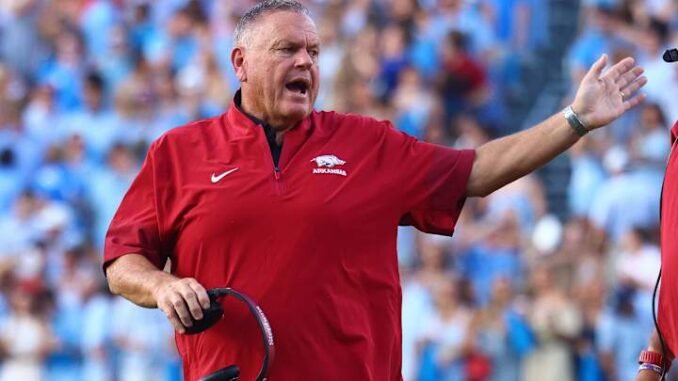
College football in the SEC is nothing if not high stakes — and for Arkansas head coach Sam Pittman, recent developments suggest he’s treading dangerous ground. In this deep dive, we explore the takeaways from his latest press conference, his record at Arkansas, the mounting speculation over whether he will be fired, and what a buyout might look like.
1. Introduction: A Tumultuous Moment in Fayetteville
Arkansas fans and college football observers were treated to a sobering press conference after a crushing 56–13 home loss to Notre Dame. The result exposed deeper issues in performance and perception, and many questions now swirl around Pittman’s future. As the Razorbacks’ record sinks close to .500, whispers about a coaching change get louder by the week.
In this article, we’ll analyze:
-
What Pittman said in the press conference
-
His overall record and trends at Arkansas
-
The probability and logic behind a midseason firing
-
Financial and contractual issues tied to a buyout
-
What the likely outcomes are
Let’s begin by reviewing what went down in that press conference.
2. The Press Conference: Accountability, Tone & Deflection
2.1 Overview of Remarks
Following the humiliating loss to Notre Dame, Pittman conducted an 11-minute press conference where he faced direct, pointed questions. He didn’t sugarcoat the situation but also tried to maintain composure.
Key points from the presser:
-
He did not deflect blame entirely; he accepted responsibility for the on-field performance.
-
Asked whether changes would come to the defensive staff, he responded that the season is still young and there will be evaluations.
-
On the booing from the crowd and fans chanting “Fire Pittman!”, he said he couldn’t always hear it, but he’d understand fan frustration if he were in their shoes.
-
He repeatedly emphasized he’s going to “fight his butt off” as long as he remains coach.
-
He placed some of the onus on what “we put on the field,” acknowledging that poor execution and mistakes are factors in the poor showing.
From tone to content, the press conference suggested a coach who is aware of the growing pressure and is attempting to defuse expectations, while still projecting dedication.
2.2 Reading Between the Lines
While Pittman tried to stay steady, a few subtleties deserve attention:
-
His acknowledgment that “how long it is [he remains coach] is partly up to me” hints at an understanding that performance must improve.
-
He did not outright guarantee job security or promise sweeping changes, which could signal a cautious approach, hedging his bet until the administration acts.
-
The fact that he accepted responsibility — instead of doling it out to assistants or the roster — may reflect that he realizes his position demands accountability.
Overall, the presser was a mixture of defiance, vulnerability, and strategic positioning. Pittman clearly knows he’s under scrutiny and is trying to balance defending his record with acknowledging fans’ frustration.
3. Record at Arkansas: Highs, Lows & Trends
To understand whether firing Pittman is justified (or imminent), one must examine his performance at Arkansas. The record, trends over time, and program growth (or regression) tell the larger story.
3.1 The Basic Numbers
-
As of that loss to Notre Dame, Pittman’s Arkansas record dropped to 32–34.
-
Under his tenure, Arkansas has had a few solid seasons, occasional bowl appearances, and flashes of promise.
-
But consistency — especially in SEC play against strong competition — has proven elusive.
These raw figures already put him under pressure: a losing overall record, and dependence on occasional successes to justify retention.
3.2 High Points and Turning Moments
-
When Pittman was hired, Arkansas was in a deep funk: they had lost 20 straight SEC games under prior regimes. He inherited a challenging rebuild.
-
In his second season, he guided the Razorbacks to nine wins and an Outback Bowl victory, marking one of the more successful seasons in recent history.
-
At times, the offense (especially with the hiring of Bobby Petrino as offensive coordinator) has looked dynamic. Yet defensive lapses, roster turnover, and inconsistency have often derailed momentum.
-
Transfers have also had a major impact: in one offseason Arkansas lost 39 players via the transfer portal — a staggering turnover that suggests instability.
3.3 Downward Trends & Red Flags
-
Recent losses to Ole Miss, Memphis, and others have been marked by late-game errors, missed assignments, and collapse under pressure.
-
The Notre Dame game was particularly bruising: it was one of Arkansas’s worst home losses in several years.
-
As of late 2025, pride in the program appears eroded — fewer fans in the stands, louder negative chants, and media narratives about his job security dominate coverage.
-
The longer he remains near or below .500, the more critical every loss becomes in the eyes of boosters, athletic directors, and the public.
3.4 Context Matters: SEC Difficulty & Resources
It’s important not to ignore the context:
-
The SEC is one of the most competitive conferences in college football, with perennial powerhouses that have advantages in recruiting, resources, and brand.
-
Arkansas has constraints: NIL (name, image, likeness) spending, facilities, and funding may lag behind elite conference peers. Pittman himself has alluded to resource limitations in interviews.
-
So while criticism is valid if performance declines, it’s fair to factor in the systemic headwinds he faces.
In sum: Pittman’s record is mixed, with flashes of success but recurring struggles. The trajectory in recent seasons leans toward underperformance, putting his position at risk.
4. Will He Be Fired? Likelihood, Timing & Logic
Perhaps the most pressing question among fans and observers: Will Sam Pittman be fired? Let’s examine possible scenarios, constraints, and predictions.
4.1 Arguments in Favor of Firing
-
The 56–13 loss to Notre Dame was a public and brutal blow. That kind of result, especially at home, frequently accelerates decisions.
-
Fan unrest is mounting: chants of “Fire Pittman!” have been audible at games, and the stands have shown lukewarm engagement.
-
Arkansas boosters and administration may feel pressure to act while there is still time to salvage recruiting or pivot before the season spirals further.
-
A coaching change could serve as a “reset” — new energy, new staff, and signaling higher ambitions.
4.2 Arguments Against a Midseason Firing
-
Firing midseason is disruptive: coordinators, recruiting, staff morale, and team performance can all suffer. Many programs avoid such drastic changes unless things are irreparable.
-
Contracts and buyouts (discussed below) impose financial limits and risks. A sudden move could cost dearly.
-
There may be a preference to wait until season’s end, complete evaluation, and then make a clean transition.
-
Pittman’s earlier successes and goodwill may grant him some leeway — especially if administration believes a turnaround is possible.
4.3 Timing Considerations & “Open Date”
Interestingly, some reporting suggests that Pittman may be fired during Arkansas’s open date (i.e. a bye week or non-game stretch) — a window that allows for change with minimal schedule disruption. That timing could afford the administration more flexibility to announce a change without immediately impacting a game.
4.4 Realistic Prediction
Given the pressure, symbolic weight of the Notre Dame loss, and the fact that many observers say “the end is near,” a firing is plausible — though midseason or after the season both remain viable. If performance doesn’t improve quickly, I would place the probability of him being relieved of duties sometime during or right after this season at high.
5. Buyout: What It Would Cost & Contractual Issues
If Arkansas indeed fires Pittman, the next question is: How much will it cost? And under what contractual terms?
5.1 What Is a Buyout?
A buyout is a sum that a school must pay to terminate a coach’s contract prematurely. It aims to compensate for lost salary opportunities, guarantee guarantees, or penalties specified in the contract.
5.2 Estimating the Price Tag
While the exact numbers aren’t publicly confirmed, there is speculation:
-
Some fans on forums argue that the buyout cost for Pittman alone — discounted by missed performance or sub-.500 record — might land between $6 million to $10 million.
-
Additional costs might include paying off contracts of key assistants or coordinators if they must be released, thus increasing the total severance burden.
-
Because Arkansas is reportedly facing budget constraints in athletics, paying a large buyout may be a hurdle. Pittman may even negotiate for a reduction or settlement.
Thus, though an exact figure is elusive, the buyout is likely substantial and not trivial for the athletic department to absorb.
5.3 Mitigation Clause & “Looking for Work” Requirement
Contract rumors suggest Pittman’s buyout clause includes a mitigation clause: if he finds alternate employment, his severance may be reduced accordingly. Some fan observers claim:
“Sam actually has to look for another job according to his contract to continue to get buyout money. There’s a mitigation clause in it.”
This kind of clause attempts to prevent double-dipping: i.e. getting paid severance while also earning a salary elsewhere. Whether that clause is enforceable or rigid depends on legal language, contract terms, and negotiations.
5.4 Risk & Negotiation
-
Arkansas might negotiate a settlement lower than the full buyout — especially given financial pressures.
-
Pittman might agree to a reduction if it’s favorable compared to staying under duress.
-
Both sides might prefer a termination at season’s end to lessen costs or allow more time to plan.
In short: a buyout will be complex, costly, and subject to negotiation rather than rigid enforcement.
6. What Could Happen Next?
Given all the above, what are the plausible scenarios moving forward? Here are several possibilities ranked by likelihood.
6.1 Midseason Dismissal (During Open Date)
-
Arkansas uses its bye week or open window to announce Pittman’s firing.
-
An interim coach is named.
-
The buyout is triggered, and negotiations begin.
-
This scenario would allow a reset before recruiting intensifies.
6.2 Let Him Finish the Season & Fire Afterward
-
The administration keeps Pittman through the remainder of the season, postponing any change until the offseason.
-
This option minimizes midseason disruption, but delays answers for fans and staff planning.
-
Recruiting and staff stability may suffer under continuing uncertainty.
6.3 Resignation or Mutual Agreement
-
Pittman could agree to resign under a settlement, with reduced buyout or media framing that minimizes controversy.
-
The “mitigation clause” might play a role — if he gets a new job quickly, severance may be discounted.
6.4 Retention (Against Odds)
-
Though least likely, the administration could back him for the rest of contract term, hoping for a turnaround.
-
If a few wins come, that decision might look defensible. But prolonged decline would further erode support.
Given trends, the first two scenarios are most credible. A midseason firing is possible, but letting him finish the season and then making a change after evaluation is perhaps the more “conventional” path.
7. Conclusion: A Crucial Junction
Sam Pittman stands at a precarious crossroads. His press conference signaled awareness of mounting pressure; his mixed record at Arkansas offers both defense and frailty; and the financial realities of a buyout create barriers to abrupt change. Whether he is fired midseason or allowed to conclude the year, the decision will resonate widely in Fayetteville and across the SEC.
Only results — and perhaps one more crushing loss — may seal his fate. The coming weeks and administrative decisions will determine whether Pittman remains the face of the Razorbacks or the next casualty of college football’s unforgiving demands.