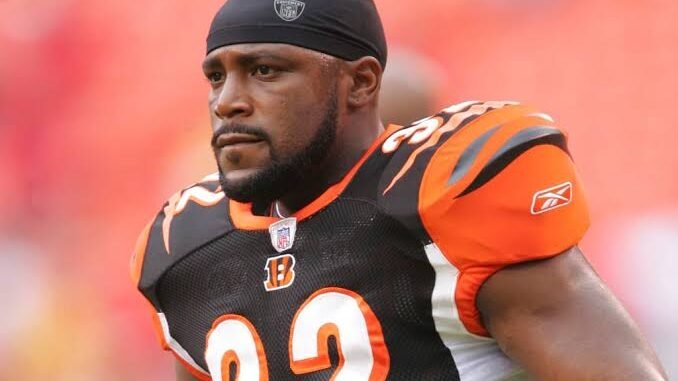
Rudi Johnson: Early Life, Career & Legacy
Childhood and College Years
Rudi Johnson, born Burudi Ali Johnson on October 1, 1979, in Ettrick, Virginia, rose from modest beginnings to star status in American football. He attended Butler Community College before transferring to Auburn University for the 2000 season, where he made a name for himself.
At Auburn, Johnson had a breakout year: he rushed for 1,567 yards and 13 touchdowns, earning SEC Player of the Year honors. His powerful running style and resilience drew NFL scouts’ attention.
NFL Career: Bengals & Lions
In the 2001 NFL Draft, Johnson was selected in the fourth round (overall pick 100) by the Cincinnati Bengals. He played with the Bengals from 2001–2007 and finished his career with a stint at the Detroit Lions in 2008.
Johnson’s best years were from 2004 to 2006. In that stretch:
-
He recorded three straight seasons rushing for over 1,300 yards.
-
His 2005 total of 1,458 rushing yards remains a Bengals single-season franchise record.
-
He was selected to the Pro Bowl in 2004.
Over his NFL career, Johnson amassed 5,979 rushing yards, 49 rushing touchdowns, along with 113 receptions for 676 receiving yards and 2 receiving scores across 95 games. Among Bengals franchise records, he ranks fourth in career rushing yards.
Off the field, Johnson was active in philanthropy. He founded the Rudi Johnson Foundation in 2005, with the aim of supporting children and families, promoting self-sufficiency, and fostering community development.
Final Message & Signs of Struggle
In early September 2025, Johnson recorded a video message (which was later played when he was inducted into a local Hall of Fame) in which he urged perseverance:
“Dream big, shoot for the stars, stay focused, never give up.”
He also expressed heartfelt gratitude for his upbringing and football journey, recalling his roots and the relationships built along the way.
While such messages are uplifting on their face, they may also raise deep questions when tragedy follows too closely after hopeful words.
What Happened? Death & Investigation
Date, Location & Official Reports
Rudi Johnson died on September 23, 2025, in Miami-Dade County, Florida.
The Miami-Dade Sheriff’s Office has stated that “all indications are leading to suicide,” and that no foul play is suspected.
According to media reporting, Johnson died by suicide in Florida shortly after midnight on that Tuesday.
However, it is important to note: no official cause-of-death has been publicly confirmed via autopsy or medical examiner release.
Local news sources indicate that Johnson’s family acknowledged he had been struggling with mental health issues, and that he might have been suffering from Chronic Traumatic Encephalopathy (CTE) — a degenerative brain condition linked to repeated head trauma in contact sports.
While CTE can only be definitively diagnosed after death (through neuropathological examination), the possibility is being raised given Johnson’s football background.
Why is Suicide Being Reported?
The reports of suicide are based on preliminary investigations and law enforcement statements, but they are not officially final, and details are still emerging.
Multiple outlets (including Reuters) have stated that authorities confirmed suicide in police statements.
Given the sensitivity of these matters, and the fact that no medical examiner has publicly released conclusive findings yet, some caution is warranted in how definitively one frames the cause.
Understanding the Context: CTE, Mental Health & Football
What Is CTE?
Chronic Traumatic Encephalopathy (CTE) is a degenerative brain disease linked to repeated head injuries, common among contact sport athletes such as football players, boxers, and hockey players. Over time, it can lead to behavioral changes, memory loss, mood swings, depression, and suicidal ideation.
Because CTE can only be diagnosed postmortem (via brain tissue examination), many suspected cases remain speculative during life.
The Toll of Head Trauma
Over years in the NFL, players experience countless sub-concussive impacts (i.e. hits that do not cause a diagnosed concussion). Even when not visibly concussed, such hits may accumulate damage.
Many former players have reported symptoms resembling CTE — depression, anxiety, impulsivity, cognitive decline, emotional instability. Some have tragically died by suicide. The association has received growing public and scientific attention.
If Johnson had been contending with undiagnosed or poorly managed brain injury effects, that could have contributed to mental health struggle. But without postmortem confirmation, CTE remains a possibility, not a certainty.
Mental Health in Retired Athletes
Retirement from professional sports can be psychologically challenging: loss of identity, physical pain or disabilities, financial stress, or unresolved trauma can contribute to depression and suicidal risk.
Even if a former athlete has had a distinguished career, that does not immunize him from mental health struggles.
In Johnson’s case, family sources have acknowledged he had been dealing with mental health challenges prior to his death.
What We Know vs. What We Don’t
Because the investigation is ongoing and no official autopsy findings have been released, some questions remain unresolved. Below is a breakdown of confirmed facts vs. open uncertainties:
| Aspect | What is Known / Reported | What is Uncertain / Pending |
|---|---|---|
| Death Date & Location | September 23, 2025 in Miami-Dade County, Florida | N/A |
| Preliminary Ruling | Authorities say all indications point to suicide; no foul play suspected | Final ruling, cause on death certificate (autopsy) |
| Mental Health History | Family sources report he had been struggling with mental health issues | Comprehensive clinical diagnosis, timeline, treatment records |
| CTE Link | Suggested by multiple news outlets as possibility given football history | Definitive confirmation (requires postmortem neuropathology) |
| Motive / Circumstances | Unknown; investigation is preliminary | Precise mental state, triggers, circumstances leading to decision |
Given these uncertainties, it is responsible to avoid overstatement or speculation, and to emphasize the provisional nature of current claims.
Why This Matters: The Broader Implications
The death of Rudi Johnson, under these reported circumstances, resonates on multiple levels:
-
Mental Health Awareness
Even public figures with successful careers can struggle with depression, anxiety, or other mental health challenges. His death underscores the need for stronger support systems for athletes both during and after their careers. -
CTE & Contact Sports Risk
If Johnson is later confirmed to have had CTE, it will add to the mounting evidence that brain injury from playing football can have devastating long-term consequences, including mood disorders and suicidality. -
Support and Suicide Prevention
This tragedy is a reminder of how critical suicide prevention resources are. Knowing signs of crisis, seeking help early, and reducing stigma around mental illness are essential. -
Legacy Beyond the Field
Johnson’s foundation work and personal message of perseverance suggest a man who sought to give back. His passing calls into question how we support the mental health of those who serve communities and once inspired many.
What We Can Do: Lessons & Support
-
Encourage Open Dialogue
Create environments (in sports, workplaces, communities) where people can speak honestly about mental health, emotional pain, or suicidal thoughts without shame. -
Invest in Mental Health Infrastructure
Teams, leagues, schools, and communities should invest in counseling, psychological support, and post-career transition programs for athletes. -
Support Brain Health Research
Funding and attention to CTE research, safer play protocols, protective equipment, head-impact monitoring, and treatment innovations are vital. -
Know the Crisis Resources
In the U.S., dialing 988 connects to the Suicide & Crisis Lifeline. Many countries have analogous hotlines and services. If you or someone you care about is at risk, seek help immediately. -
Honor the Person, Not Just the Athlete
Remember Rudi Johnson not only as a football star, but as a husband, father, friend, community-builder—and advocate for compassion in mental health.
A Balanced Narrative: How Did He Die?
To directly address the user’s query in an SEO-friendly way:
-
Cause of Death: Not yet officially confirmed via autopsy or autopsy report.
-
How Did He Die: According to preliminary police statements, he died by suicide in Florida shortly after midnight on September 23, 2025.
-
Suicide?: Yes, that is the current working determination by authorities. However, the final ruling or medical findings could nuance or confirm that conclusion further.
-
What Happened to Him: He was a former NFL star with a significant legacy, struggled privately with mental health and possibly long-term brain trauma, left a final message of hope, and died under tragic circumstances that are still under investigation.
Final Thoughts & Caveats
At the time of writing, the facts point to a deeply tragic end: a talented athlete, known for his strength both on and off the field, appears to have lost his battle with mental health, perhaps exacerbated by neurological injury. However:
-
Because no publicly released autopsy or medical examiner report currently exists, we must treat claims of cause with caution.
-
The possibility of CTE or other medical contributors remains speculative until confirmed.
-
Out of respect to the family and the investigative process, we should avoid sensationalism or definitive claims unsupported by evidence.
In sum, Rudi Johnson died in Florida on September 23, 2025, and authorities currently believe the death was by suicide, with no foul play suspected. Public reports suggest he had been grappling with mental health issues and that his long football career may have contributed to neurological problems. But beyond these preliminary views, many details remain unverified and awaiting further disclosure.