1. Introduction
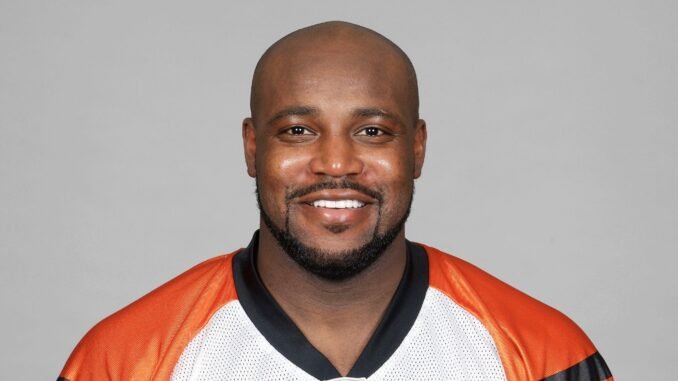
Rudi Johnson was a standout running back in American football whose dynamism on the field, community work off it, and remarkable college and NFL careers made him a beloved figure among fans. His recent passing at the age of 45 has generated widespread grief and questions: how did he die? What was the cause of death? And what role did his time in college (and later in the NFL) play in his journey?
This article dives into verified information about Rudi Johnson’s life—from college to professional milestones—and examines the known facts and uncertainties surrounding his death, including discussions of mental health and chronic traumatic encephalopathy (CTE).
2. Who Was Rudi Johnson? (Early Life & College)
-
Full name: Burudi Ali “Rudi” Johnson.
-
Birth & Early Years: He was born October 1, 1979, in Ettrick, Virginia.
-
High School: Attended Thomas Dale High School in Virginia.
College Career
Rudi Johnson’s college path:
-
Butler Community College (1998-1999): He spent two years at Butler CC in Kansas, where he played football and gained attention.
-
Auburn University (2000): He transferred to Auburn as a junior, where he truly made his mark. At Auburn:
-
Johnson rushed for 1,567 yards and 13 touchdowns in the 2000 season.
-
He was named SEC Player of the Year in 2000, and earned First-Team All-SEC recognition.
-
He was also a Heisman Trophy voter that year, finishing in the top ten.
-
-
Academic Major: He majored in sociology.
His success at Auburn laid the foundation for his entrance into the NFL.
3. Professional Career Highlights
After leaving college, Rudi Johnson was selected in the 4th round (100th overall) of the 2001 NFL Draft by the Cincinnati Bengals.
Some key points from his NFL career:
-
Early years (2001-2002): He had limited action, as he was backing up established players.
-
Breakout: By his third NFL season, he became a starting running back. In 2003, he rushed for 957 yards and 9 touchdowns.
-
Peak performance:
-
In 2004, Johnson made the Pro Bowl, with strong rushing performances.
-
In 2005, he set a Bengals franchise single-season rushing record: 1,458 yards.
-
In 2006, he continued high performance with over 1,300 rushing yards.
-
-
Later career & final season:
-
His playing career with the Bengals lasted until 2007.
-
In 2008, he played one season with the Detroit Lions, which marked his last as a professional player.
-
-
Career totals (regular season):
-
5,979 rushing yards
-
49 rushing touchdowns
-
Additional receiving stats: over 100 receptions, nearly 700 receiving yards.
-
Johnson was known as a physical, durable back during his prime, respected for his ability to carry the load and perform under pressure.
4. The Rudi Johnson Foundation & Off-Field Life
Beyond the gridiron, Rudi Johnson contributed to his community:
-
In 2005, he founded the Rudi Johnson Foundation, aimed at assisting families and children, promoting self-sufficiency, organizing community programs, and being involved in charitable efforts.
-
His foundation supported educational, health, and youth initiatives.
On personal life:
-
Public records suggest Johnson was never married, had no children, and largely kept private his personal relationships.
5. Death of Rudi Johnson
-
Rudi Johnson died in September 2025, at the age of 45.
-
His death was confirmed by a family source, via media outlets such as TMZ.
6. Cause of Death: What Is Known & What Remains Uncertain
What is Reported
-
TMZ reported that law enforcement found he died by suicide in Florida, just after midnight on a Tuesday.
-
Family sources have said that Johnson had been struggling with mental health issues, as well as possible effects of chronic traumatic encephalopathy (CTE), which he “could not overcome.”
What Is Not Yet Confirmed
-
Official cause of death: While suicide is reported, full official confirmation (e.g., coroner’s report) has not yet been made public in all sources.
-
Exact medical or psychiatric details: The precise type or severity of any mental illness, or the confirmed presence of CTE, is not publicly verified. CTE can only be definitively diagnosed post-mortem.
7. How Did Rudi Johnson Die: Circumstances & Reports
Putting together various reports:
-
Date/Time/Place: Reports say he died in Florida, just after midnight on a Tuesday.
-
Method: Suicide is the reported cause, according to police sources relayed via TMZ and other media.
-
Contributing factors: Mental health struggles, possibly depression or other psychiatric issues, and suspected long-term brain injury effects (i.e. CTE) have been mentioned as being things he could not overcome.
It should be noted that while these reports are widespread, some details still are based on family sources, media outlets, and law enforcement statements—not every detail has been independently confirmed via official medical or coroner’s reports.
8. Mental Health, CTE & the Wider Context
The death of Rudi Johnson has reopened discussions around:
-
CTE (Chronic Traumatic Encephalopathy): A degenerative brain disease associated with repeated head trauma (common in contact sports like football). Symptoms can include mood disorders, depression, cognitive decline, etc. Some reports suggest Johnson may have been experiencing effects that align with CTE.
-
Mental Health Awareness in Former Players: Many former NFL players struggle with mental health after their careers; issues like depression, anxiety, substance use, brain injuries are more visible now in public discussion. Johnson’s reported struggles add to that narrative.
-
Support Systems & Policy: The importance of mental health care, monitoring brain health, and support networks for players during and after their careers is often discussed in such tragedies.
9. Legacy & Remembering Rudi Johnson
-
Records & Stats: Johnson remains a Bengals legend, holding the franchise single-season rushing record (1,458 yards in 2005), multiple seasons over 1,300 yards, Pro Bowl recognition, etc.
-
Influence: From Auburn college success to being a workhorse back in the NFL, he was admired for perseverance, physical playing style, and consistency.
-
Charitable Work: His foundation and community involvement are part of how people remember him.
-
Fan Reactions: After the news broke, there has been an outpouring of tributes from teammates, fans, sports commentators. Many recalling his importance to the Bengals’ offense and his character off the field.
10. Conclusion
Rudi Johnson was more than just an impressive football player; he was a college star, an NFL workhorse, a community builder, and a person with struggles many may never have fully seen. His death at 45—reportedly by suicide, amid mental health challenges and possible CTE—brings both sadness and a reminder of the risks athletes sometimes carry beyond their career glory.
While many facts are clear (college achievements, NFL stats, death reports), key details about his mental health status, the exact medical findings, and full confirmation of circumstances are still emerging. In time, fuller reports may help answer lingering questions. For now, the emphasis for fans, community, and sports-media alike is on honoring his life, learning from what might have contributed to his pain, and pushing for better mental health care and brain injury awareness for athletes.