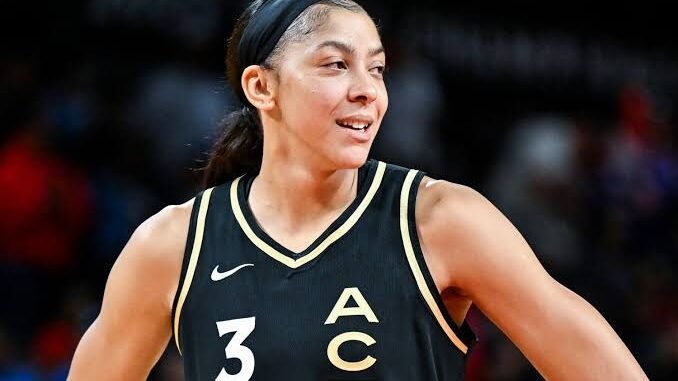
Candace Parker’s impact on the WNBA and women’s basketball at large is monumental. In 2025, two defining moments have underscored her legacy: her jersey retirements by the Los Angeles Sparks and the Chicago Sky, and a public debate sparked by her ranking of rising star Angel Reese. Together, these highlight not only Parker’s storied career and enduring influence, but also broader conversations about legacy, player evaluation, and respect in the sport. This article explores her jersey retirement, reflects on her legacy, and examines reaction to her comments about Angel Reese.
1. The Jersey Retirement: Honoring a Legend
a. Sparks Retire Parker’s No. 3
On June 29, 2025, the Los Angeles Sparks officially retired Candace Parker’s No. 3 jersey in a halftime ceremony at Crypto.com Arena. Parkers becomes just the third player in franchise history, alongside legends Lisa Leslie (No. 9) and Penny Toler (No. 11), to receive this highest honor.
The ceremony was imbued with emotion. Parker wore an orange outfit as an ode to her college days at Tennessee, walked onto the court during the first timeout, and was met with a standing ovation. ESPN.com She thanked her family, coaches, teammates, the Sparks organization, and the fans, reflecting on the ups and downs, the victories and defeats.
Magic Johnson, Lakers legend and Sparks co-owner, called Parker “the best all-around player that has ever played in the WNBA” and praised her as a “true ambassador of our franchise and women’s basketball as a whole.” Lisa Leslie, who preceded Parker in Sparks lore, introduced her and spoke of how she “handed the keys” to Parker knowing the franchise was in good hands.
b. Chicago Sky Retirement of Parker’s Number
Weeks after LA’s ceremony, Parker received another jersey-retirement honor from the Chicago Sky, who also retired her No. 3. This was extra meaningful because Parker grew up near Chicago, in Naperville, Illinois; she played high‐school basketball at Naperville Central. The Sky celebrated the moment in a game at Wintrust Arena, raising her number to the rafters at halftime.
Players, coaches, peers all weighed in on how special it is to see one’s jersey raised by multiple franchises. It marks a unique place in history and underlines that Parker’s impact transcends a single city, team, or moment.
2. Retirement and Legacy: Beyond the Numbers
Candace Parker officially retired from professional basketball on April 28, 2024. Her career spanned over 16 years in the WNBA, where she achieved the rare feat of winning championships with three different teams: Los Angeles Sparks (2016), Chicago Sky (2021), and Las Vegas Aces (2023). Wikipedia+1
Her awards and accolades are breathtaking: two‐time WNBA MVP (2008, 2013), Finals MVP, Rookie of the Year plus MVP in the same season, multiple All-Star appearances, defensive awards, rebounding titles, assists leadership, etc. Beyond the WNBA, she had success in college, in international basketball, and became a prominent voice in media and advocacy after retirement.
In her Sparks jersey retirement ceremony, some of her key quotes captured what her career meant, both personally and publicly:
-
“As a kid … my idea of Hollywood was through basketball. It wasn’t the glitz or the glam …”
-
On dreams and persistence: “I made mistakes and took two steps forward and one back, but I was always moving forward.”
-
“LA isn’t just about ball for me anymore. It’s now where we call home. And we will forever call home.”
Her legacy is therefore not just in stats, titles, or rings, but in how she has inspired younger players, how she bridged generations, and how she pushed the narrative of what women’s basketball can be. The dual jersey retirements affirm that her influence is national, not just local.
3. Reaction to Candace Parker’s Comments About Angel Reese
In mid-2025, Candace Parker triggered widespread discussion by rating Angel Reese in a “tier” list of WNBA players. In her ranking, Reese was placed in the C-tier, with Parker citing that top-tier status should require a player to have the ability to carry a team, to be a “one or two option,” something Parker believes Reese is not (yet) at.
a. What Parker Said
-
Parker explicitly said: “I put her [Angel Reese] right at that C level.”
-
She also acknowledged that Reese has shown growth since her rookie season and praised her role, particularly her offensive rebounding.
-
Parker stated that being in C-tier doesn’t mean someone is bad; rather, she’s ranking players based on where she sees them now versus where she believes they could be in the future.
b. The Backlash and Criticisms
-
Many fans, analysts, and players pushed back on the idea that Reese belongs in the bottom tier, especially given her current performance: formidable rebounding, double-doubles, All-Star selections, etc.
-
Some noted that Reese leads the league in total rebounds, contributes in points, assists, and often plays a central role for the Sky; suggesting the “role player only” framing undervalues her contributions.
-
There was also discussion about whether Parker’s own positional bias (as a power forward herself) or her standards for “elite” might have influenced her ranking. Some saw her criteria for being “one or two option” as particularly stringent.
c. Reese’s Response & Broader Implications
-
Reese responded publicly in more cryptic tones, including social media posts interpreted as addressing negativity around her ranking. Especially one post citing “Clout is one helluva DRUG. like it really gets to a point.” Many fans read this as directed toward critiques like Parker’s.
-
Beyond personal feelings, the situation stoked conversations about how legends critique newer players, how media narratives are framed, and what metrics or qualitative measures should truly matter when ranking players.
4. Comparing Retirement Legacy vs. Player Evaluation
These threads—Parker’s legacy and her comments about Reese—connect in interesting ways.
a. Legacy Gives Platform, Responsibility
Candace Parker’s achievements grant her a large platform: people listen when she speaks. Her jersey retirements and accolades amplify her voice. With that amplification comes responsibility; when she critiques others, her statements carry weight. In this case, Parker’s tiering of Reese shows just how much influence veteran stars have in shaping perceptions of current stars.
b. The Gap Between Now and Potential
One of Parker’s consistent points is a distinction between performance right now (present achievements) and what’s possible (potential). She places Reese in C-tier for now but acknowledges that she could ascend to higher tiers. Many analysts agree potential should be recognized—but there is also merit in evaluating players by what they have already done. The tension is between respecting achievements and setting high benchmarks.
c. How Fans React to Criticism Among Women Athletes
The reaction to Parker’s comments reveals a pattern: critiques of women players by former stars often draw sharp reactions. Some consider them constructive; others see them as harsh, unfair, or minimizing. In Reese’s case, many felt she’s proven enough to warrant higher recognition, and some take offense at comparisons which seem dismissive. It also raises questions: do we judge women players by the same standards we do men? Are we fair in how we praise or criticize?
5. What This Means for Angel Reese & the WNBA
Despite the controversy, Angel Reese’s star continues to rise. Here’s how the events might affect her and the league:
-
Motivation and growth: Criticism often fuels improvement. For Reese, being placed in C-tier might serve as motivation to push harder, polish her offensive skills, leadership qualities, and consistency.
-
Expectations management: Part of being a rising star is managing expectations — from oneself, from fans, from media. Parker’s comments illustrate that as players ascend, more scrutiny follows.
-
Evolution of her profile: Reese is already making waves in rebounding, double-doubles, and visibility. If she continues to develop scoring, leadership, defensive consistency, she could shift the narrative quickly.
-
League conversations on measurement: The episode pushes the WNBA and media to examine how they rank and talk about players: what metrics, what intangibles (leadership, impact, team context) get counted, and whether legacy standards bias certain views.
6. Summing Up: Candace Parker’s Dual Role in Retirement and Critique
Parker’s retirement and jersey retirements affirm her place among basketball legends. They enshrine the career of someone who achieved at the highest levels, who inspired and carried the game forward.
At the same time, her critique of Angel Reese reminds us that even legends are part of the ecosystem of evaluation—and that their opinions generate real responses. Criticizing isn’t inherently bad, but it becomes part of the legacy too: how one speaks about others, how one uses authority.
Parker’s legacy won’t be only what she won, or what her jersey numbers mean; it will also include how she shapes the game off the court, including conversations like this one. And Angel Reese, whether her current ranking stands or not, is clearly a name this whole league is paying attention to.
7. Final Thoughts
Candace Parker’s career may have formally ended on the court, but it clearly hasn’t ended in its influence. The jersey retirements are a fitting tribute to a player who did so much for the sport; the controversies that follow her critiques show exactly how much people still listen—how much she still shapes perceptions.
In the end, both Parker and Reese are contributing to the narrative of women’s basketball: where it’s been, where it’s going, and how we talk about greatness. Candace has shown what it means to build a legacy; Angel is showing what it means to build on it.
Only time will tell how high Reese can rise, and how her legacy will be framed in turn. But Parker’s words, and the responses they have generated, confirm one thing: the WNBA is no longer on the sidelines. It’s center court.